Plan the Final Delivery Route With a Whole House Furniture Supplier
A house can have enough floor space for its furniture and still be difficult to furnish. The problem often appears between the unloading point and the intended room. A whole house furniture supplier should help connect the selected pieces with that route before the order is fixed. HEZEN CASA’s curved leather sectional, round marble dining table, wingback bed with lamps and wood sideboard illustrate four different delivery questions. Begin with the largest actual component, its handling requirements and the narrowest change of direction on the route.

Give the whole house furniture supplier a route, not only a floor plan
A furnished floor plan shows where objects belong. It may not show the gate, lift, landing or corridor through which they must travel. Record those transitions separately and connect them to each selected piece. Include any doors that must remain usable during unloading. A wide living room beyond a tight entrance does not make a large sofa easy to deliver. A generous bedroom above a winding stair presents a different problem again.
HEZEN describes interior planning, production drawings and logistics coordination in its furniture and project services. Use those capabilities to request the information needed for your property. The public service description does not establish that every delivery includes carrying furniture upstairs, assembly or removal of packaging. Confirm the agreed scope for the actual destination and route.
Furniture retailer Room & Board’s delivery measuring guidance is a useful general reminder to consider the route into the room, including turns and openings. Its procedures are not HEZEN’s delivery terms. Apply the principle to the selected components and obtain the measurements and handling information relevant to this order.
The sectional’s overall footprint is not its largest delivery component
The burgundy and white Nappa leather sectional is listed at 320 × 180 × 85 cm with solid wood. These dimensions describe the listed furniture arrangement. They do not tell the delivery team the size of the largest packed section. Ask which components separate, their packed dimensions and which assembly steps occur after placement.
A buyer furnishing a ground-floor lounge may focus on the 320 cm span because it determines the seating layout. The delivery team may instead need the length and depth of one section at a corridor turn. Keep both sets of dimensions. Substituting the assembled footprint for the component dimensions can create an unnecessary rejection or an unjustified assumption that the sofa will pass.
Do not plan to compress upholstery or remove a part simply because it appears detachable in a photograph. Ask what the manufacturer permits and what must remain supported during movement. If a particular component cannot follow the normal route, resolve the furniture or delivery arrangement before the item reaches the property. Improvised handling is a poor substitute for an agreed plan.
A marble table changes the sequence of a whole-house delivery
The round natural marble dining table is listed at 150 cm in diameter and 75 cm high, with a metal base and rotating tray. Its assembled shape says little about the supplied package arrangement. Ask how the top, base and tray are identified and handled, and whether they arrive separately. Obtain the relevant component weights rather than estimating them from the appearance.
Keep the stone top’s landing area clear before the dining chairs arrive
A dining room full of chair cartons can obstruct the work needed to position and assemble the table. Agree the order of movement with the receiving team. Provide a clear location for the table components and the operations specified by the supplier. Do not assume that the top can be leaned against a convenient wall or temporarily placed on another piece of furniture.
The finished floor also belongs in the discussion. A newly completed room may require protection appropriate to the floor and the delivery work. The team should know where components can be set down and where packaging can be opened. Ask for the actual table’s handling and assembly instructions; general confidence that a crew has moved heavy furniture before does not explain this table’s connections.
For a renovation in an occupied house, the dining room may still be a route to another space. Decide whether the table can be installed without blocking the movement of bedroom or living-room furniture. A finished table is an awkward obstacle to work around if large packages must repeatedly pass beside it. The final room arrangement and the installation sequence need not be identical.
The bedroom route must account for the wingback headboard
The off-white linen bed with built-in lamps is listed at 230 × 190 × 130 cm in a King option. Its wingback form makes the headboard an important part of the room and of the delivery discussion. Confirm the headboard’s supplied dimensions and whether the wings or other parts arrive separately. The overall bed measurements cannot answer that question.
Plan the lamp connections before placing the bed against the wall
The listing identifies built-in lamps but does not establish the electrical details required for every destination. Ask for the applicable connection, voltage and supporting documentation for the ordered version. Coordinate those details with the room’s electrical provision and a qualified local professional where necessary. Do not treat a photograph of a lamp as proof that it can be connected directly in any market.
A contractor completing several bedrooms should decide when the lamp and bed checks occur relative to wall finishes and final positioning. Moving the entire bed again because a connection is inaccessible can disturb an otherwise completed room. Leave the required working access until the actual supplied parts have been checked and the agreed installation is complete.
The mattress may be supplied separately from the furniture order. Confirm its dimensions and the bed’s corresponding opening and support requirements before delivery. Arrange a practical sequence for bringing both into the room. A bed assembled too early may occupy the space needed to move another bulky item, while a mattress placed on site too soon may obstruct the remaining work.
Position the sideboard only after checking its usable access
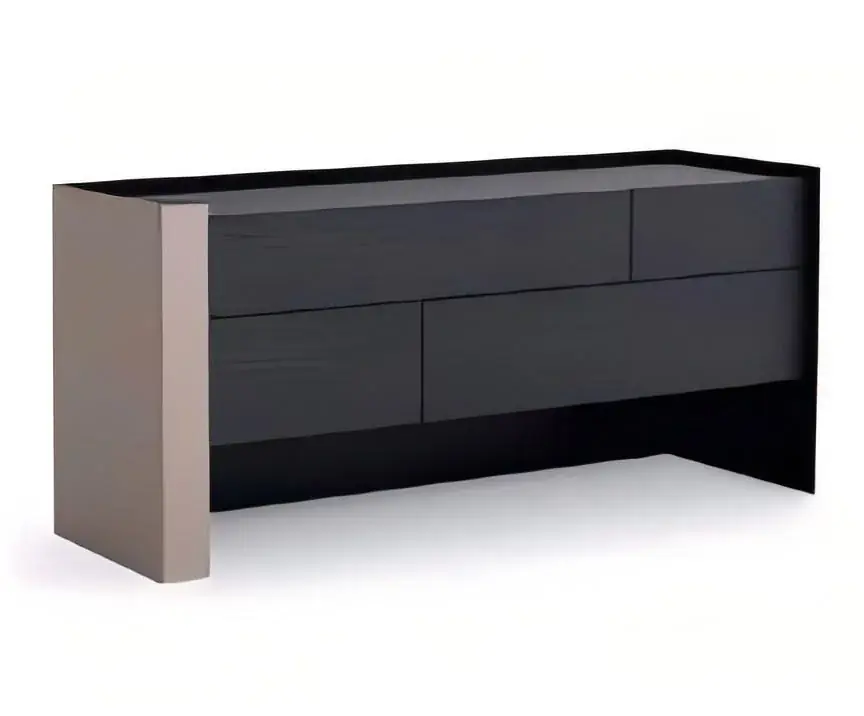
The asymmetric dark wood sideboard is listed at 180 × 45 × 80 cm with veneer, solid wood and multiple compartments. Its low rectangular footprint can appear straightforward on a plan. The receiving team still needs to know its supplied condition, any separate parts and the intended way of lifting or supporting it. Do not assume that a decorative edge is a lifting point.
At the destination, check the cabinet’s opening space before filling it. A nearby wall return, dining chair or other furnishing can restrict access even when the closed cabinet fits. Place the sideboard in its proposed position, review the actual movement of its fronts and confirm that the intended contents can be used. The 45 cm outside depth is not a usable internal measurement.
If the order includes installation or fixing requirements, obtain the instructions applicable to the supplied sideboard and the local wall or floor condition. The public product listing should not be treated as a complete installation manual. Assign responsibility for those operations explicitly, particularly where the delivery crew and the room fit-out contractor are different businesses.
Check delivered furniture again after assembly
At arrival, the team can identify packages and record visible condition. After placement and assembly, it can check the sectional arrangement, table connection, bed components and cabinet operation. Those are related but different observations. A signature confirming that cartons arrived should not be mistaken for a completed review of every function in every room.
Use the actual furniture names and room destinations in the record. A note saying one large item is damaged leaves too much uncertainty in a mixed shipment. A clear photograph of the relevant package identification and affected component helps connect the observation to the order. Follow the agreed reporting process and timing rather than inventing a procedure after the delivery crew has left.
Resolve the conflict between the marble table and the bedroom delivery path
Imagine a house where the dining area sits between the front entrance and the stair. If the table is assembled first, the remaining bed packages may have to pass beside its stone edge. The better sequence depends on the actual plan and component sizes, but the conflict should be visible before unloading. Mark the temporary movement area as well as the final table position, then agree which furniture moves through first.
The same house may have a sideboard intended for the wall beside that route. Leaving it in the center of the room while waiting for assembly can create another obstruction. Assign an agreed temporary position that does not compromise the furniture or block access. Keep the components and fittings identified with the item, so a decision to postpone installation does not separate the sideboard from the parts needed to complete it.
A sectional introduces a different timing issue. Once the lounge is arranged, it may become the most convenient place for people to sit while other work continues. Decide when it is ready for use and how it will be kept clear of ongoing fit-out activity. The selected Nappa leather covering should receive the care and protection appropriate to that material, based on the supplier’s instructions, rather than whatever cleaning product happens to be available on site.
For the wingback bed, a delayed electrical check can leave a seemingly finished bedroom incomplete. Connect the delivery record to the actual remaining task: the bed components may be present and assembled, while the lamp connection still awaits the responsible professional. Recording that distinction is more useful than marking the entire bedroom finished or unfinished without explanation. It lets the next person act on the specific outstanding requirement.
Make the whole-house handover usable even if one room remains unfinished
A property may be ready unevenly. The lounge can be complete while an upstairs bedroom still needs work. Decide whether the furniture should wait, arrive in separate groups or move into a suitable agreed holding area. Storage conditions and access must suit the actual materials and packages. A nominally empty room is not automatically a suitable place for marble, upholstery and finished wood.
For an overseas order, clarify which transport and destination services are included in the agreed arrangement. ICC’s Incoterms guidance distinguishes responsibilities, costs and risk in trade arrangements. A named term alone does not describe all the work of carrying and assembling furniture inside a house; the practical scope still needs to be written.
The villa order planning article discusses approving furniture across several material families. Once those choices are settled, walk the delivery route with the proposed components in mind. The most useful final decision may be a changed assembly sequence, a confirmed headboard dimension or a clear responsibility for the stone table. Resolve that specific obstacle while the order can still respond to it.