Sideboard vs Console Table: Choose Storage or a Slim Surface First
If the brief is a place for keys, a lamp and a small display, a console table may do the job. If the brief includes dinnerware, table linen and serving pieces, start with a sideboard and its internal storage. The sideboard vs console table decision is mainly about what the furniture must do and how much room it can occupy, not which name sounds more suitable for the interior.
HEZEN CASA offers a ribbed console listed at 140 × 35 × 80 cm and sideboards with 180 cm or 200 cm widths and 45 cm depths. Those dimensions make a useful comparison, particularly in an entrance, dining room or behind a sofa. Check the offered construction and usable storage before assuming one type can replace the other.
Resolve the sideboard vs console table choice through the contents
Write down what will live on the furniture and what needs to go inside it. A decorative bowl, a lamp and the day's post require a surface. Plates, glassware, folded linen and serving trays require storage with suitable clear dimensions and access.
A console may include storage in some designs, and a sideboard may be used mainly for display. The names are not strict guarantees. Read the actual product description and drawing rather than attaching every familiar feature of a furniture category to the selected piece.
For a buyer furnishing a whole home, keep the requirements for each location separate. The entrance may need a shallow landing surface, while the dining room needs a cabinet that can be opened during a meal. Using the same style throughout does not mean choosing the same furniture type for both tasks.
The ribbed console is a specific 35 cm-deep candidate
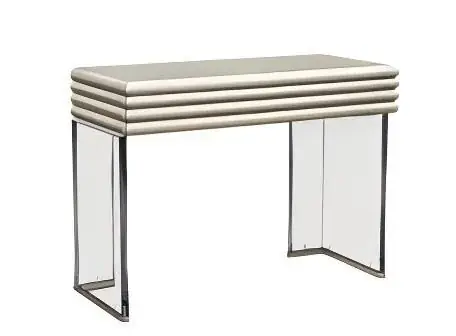
The Ribbed Leather Acrylic Console Table is listed at 140 × 35 × 80 cm. Its description identifies a padded leather top and transparent acrylic legs. It is a candidate for a slim display or entry surface, subject to the offered construction and its intended use.
The description does not establish a drawer, enclosed compartment or storage capacity. If the entrance needs somewhere to hide bags or larger belongings, this console should not be treated as a cabinet simply because it fits the wall. Keep the surface function and the concealed-storage requirement separate.
Check the usable top outline with the actual lamp or bowl you intend to place there. Ribbed or padded detailing may affect where an object can sit securely, so the overall 140 × 35 cm envelope is not automatically one uninterrupted working surface.
Compare console depth with the space a sideboard needs
The listed console depth is 35 cm, while the sideboards in this comparison are 45 cm deep. That 10 cm difference is worth drawing accurately in a passage or behind a sofa. It does not, by itself, tell you whether either piece leaves a suitable route.
Measure from the furniture's actual outer edge to the next obstruction, including any required separation from the wall. Then consider people walking past, using the top or opening nearby doors. For a sideboard, add the storage-opening movement and the space needed to retrieve items.
The rounded sideboard adds enclosed storage within a larger footprint
The Rounded Marble Top Light Oak Storage Sideboard is listed at 180 × 45 × 80 cm, with light oak and natural marble in its description. Compared with the ribbed console, it is 40 cm wider and 10 cm deeper at the same listed overall height.
That extra envelope may be justified when the room needs the offered internal storage. Confirm the compartment sizes and operating fronts for the actual version. Do not assume that its curved ends or smooth exterior guarantee a particular door arrangement.
In an entrance with enough room, the rounded sideboard may provide a place for objects that would otherwise accumulate on top of a console. In a narrow passage, the additional depth and opening space may be the wrong trade-off. The choice depends on whether the storage solves a real problem without compromising movement.
The same 80 cm height can support very different jobs
The ribbed console and rounded sideboard both have a listed overall height of 80 cm. That shared number does not make them equivalent. One is described around a slender surface and open supports; the other is a storage cabinet with a broader body.
Try the intended action at the proposed height. Setting down keys, placing a serving tray and arranging a lamp are different uses. Check the top's shape, finish and supplied care or loading guidance before assigning a demanding role to either piece.
For a dining room, a sideboard can keep the relevant items near the table and provide another surface when needed. A console could work as a display element in the same room, but it would not resolve the dinnerware-storage brief unless the actual offered design includes appropriate storage.
For a hall, the priorities may be reversed. A slim top may be sufficient, and extra cabinet storage may be unnecessary. Do not buy a larger body just to fill the wall if it makes the entrance harder to use.
The asymmetrical credenza offers a different interior to investigate
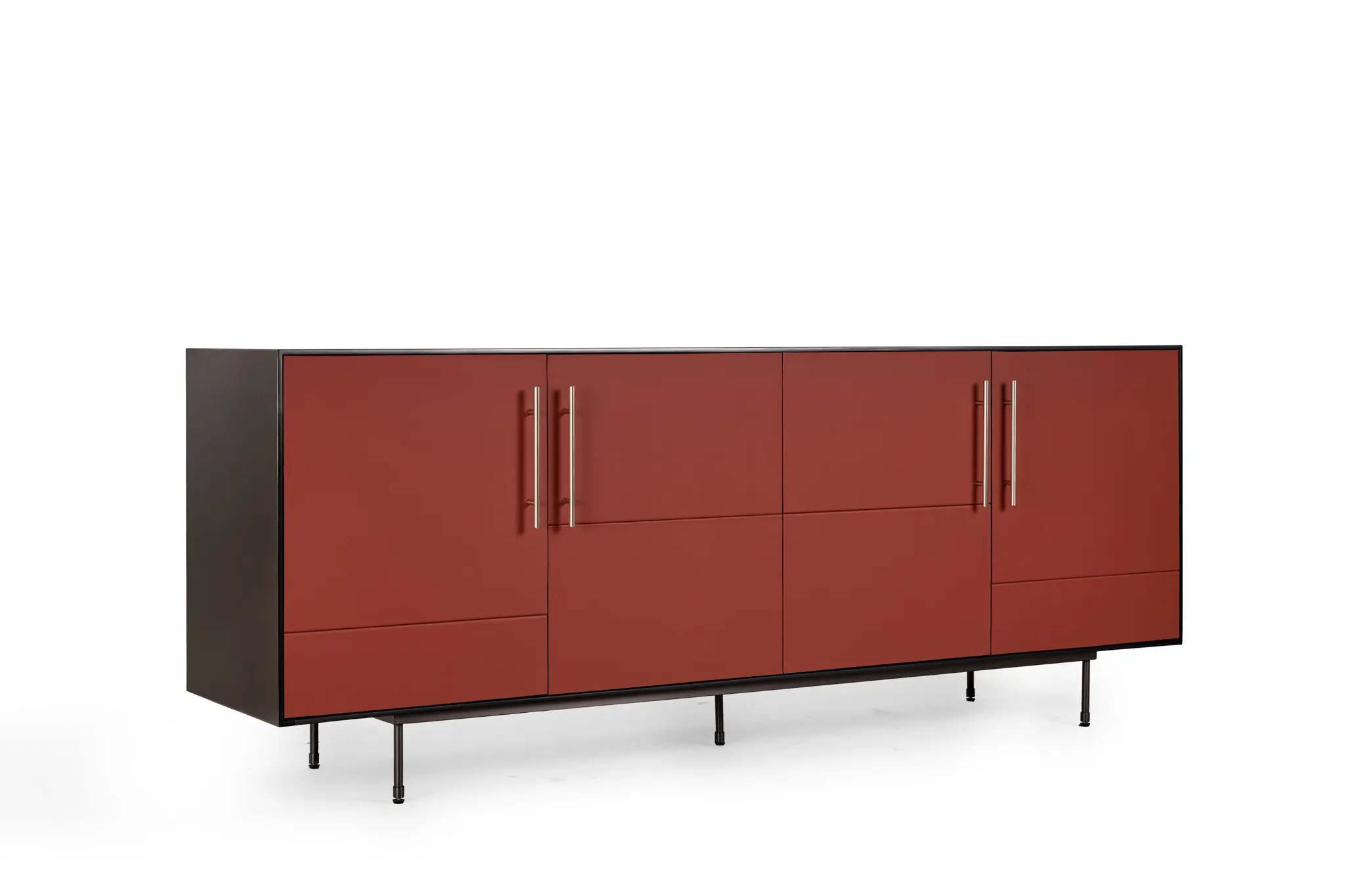
The Asymmetrical Dark Wood Minimal Sideboard Credenza is listed at 180 × 45 × 80 cm, matching the rounded sideboard's published envelope. Its divided storage and asymmetrical frame offer another design direction within that size.
Compare the internal arrangement with the objects being stored rather than choosing between these two cabinets by outside dimensions alone. A buyer with smaller accessories may need different compartment divisions from one storing broad serving pieces. Neither arrangement should be inferred from the word “credenza.”
Use a console behind a sofa only when the whole arrangement works
A console can give a sofa arrangement a surface for a lamp or selected objects, but its height and depth need to relate to the actual sofa and room. Check whether it remains accessible, whether cables have a suitable route and whether the furniture interrupts movement behind the seating.
For the 140 × 35 × 80 cm ribbed console, draw all three dimensions beside the selected sofa. Do not assume that an 80 cm top will align with the sofa back or stay comfortably below it. The sofa's confirmed profile is needed for that comparison.
Also consider how the top will be used. If people must reach awkwardly over the sofa to place objects on it, the console may be in the wrong position for that purpose. A lamp can create another relationship to check: its base, switch and cord should work with the actual seating arrangement.
A sideboard behind the same sofa introduces additional questions. Its doors or drawers need access, and the person using them needs somewhere to stand. A cabinet that can only be opened after moving the sofa is unlikely to be a useful daily storage solution.
Crate & Barrel's accent-table guide describes consoles as relatively narrow surfaces used at walls, entrances or behind sofas. That general category explanation helps frame the choice; the confirmed HEZEN dimensions and the room determine whether the particular placement works.
Choose a wider sideboard when its storage earns the extra room
The Dark Wood Sliding Door Sideboard with Drawers is listed at 200 × 45 × 90 cm. It extends the comparison beyond the two 180 cm sideboards and the 140 cm console, with a wider and higher storage proposition.
Its sliding-door and drawer description is relevant when planning access, but the working movements still need to be confirmed separately. Sliding fronts do not remove the space required for drawer extension or for someone to use the cabinet.
A buyer furnishing a dedicated dining room may prefer this larger option if the confirmed compartments suit the tableware collection. The same cabinet could be excessive in an entrance that needs only a lamp and a place to set down keys. Match the added width to a real storage need.
Do not assume a 200 cm cabinet has a continuous 200 cm internal opening. Divisions, panels and moving fronts affect access. Check the largest stored object and how it will be taken out before accepting the larger size as a capacity upgrade.
Keep furniture names from hiding a different requirement
During a larger furnishing project, a request for a “console” can mean different things to different people. One person may imagine a slim open table; another may mean a storage cabinet used below artwork. Put the intended contents and function beside the product reference so that the selection stays clear.
The word can also refer to media furniture. HEZEN's Italian Minimalist TV Entertainment Cabinet is listed at 160 × 40 × 50 cm and described for media-equipment storage. That is a different role and height from the ribbed 140 × 35 × 80 cm console table. If the brief includes electronics, clarify the equipment dimensions, cable route and any ventilation requirements rather than substituting a decorative console or dining sideboard by name. The media description itself does not confirm a particular cable opening or the fit of every device.
For the ribbed console, identify the items intended for the top and any required clear space underneath. For the rounded or asymmetrical sideboard, identify the storage groups and the compartments they need. For the wider sliding model, show both the storage function and the room needed to operate it.
This also helps when a proposed item changes. Replacing the open console with a cabinet may add useful storage but alter the passage and opening requirements. Replacing a sideboard with a console may preserve a decorative surface while removing the reason the original furniture was requested.
The furniture procurement brief can hold those functional requirements alongside the room dimensions. Use HEZEN CASA's furnishing service to clarify the selected item and the actual configuration being offered.
Approve the piece that handles the room's everyday task
Look at the proposed furniture with the ordinary objects shown, not only the decorative styling. If the task is a slim landing surface and the 35 cm console depth works with the route, keep the choice focused. If the task is organised dinnerware storage, inspect the sideboard interior and its access before choosing the finish.
Walk past the furniture, use the top and, where applicable, open the storage. A clear answer to those actions is more useful than trying to decide whether the room ought to have a console, buffet or credenza by name. Choose the furniture that performs the intended job without making the surrounding space harder to use.