Sideboard Size Guide: Work Backwards from What You Need to Store
Take out the largest serving platter before you choose a sideboard. It is a more useful starting point than the empty wall. A sideboard size guide should help you find furniture that holds the right things, leaves the room usable and provides a convenient surface. Start with the contents, then compare the cabinet's internal arrangement with its outside width, depth and height.
HEZEN CASA's sideboard choices include several 180 × 45 cm footprints, a wider 200 × 45 cm option and different top heights. Those catalogue dimensions help narrow the selection. They do not tell you the clear shelf depth, drawer interior or opening available for a large dish, so keep those measurements on the selection brief.
A useful sideboard size guide starts inside the cabinet
Separate the things that need a home: dinnerware, serving pieces, glassware, table linen and the small items used to set the table. A pile of plates needs different storage from tall glasses or a wide tray. The question is not simply whether the cabinet has plenty of space; it is whether that space is divided in a useful way.
Measure the largest item in each group and note how you want to remove it. A platter that fits diagonally on a shelf may still be inconvenient to retrieve through the door opening. Stacked dishes also need an accessible position that suits the intended user and the cabinet's confirmed shelf capacity.
For a buyer replacing an existing sideboard, list what fails in the current one. Perhaps the serving trays live elsewhere, or the top drawer is too shallow for the chosen organiser. Those specific problems give the new selection a purpose and prevent a larger cabinet from repeating the same internal limitations.
Ask for clear compartment measurements rather than estimating them from the external size. Panels, shelves, hardware and door construction occupy part of the envelope. Multiplying outside width, depth and height produces a furniture volume, not a reliable measure of usable storage.
The rounded marble-top sideboard needs clear shelf dimensions
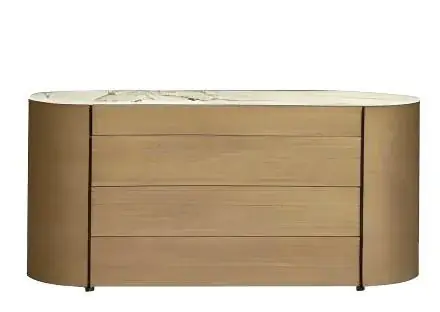
The Rounded Marble Top Light Oak Storage Sideboard is listed at 180 × 45 × 80 cm, with light oak and natural marble in its material description. Its rounded ends give it a distinctive outline, but the external 180 cm width does not establish a continuous internal shelf of that length.
Request the compartment layout and the dimensions of the opening through which the largest item must pass. Confirm how the curved ends affect the usable interior of the offered version. The smooth front should not be used to guess the door count, hinge arrangement or shelf positions.
This may be an attractive candidate for a dining room where the cabinet also acts as a visual focal point. Keep the storage test attached to that preference. A pleasing curved profile will be easier to live with if the everyday serving pieces fit without being shuffled around.
Compare sideboard width against the usable wall, not the whole wall
Measure the wall section that is actually available. Exclude door swings, fixed controls, access to nearby openings and any part of the room that must remain clear. Then draw the cabinet with its widest points and the gaps needed for its actual construction.
A 200 cm sideboard is 20 cm wider than a 180 cm one. If both are centred on the same wall position, the wider cabinet extends 10 cm further at each end. That simple comparison helps reveal whether it approaches a doorway or interrupts the intended access beside it.
The asymmetrical wood sideboard shares the rounded model's footprint
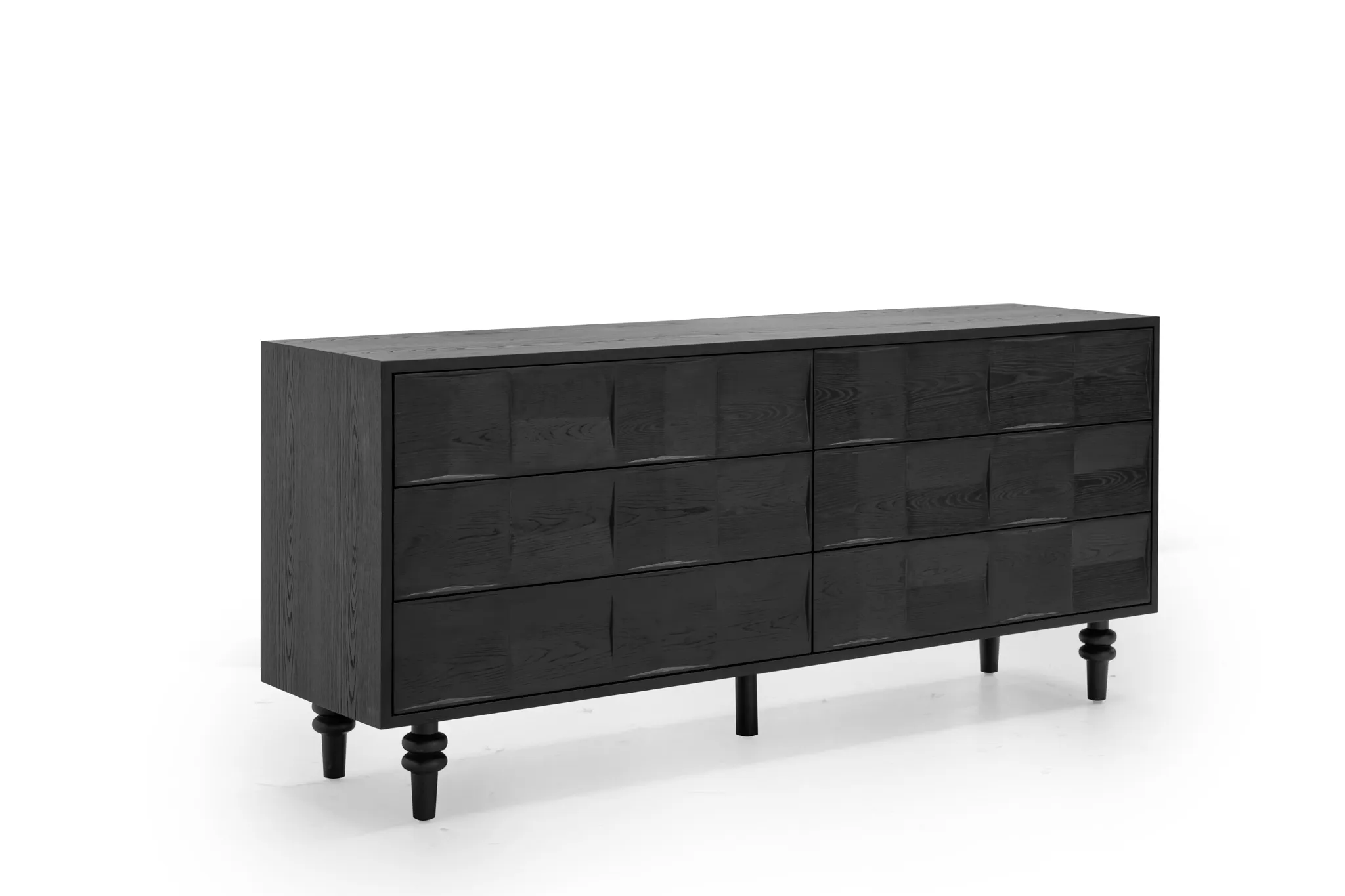
The Asymmetrical Dark Wood Minimal Sideboard Credenza is also listed at 180 × 45 × 80 cm. Its description identifies an asymmetrical frame and divided storage. It therefore provides a different design to investigate within the same published outer envelope as the rounded marble-top sideboard.
Do not assume the two have equal usable capacity because their outside measurements match. Compare the actual compartments with your stored items. A divided arrangement might suit smaller groups of objects while another layout may be preferable for wider serving pieces.
For a purchasing coordinator working across several rooms, this is a useful distinction. The same available wall width can support different storage needs. Keep the cabinet choice specific to what each room will hold instead of repeating one model merely because its external dimensions fit everywhere.
A household storing many small serving accessories may value the divided arrangement of the asymmetrical credenza differently from one storing large bowls. Compare the confirmed drawer interiors with the actual organisers, including the room needed to lift them out. For the rounded sideboard, check whether the shelf arrangement can accommodate the intended stack heights. Do not use the number of front panels as a capacity score: several small compartments and fewer broad ones solve different problems, even within the same 180 × 45 × 80 cm envelope.
The 200 cm dark wood sideboard needs a reason for its extra width
The Dark Wood Sliding Door Sideboard with Drawers is listed at 200 × 45 × 90 cm. Its sliding-door and drawer description suggests a different access arrangement to investigate, alongside the additional width and height.
Use the wider option when its confirmed storage layout or usable top improves the brief. Do not choose it just to fill a longer wall. Check the clear shelf openings and drawer interiors, then confirm how the sliding fronts affect access to different compartments.
If a large platter needs to be removed straight out, the available opening matters more than the total cabinet width. A long cabinet with a restricted opening can be less useful for that object than a smaller one with a better internal arrangement.
Check sideboard depth with the dining room occupied
The three sideboards above all have a listed depth of 45 cm. That figure is helpful when placing the closed furniture on the floor plan, but the working space in front will depend on the offered doors, drawers and the person using them.
Show the dining chairs in their occupied positions before deciding that the cabinet fits comfortably opposite them. Then open the relevant storage in the drawing. The remaining route must suit the room's users and any applicable project requirements; the cabinet's 45 cm depth alone cannot establish that.
In a narrow dining room, a buyer may discover that the main problem is the operating space rather than the closed footprint. A sliding-door description can be worth investigating in that situation, but the drawers still need their own extension space. It does not remove the need to stand in front of the cabinet and retrieve items.
Also check the rear relationship to the wall. Skirting, sockets or required installation details may keep the cabinet from sitting exactly where an early plan places its back edge. Use the actual installation requirements rather than assuming the outside depth begins flush against every wall.
Choose the sideboard height for the way its top will be used
The 80 cm tops of the rounded and asymmetrical sideboards create a different working level from the 90 cm dark wood option. Try the intended action at the proposed height: placing a tray, sorting table linen or using the surface for display. The most useful height depends on the task and the people doing it.
Do not force the sideboard top to match the dining table simply because they occupy the same room. They serve different actions. A consistent visual line can be attractive, but it should not override comfortable use or the storage arrangement underneath.
The 100 cm slatted combination needs its own working-surface check
The Cream Slatted Multi-function Desk Sideboard Combo is listed at 180 × 45 × 100 cm and described as a combined storage and writing unit with an extendable surface. It is a different proposition from a conventional cabinet with one continuous top.
Confirm which part reaches the stated overall height, the level of the writing surface and the dimensions in each offered position. Do not treat the 100 cm overall height as proof that every surface is at that level. Its full working arrangement may extend beyond the closed storage footprint.
For a room that genuinely needs both storage and occasional desk use, that combination may be worth reviewing. If the requirement is only dinnerware storage and a serving surface, compare whether the extra function adds value or complicates the layout.
Test the sideboard top separately from the storage underneath
A cabinet can hold everything required while leaving too little clear surface on top. Place the intended tray, lamp or decorative object on a scaled top outline. Include any raised edge or shaped end that reduces the area available for a particular object.
For the rounded marble-top sideboard, use the actual curve rather than a full 180 × 45 cm rectangle as the usable surface. For the asymmetrical wood design, confirm whether any frame detail changes the available top area. For the wider dark wood model, decide whether the additional length will actually be used.
IKEA's IDANÄS sideboard information illustrates the distinction between storing dinnerware and using a top for serving dishes. That is general functional context; its compartments and hardware belong to that product and should not be assigned to a HEZEN cabinet.
Confirm the care and loading guidance for the selected top before planning demanding uses. The presence of a stone surface or a substantial-looking base does not establish a load rating, heat tolerance or permission to use the cabinet as seating.
Keep the chosen cabinet size tied to a usable interior drawing
Before the order is fixed, keep the outside dimensions, compartment drawing and intended contents together. The furniture specification sheet guide helps organise those details. HEZEN CASA's furnishing service provides a route for resolving the offered configuration.
For the 200 cm sideboard in particular, check the delivery route and the actual packed or component dimensions separately. The dimensions used to place the finished furniture in the room are not a transport specification. Do not assume the cabinet can be separated into smaller parts unless that is confirmed.
Return to the largest platter or tray that started the selection. If it fits through the opening, has a sensible place inside and can be removed while the room is in use, the size decision is doing its job. Then choose the finish and form you want to see every day.