Working With an OEM Furniture Manufacturer Without Losing Control of the Design
A private label on a familiar chair and a sofa developed from an original drawing are different assignments. An OEM furniture manufacturer should understand which one the buyer is commissioning before discussing samples or quantities. HEZEN CASA welcomes OEM/ODM enquiries and describes a custom drawing and development service. Its tufted modular sofa, low Nappa leather bed, asymmetric sideboard and upholstered dining chair provide concrete starting points. First establish the permitted design, the proposed changes and who approves the resulting furniture.
Define the OEM furniture manufacturer’s assignment before sending a reference image
A retailer may want a current dining chair in a selected fabric with its own product label. A design studio may instead provide a new chair drawing and expect development around a particular silhouette. A reference photograph alone does not distinguish those requests. Explain whether the existing piece is being ordered, adapted or merely used to communicate a broad preference.
The upholstered dining chair is listed at 54 × 56 × 93 cm with fabric and solid wood. Those dimensions identify an existing starting point; they do not define every detail of a new version. If a buyer asks for a narrower chair, the instruction may affect the frame, upholstery and relationship between the seat and back. Treat that as a development question rather than a simple label change.
Be equally clear about the commercial identity. The proposed brand name, model reference and packaging text should be distinguished from the underlying construction specification. A correct label cannot resolve an unapproved seat shape. Conversely, an approved physical chair does not establish that the carton artwork, care information or product identification is ready for use in the buyer’s market.
A private-label dining chair needs a defined physical reference
For an existing chair with a new fabric, identify the exact chair, fabric reference and approved appearance. Ask whether the fabric change affects seams, upholstery fullness or the feel of the seat. A retailer presenting the chair beside an existing dining table should assess the adapted sample in that relationship. The outside height does not reveal seat height or clearance below the table.
A distributor planning several colors should separate a color approval from approval of the chair itself. Photographs of loose swatches can help select a direction, but they do not show how the chosen textile behaves on the curved back or around the seat edge. Decide which changes require another physical review before treating the color range as ready to order.
Original furniture development requires permission as well as a drawing
Sending an image found online does not establish a right to reproduce the pictured design. WIPO’s industrial design overview explains that protection can concern a product’s visual features. Buyers should establish their authority to use the drawings, design and branding they supply, with appropriate advice where ownership or permitted use is uncertain.
Keep the design brief specific without asking the supplier to imitate another company’s identity. A requirement for a low bed with a smooth upholstered headboard can be expressed through dimensions, material preferences and room use. It need not depend on copying a protected branded product. The supplier can then explain how its existing range or development service relates to the brief.
For a new design, identify what the buyer supplies and what the manufacturer is expected to develop. A concept sketch may leave joints, support details and upholstery transitions unresolved. Decide how those details will be proposed and approved. Do not assume that a drawing service automatically includes exclusive ownership, tooling rights or unrestricted use of every developed detail.
Separate the low leather bed’s appearance from its mattress interface
The beige Nappa leather platform bed is listed at 220 × 180 × 85 cm, with solid wood and Queen/King options. These are useful product references, but the outside measurements do not establish the internal mattress opening for a custom version. A buyer developing its own bedroom line should supply the intended mattress dimensions and obtain the matching support information.
If the headboard becomes taller or wider, review the connection and delivery implications alongside the appearance. A retailer may approve a dramatic room photograph while overlooking whether the proposed headboard can reach the customer’s room. Record which parts are supplied separately and how the approved configuration is assembled. Those details belong to this bed, not to a generic statement that furniture is easy to install.
Use a control sample to make OEM sofa changes visible
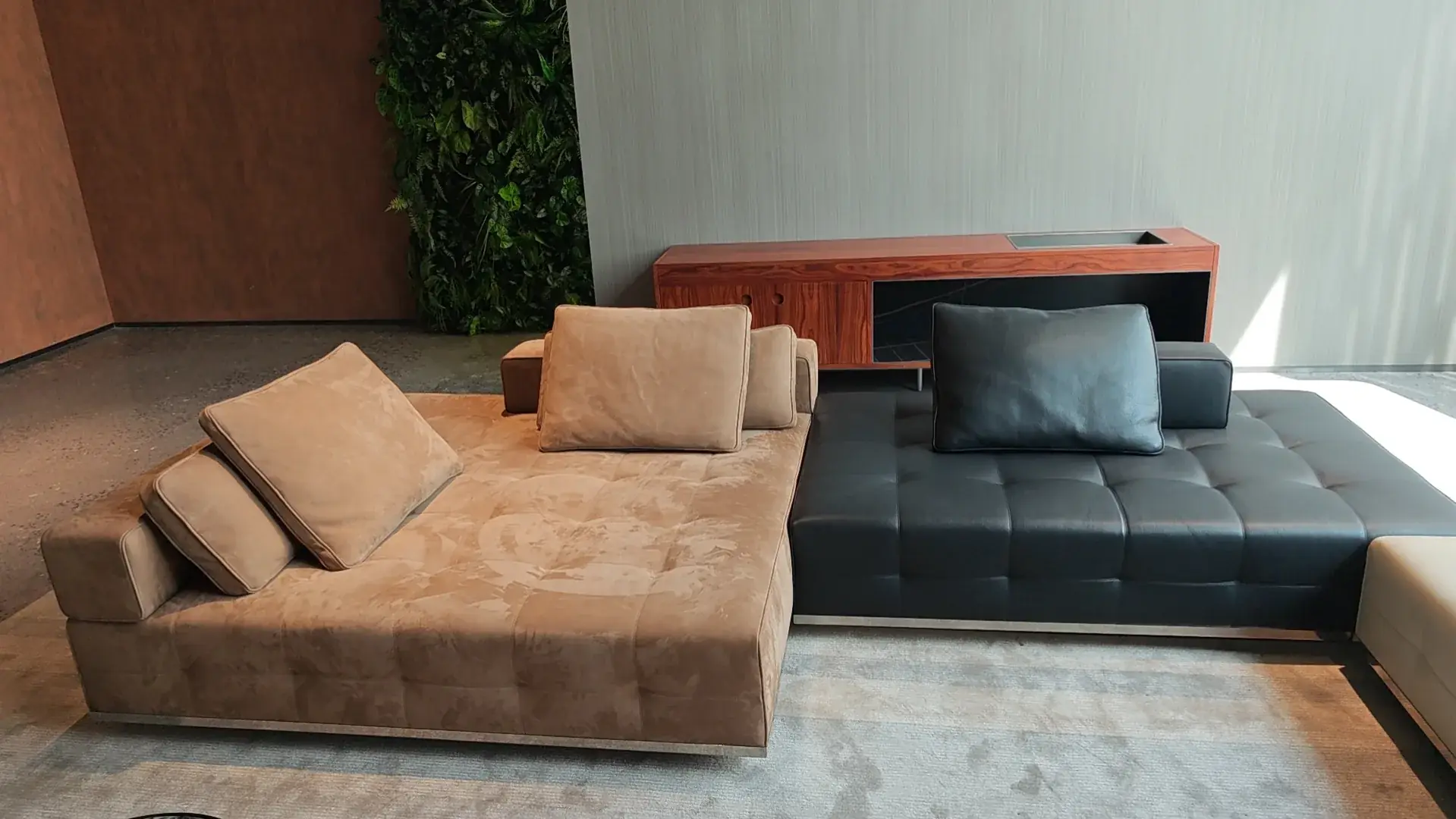
The camel suede and black leather modular sofa combines two visibly different upholstery zones. Its listed dimensions are 300 × 180 × 85 cm, with suede, top-grain leather and solid wood. For an adapted collection, the buyer needs to identify which surfaces retain those materials and which are changing. A single overall color name is not a complete upholstery instruction.
Tufted sofa panels need their own material and seam decisions
Changing the tufted area can affect the appearance of the depressions, folds and adjoining panels. Ask to review the proposed material on the relevant sofa section. A flat swatch cannot demonstrate all of those relationships. If the buyer wants a smoother appearance, establish whether that changes only the covering or the underlying upholstery arrangement as well.
A control sample should be identifiable as the approved version. Keep its drawing and material references connected to it. When a later proposal changes a seam or covering, compare that specific feature with the approved reference. Avoid accepting a distant photograph as evidence that every detail remains unchanged. The more distinctive the upholstery pattern, the more useful a clear close-up becomes.
For a distributor launching the sofa across several showrooms, the first priority is that each sales team describes the same configuration. Explain which modules and finishes the displayed sample represents. A showroom arrangement should not become an accidental promise that every component can be exchanged or sold independently. Obtain the applicable configuration information before advertising that flexibility.
The sideboard’s concealed details belong in the OEM approval too
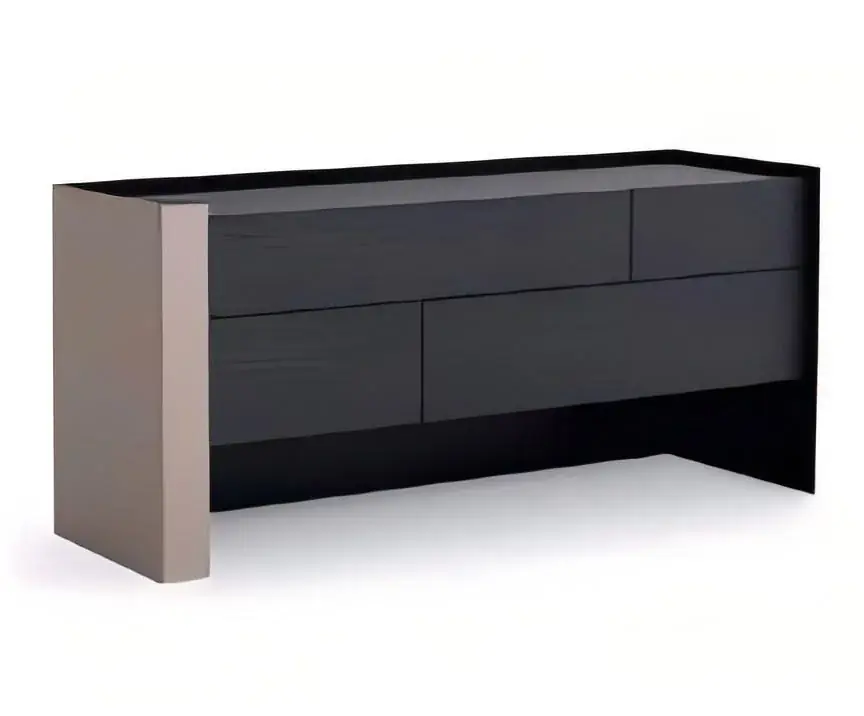
The asymmetric dark wood sideboard is listed at 180 × 45 × 80 cm with dark wood veneer, solid wood and multiple storage compartments. A brand developing a coordinated dining collection may be attracted to its broad horizontal form. Yet a change in outside length can alter the compartment arrangement and the proportions of the fronts. Review the inside and outside together.
Specify the intended contents when usable space matters. A serving platter, document file or electrical component presents different requirements. The outside depth is not the clear depth inside a compartment. Ask for the dimensions relevant to the intended object, and make any required access or cable provision explicit. Do not infer such features from a closed cabinet photograph.
The veneer appearance also needs a shared reference. If several cabinets will stand together in a showroom, review their intended visual relationship rather than approving an isolated small sample. Ask how the selected finish will be represented on broad fronts and edges. This is an appearance agreement for the chosen sideboard, not a claim that natural material can be made visually identical in every respect.
Label sofa modules and bed parts by their approved version
A buyer selling under its own name needs a reliable connection between the article ordered, the carton received and the item described to the end user. For the sofa, identify the actual configuration and any separate components. For the bed, identify the selected size and parts. For the sideboard, identify the finish and any separately supplied fittings.
Agree where approved labels and instructions will appear and who supplies the final artwork. Ask for a review of the relevant packaging information before dispatch. This does not establish a particular packing method or certification; it prevents the approved furniture from arriving under ambiguous identification. Any handling or assembly information should apply to the actual supplied item.
Give the chair collection a usable material naming system
A retailer may use a short marketing name for an upholstery color, while the supplier needs a precise material reference. Keep the relationship between those names clear. If two fabrics are both presented to shoppers as beige, the order still needs to distinguish them. The chair’s fabric approval should connect to the physical reference, not merely to a broad color description that several materials could satisfy.
Apply the same discipline to the sofa’s two upholstery zones. A label that names only the main color can leave the contrasting section ambiguous. Mark the material positions on an agreed view and check them on the sample. For a bed and sofa sold together, do not imply that their leather is identical merely because both product descriptions use the word Nappa. Confirm the selected references independently.
Product photography should also represent the approved version. If the retailer photographs an early chair sample and later changes the back upholstery, decide whether the sales images need updating before the collection launches. The buyer’s own product description should not continue to promise the old detail. This is especially important when an image shows a distinctive seam or material contrast that shoppers can reasonably expect to receive.
For the sideboard, distinguish the approved finish sample from a photograph whose color may vary with lighting and display settings. The image can communicate the intended appearance, while the agreed physical reference anchors the finish decision. Ask how broad veneered faces and smaller edge details will relate to that reference. A private-label launch is easier to explain when the names, photographs and actual furniture all point to the same version.
Decide which OEM chair and sofa changes reopen sample approval
Not every later question requires starting development again. A correction to an internal order reference is different from changing the chair fabric, sofa covering or bed support arrangement. Establish which physical changes need another sample or documented review. The decision should follow the effect on the furniture rather than the convenience of describing the change as minor.
Consider a retailer whose selected fabric becomes unavailable before production. A replacement that looks similar in a small photograph may differ when stretched over the chair back. Ask what has changed, what evidence is available and which earlier approvals remain applicable. The buyer should then make an explicit decision about the proposed version instead of allowing the original material name to remain on the order.
For a new collection, plan the first review around the hardest unresolved detail. That might be the sofa’s tufted transition, the bed’s mattress fit or the sideboard’s compartment opening. Solving that detail early can be more useful than approving every decorative accessory around an unfinished sample. It also gives the supplier a focused question to answer.
The cabinet planning guide develops the relationship between outside size and usable storage. Apply that same discipline to the collection brief: identify the furniture version that can actually be approved, connect it to the permitted design and branding, and resolve the features your own sales team will need to explain. A clear OEM order begins with a clear product, not merely a new name.