Storage furniture · Bespoke scope
Briefing a Custom Cabinet Supplier When Freestanding Furniture Meets Fitted Storage
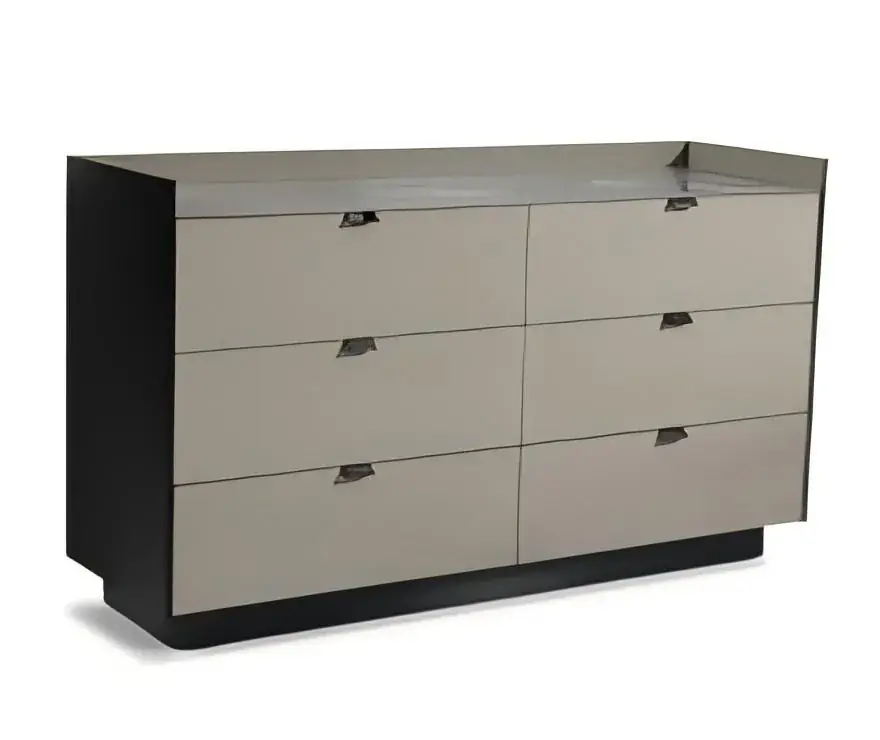
A 180 cm sideboard placed against a wall and a cabinet made to fill a 180 cm opening are different orders. Designers and residential project buyers choosing a custom cabinet supplier should settle that distinction before discussing finishes. HEZEN CASA offers freestanding storage designs such as the Asymmetrical Dark Wood Minimal Sideboard Credenza and Minimalist 6 Drawer Leather Wide Dresser, alongside a custom design service that develops production drawings from ideas and dimensions. Start by deciding which parts of the room must remain independent furniture and which require a separately agreed fitted solution.
A custom cabinet supplier needs the storage task before the wall width
The useful capacity of a cabinet is determined by what must go inside and how it will be retrieved. A wide sideboard might suit dining-room objects and display above it, while a drawer chest serves a different pattern of access. Neither can be selected reliably from the available wall length alone.
For a dining-room renovation, imagine a buyer who has 180 cm between two architectural features. The dark wood credenza is listed at 180 × 45 × 80 cm, with dark wood veneer and solid wood, and multiple compartments. That makes it a potential starting point for the furniture brief. It does not prove that the piece will fit tightly between those features, clear the skirting or accommodate the objects intended for storage.
Measure the room opening at more than one relevant position and show projecting trim, sockets and adjacent furniture. If the intention is to retain a freestanding appearance, allow the designer to establish deliberate space around the piece. A narrow, accidental-looking gap can be less satisfactory than a clearly designed separation.
For an importer buying display furniture, the same credenza may be judged as an independent object rather than as part of one measured room. In that case, the approved overall dimensions, finish and internal arrangement matter more than a wall-to-wall installation detail. Keep those two briefs separate so a room-specific modification does not quietly become the standard retail version.
A dark wood sideboard needs an internal arrangement drawing
The Asymmetrical Dark Wood Minimal Sideboard Credenza is described with multiple compartments, but its public summary does not provide every internal measurement or opening detail. Ask for an elevation showing the actual fronts and a plan or section of the storage arrangement. The word “compartments” is not enough to establish whether a serving platter, document file or audio component will fit.
If the credenza is to hold electrical equipment, identify the equipment and its requirements before requesting changes. Cable routing, ventilation and access need a defined solution. Do not assume that an ordinary storage cabinet is already configured as an equipment enclosure simply because it is the right external size.
Six drawers can occupy a bedroom in two very different ways
HEZEN CASA lists both the wide six-drawer dresser and a Curved 6 Drawer Tall Leather Chest of Drawers. The shared drawer count is the least useful part of the comparison when deciding where the furniture belongs.
The 160 cm wide leather dresser uses horizontal wall space
The wide dresser is listed at 160 × 45 × 85 cm, with leather and solid wood and six drawers. Its broad format can be considered where a bedroom has a substantial uninterrupted wall. Before placing artwork or a mirror above it, confirm the finished top level and the relationship to nearby furniture.
Do not translate six drawers into a claimed storage volume. Drawer-box dimensions, side thicknesses and runner space affect usable capacity. If the order is intended for folded clothing or specific storage boxes, provide those object sizes and request the internal measurements. A drawer that looks generous across the front can still be unsuitable for the buyer’s intended arrangement.
The narrow leather chest is 60 cm wide and 130 cm tall
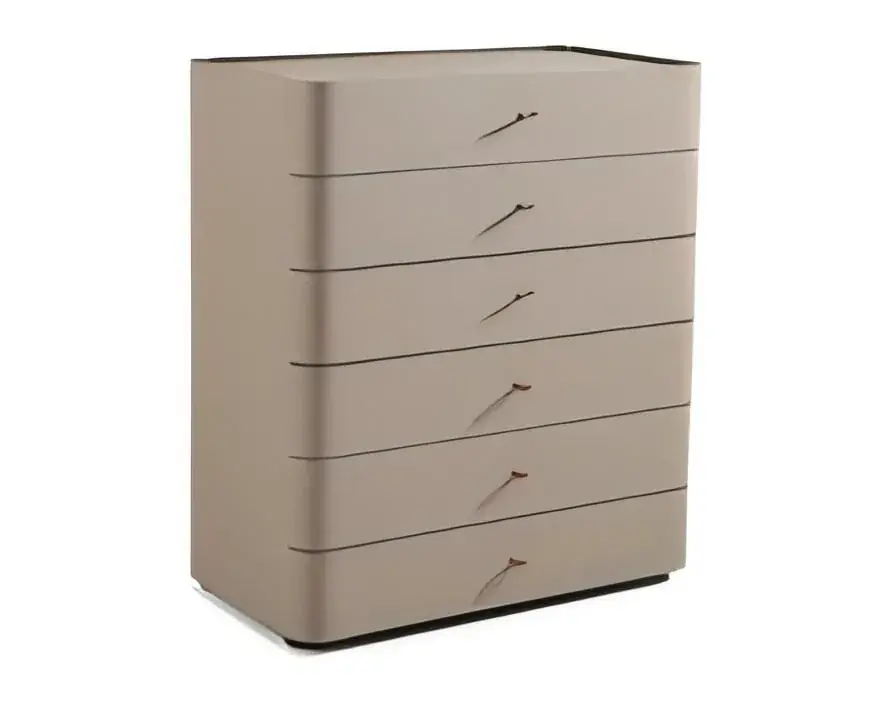
The curved tall chest is listed at 60 × 45 × 130 cm, also with leather and solid wood and six drawers. It uses less wall width than the wide dresser, but access moves upward through the piece. Consider who will use the upper drawers and how the chest relates to the bed, door and adjacent wall.
A buyer furnishing a compact bedroom might prefer the narrower footprint while overlooking the space needed in front. Draw the drawers in their open positions and show the person using them. The closed 45 cm depth does not describe the complete operating space. The required extension and clearances must come from the actual drawer construction.
Stability and restraint information also belong in the cabinet specification. The U.S. Consumer Product Safety Commission’s Anchor It guidance highlights furniture tip-over prevention. Obtain the applicable manufacturer instructions and have the installation method assessed for the actual wall and product. A tall chest should not be described as safe solely because it feels heavy or has a small footprint.
The stacked accent dresser raises an additional placement question because its fronts project in different directions. Do not position a neighboring cabinet solely against the closed central body. Obtain the full envelope and drawer movement information for the supplied version, then verify access beside the adjoining furniture. A sculpture-like arrangement should remain usable after the room is furnished.
Fitted storage requires a new agreement at the room interface
Turning the dark wood credenza into a fitted installation changes the question from “Which piece?” to “Which assembly, measured and installed by whom?” A freestanding product specification cannot answer every issue created by uneven walls, skirting, service points or adjoining joinery.
HEZEN CASA’s custom service describes production drawings developed from supplied photos, sketches and dimensions. Use that service to establish a proposed solution, while confirming the boundary of the order. Do not infer that on-site measuring, wall preparation, filler panels, final installation or a complete kitchen system are included. Each of those would need explicit agreement if the project requires it.
Suppose a designer wants the 180 cm sideboard appearance extended across a longer dining-room recess. Stretching the outside width may affect door proportions, drawer fronts, shelves and the underlying structure. The appropriate development may be a revised cabinet or several coordinated units. It should be resolved through drawings and supplier evaluation, rather than by applying a percentage increase to the published dimensions.
For a bedroom alcove, the decision may be simpler: retain the wide dresser as furniture and finish the surrounding wall independently. That can preserve a clear replacement route and avoid making the cabinet responsible for correcting the building. It is an option to consider, not a claim that freestanding furniture is always preferable to fitted joinery.
Drawer and door movement must survive the fitted-cabinet design
For any custom version of the drawer chests or credenza, show the moving parts in their open positions. A nearby wall return, projecting handle or neighboring cabinet can restrict access even when the closed fronts align neatly. Establish the hardware and clearances before the external appearance is treated as final.
Blum’s cabinet planning system includes collision checking for fittings, illustrating why hardware selection and cabinet geometry are connected. This does not mean that HEZEN CASA uses Blum hardware. The order should identify the actual fittings proposed, their relevant dimensions and the approved operating arrangement.
If a buyer requests a different runner or hinge after the drawings are approved, ask which dimensions or drilling positions change. Retaining the old drawing merely because the visible front is unchanged can leave the production team with conflicting instructions. Keep the selected hardware and the applicable drawing revision together.
Leather, veneer and sculptural drawers call for different approvals
The leather-covered chests, dark wood credenza and Designer Stacked Irregular Accent Dresser should not be reviewed using one generic finish photograph. Each design makes different construction details visible.
The stacked accent dresser is listed at 120 × 45 × 110 cm, with solid wood and veneer and five drawers. Its offset appearance is central to the design. Ask how the approved envelope is measured across the projecting fronts and how each drawer opens. A buyer should not assume that the maximum width is available as usable internal drawer space.
For the leather chests, review the material where it turns around the drawer front and meets any handle or exposed frame. Confirm the leather specification, color reference and care instructions for the version ordered. The fact that the tall and wide pieces both mention leather does not establish that they use an identical material or finish.
For the dark wood credenza, review the direction and appearance of the veneer on adjoining fronts and visible sides. If two units will sit together, approve the intended visual relationship rather than assume the grain will repeat. A natural-looking surface can be coordinated without being identical, provided the buyer and supplier agree what is acceptable.
The sculptural dresser is a stronger visual object than a quiet rectangular storage piece. It may suit a deliberate accent position, while a restrained bedroom scheme may call for the simpler wide dresser. It is a poor substitute when the brief requires a flush, regular wall of fronts. Choose its irregularity because the room needs it, not because the word designer implies greater storage usefulness.
Protect drawer fronts and identify cabinet components for delivery
Before the leather chests are packed, inspect the drawer fronts both closed and open. Closed views show their alignment within the frame; open views help identify the actual interior and hardware supplied. If the wide dresser and tall chest share a finish reference, photograph them under comparable lighting so the buyer can review the intended relationship without assuming their construction is identical.
For the wide dresser, confirm whether the cabinet travels as one assembly and whether drawers, handles or supports are removed for transport. For the tall chest, identify the protected overall height and handling orientation. For the stacked dresser, ask how projecting fronts are protected without using them as lifting points. These are different packing questions tied to the actual shapes.
The receiving team should know which parts are adjustable, which must remain fixed and what assembly steps are permitted. If a fitted version has been agreed, identify room-specific panels and hardware clearly. Do not leave the installer to distinguish similar pieces by finish color alone, particularly when more than one room has coordinated cabinetry.
Use HEZEN CASA’s pre-shipment inspection guidance as background, then record the movement and finish of the selected cabinets before packing. A short demonstration of the actual drawers and doors can complement the dimensional record. It should show the approved piece, not a different sample with a similar front.
Close the purchase with a clear scope sentence for each item: an independent credenza, a narrow six-drawer chest, a wide dresser, or a specifically drawn fitted assembly. Attach the relevant internal measurements, finish approval and installation boundary to that item. The cabinet supplier can then price and produce a defined storage solution, and the room team knows exactly which remaining work belongs on site.