Test the Layout Options Before Selecting a Modular Sofa Manufacturer
The ability to deliver a sofa in sections does not automatically mean those sections can become independent seats or be rearranged freely. A modular sofa manufacturer should explain the actual component system behind the layout being offered. HEZEN CASA’s tufted modular sofa, curved bouclé sectional and two-tone Nappa sectional are starting points for that discussion. Before ordering for a home, showroom or project, identify which configurations are supported, which surfaces become exposed and which connections belong to the supplied version.
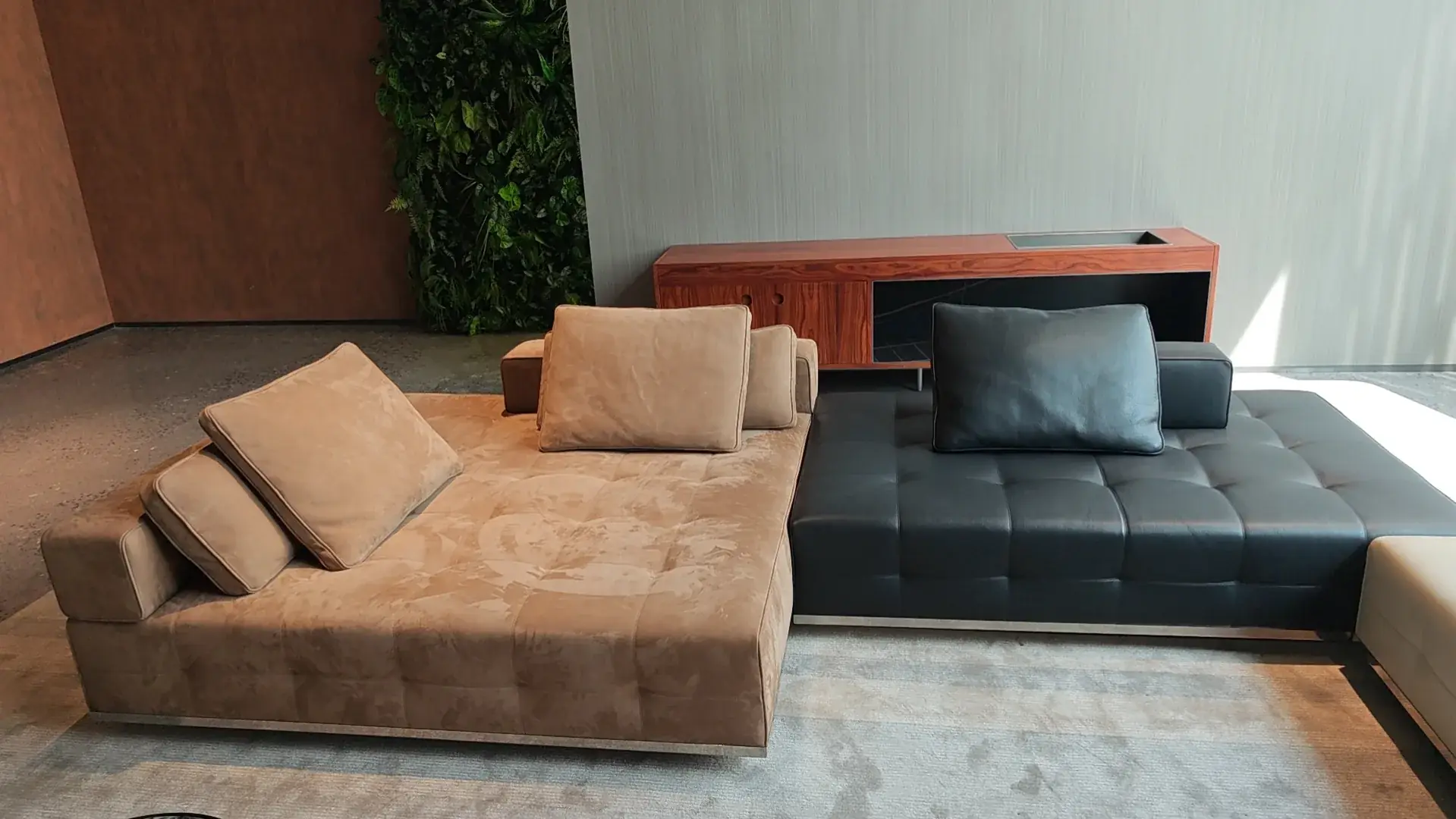
A modular sofa manufacturer should define the components before promising flexibility
The camel suede and black leather sofa is listed at 300 × 180 × 85 cm with suede, top-grain leather and solid wood. Its modular description supports a discussion of components, but the public listing does not provide a complete compatibility chart. Request the actual parts and approved arrangements for the version under consideration.
The off-white curved sectional is listed at 300 × 180 × 80 cm with bouclé and solid wood. The burgundy and white Nappa sectional is listed at 320 × 180 × 85 cm. Their sectional forms do not establish that they share parts with the tufted sofa or with each other. Treat each as a separate design until the supplier provides specific information.
A distributor may want to show one arrangement and offer several alternatives from the same components. A homeowner may expect to change the layout after moving. Those intentions should be stated at the beginning. They require more information than an order for a single fixed configuration that will remain together in one room.
Identify an end section before using it as a freestanding seat
A component that works at the end of an assembled sofa may have a particular arm, support or finished side. Ask whether it is intended to stand independently and how that use is supported. Do not assume the answer from its appearance in the complete arrangement. The relevant information must apply to the actual supplied part.
For the tufted sofa, a buyer may want to separate one section when hosting a larger group. Confirm the resulting seat’s stability, exposed surfaces and permitted use with the manufacturer. A component designed only as part of the assembled sofa should not be marketed as an independent chair without supporting information.
For the curved sectional, moving a section can also change the way the outline joins the neighboring piece. The components may have a particular relationship rather than interchangeable straight edges. Ask the supplier to demonstrate the proposed alternative arrangement. A photo edited to show a different shape is not evidence that the physical parts fit that way.
Review the modular sofa where two sections meet
The connection affects how the arrangement is assembled and retained in use. Obtain the applicable instructions and component identification for the chosen sofa. The public dimensions and upholstery descriptions do not reveal the connector type, its position or the steps required for a change of layout.
Manufacturer documentation such as King Living’s joiner instructions illustrates that connection procedures belong to a particular system. It does not establish that HEZEN uses those connectors or construction. Request HEZEN’s own applicable information for the actual sofa rather than transferring instructions from another brand.
Inspect the tufted sofa’s meeting edges in the approved arrangement
Review how the neighboring surfaces align when the supplied sections are assembled as intended. Ask the manufacturer to identify any designed gap or transition and explain how the arrangement is held together. The buyer should know what the accepted sample shows before comparing later photographs or delivered components.
Do not judge alignment from two unrelated close-ups. A continuous view of the assembled junction helps connect the observation to the correct sections. If the sofa uses contrasting materials at that location, include both surfaces in the reference. That makes it easier to distinguish an intended visual change from a configuration or assembly question.
A retail team moving display furniture frequently needs the permitted reconfiguration procedure. Establish which actions staff may perform and what instructions or assistance are required. Avoid assuming that a component can be dragged, lifted by an arm or detached without following the supplied guidance. Flexibility is useful when the system can be handled correctly.
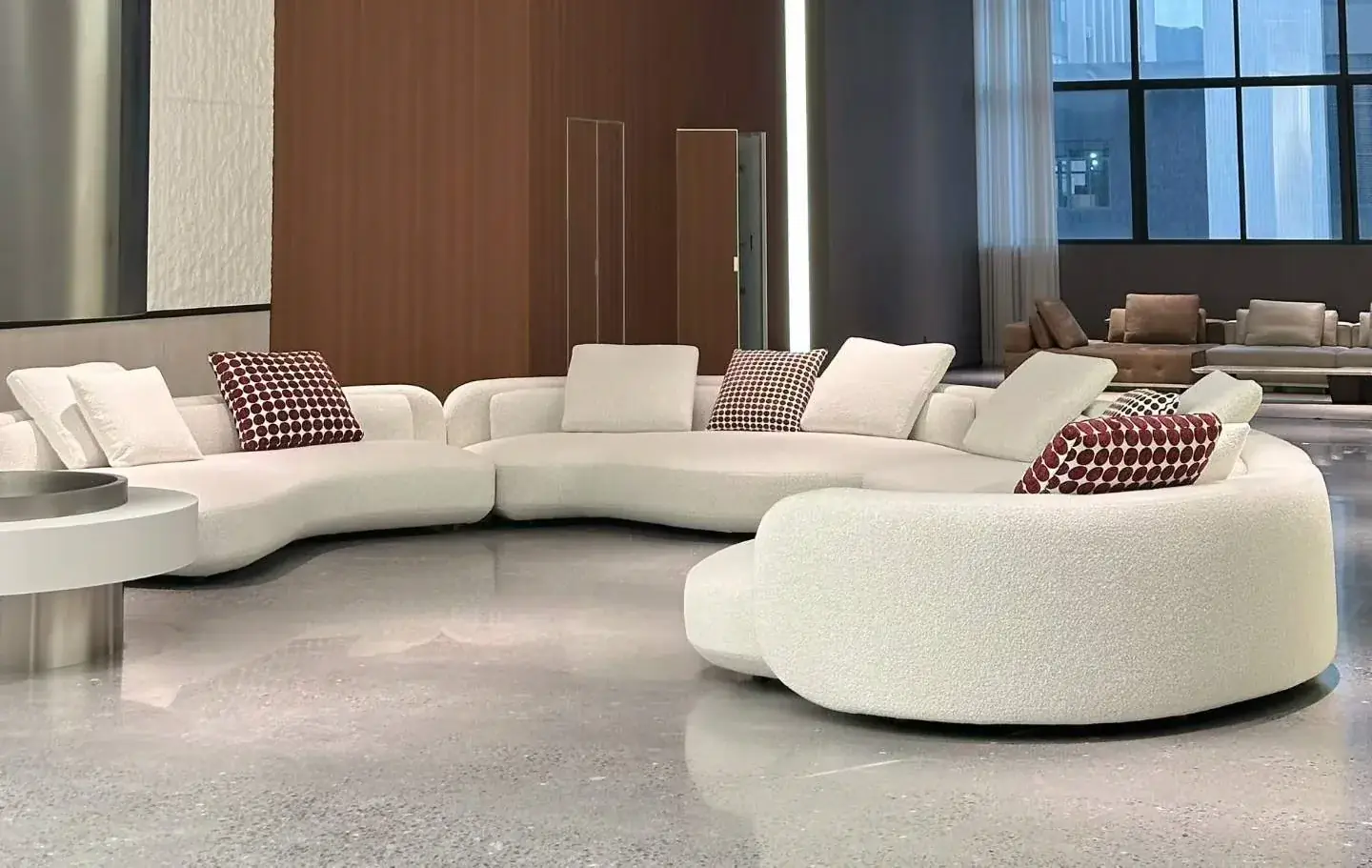
A new sofa arrangement exposes surfaces that the original display may hide
Moving a section away from its neighbor can reveal an edge or side that was not prominent in the showroom configuration. Ask to see those surfaces before approving independent or alternative use. The finished appearance should match the intended placement, particularly when the sofa floats in a room and is visible from several directions.
The two-tone sectional needs a color plan for every approved layout
The burgundy and white design uses contrast as part of its identity. If the buyer proposes a different arrangement, review where the colors appear and how they meet. The original photograph cannot approve an arrangement that changes those relationships. Connect each alternative to a clear drawing and the actual material references.
A showroom might prefer to display the more striking contrast toward the entrance. A residential project may need a quieter rear view facing a dining area. Explain the intended viewpoints to the supplier. A configuration that works from one presentation angle may require another review when the room exposes different sides.
The same issue applies to the camel and black sofa’s tufted divisions. An alternative layout may alter the rhythm of panels and the apparent continuity of the upholstery. Ask to see the proposed assembly rather than relying only on an individual component photograph. The parts and the complete composition are both relevant to approval.
An exposed end of the suede-and-leather sofa needs its own approval
When two sections stand together, their adjoining faces may be hidden. Separating them can expose a surface that the buyer has never reviewed. Ask for the relevant view and confirmation of whether independent use is supported. Do not assume the newly visible side has the same upholstery treatment as an original outer arm or finished end.
This matters particularly for a showroom that wants to demonstrate several arrangements from one order. Mark the faces visible in each proposed display and have the supplier identify any limitation. The order can then specify the supported arrangements clearly. A component that is suitable only within the full assembly should not be presented as an independent occasional seat.
A second practical question is where unused parts will go. If the display changes from a larger to a smaller configuration, the remaining component needs an approved use or suitable storage plan. Review its size, handling and covering protection with the supplier. Treating it as spare stock without identifying its condition and component reference makes a later complete display harder to reconstruct.
For a project buyer, photograph the accepted arrangement with its component labels before those labels are removed. The record should connect the intended room layout to the actual supplied pieces. It does not need to promise future interchangeability; it needs to make the current assembly unambiguous to the receiving and installation teams.
Include the supplier’s confirmed restrictions with the layout drawing used by the showroom team.
Use a separate chair when the sofa system cannot provide the needed seat
HEZEN’s sculptural bouclé chair is listed at 80 × 90 × 95 cm with bouclé and metal. It offers an independent furniture choice for a seating group. It should not be described as a compatible module of any sofa, but it can be assessed alongside the selected sectional when another seating direction is needed.
A homeowner may want one person to face a window while others use the sofa for conversation. If the approved sectional cannot be separated into the required independent seat, a purpose-selected chair may be the clearer solution. Compare the actual plan and sample experience rather than forcing the sofa into an unsupported arrangement.
A designer working in a compact room may reach the opposite conclusion: the additional chair could obstruct access, making a confirmed smaller sofa arrangement more useful. The point is to compare real options. The modular label should not prevent consideration of a separate chair, and a matching upholstery color should not be mistaken for mechanical compatibility.
Keep the chair’s movement space separate from the sectional’s component plan
Show the chair where it will be approached and used, not merely where its closed footprint fits. The chair’s 95 cm overall height does not establish its seat height or its relationship to the sofa’s sitting surface. Obtain the relevant information and review the arrangement with the intended users when possible.
If the chair moves between positions in the room, identify where it can be placed without blocking the sofa’s access. That is a room-planning choice, not a property of the sofa connector system. Keeping those decisions separate helps the buyer obtain useful answers from the manufacturer instead of asking the modular range to solve every circulation problem.
Order future sofa changes as defined options, not assumptions
A buyer may expect to add another component later. Ask whether that option is available for the selected design and what information must be retained to identify the original version. Do not promise future availability, exact material matching or interchangeability unless those terms are supported by the supplier’s actual offer.
HEZEN’s custom development service provides a way to discuss a changed configuration. A development proposal is different from confirmation that an existing module can be added immediately. Establish whether the request uses current parts or requires a new design decision, then review the consequences for dimensions, materials and delivery.
A distributor planning a phased showroom expansion should keep the approved component identities and layout drawings. If the range changes, those records help the supplier explain the available options. A familiar product name alone may not describe every detail of a later order. The buyer needs a traceable version rather than an expectation based on a past display photograph.
The packing record should identify the parts required to assemble the approved layout. If some components arrive separately, confirm whether the first delivery can be used as intended or must wait for the remainder. A group of attractive upholstered pieces is not necessarily a complete working sofa until the applicable components and connections are present.
Accept the modular sofa only after the intended layouts have been demonstrated
The custom sofa dimension guide explains how a revised outline can affect arms, seats and seams. Apply that same precision to modular selection. List the arrangements the buyer actually needs and ask for a clear response on each one, including any arrangement that is not supported.
For the final order, identify the chosen layout, the supplied components, their material positions and the applicable assembly instructions. If a second layout is part of the reason for buying, review it before approval. The value of a modular sofa is the flexibility the defined system can actually provide, not the number of imagined arrangements that can be drawn from a photograph.