When a Modern Luxury Furniture Manufacturer Must Balance Statement Pieces and Daily Use
The chair that makes a room photograph memorable may not be the chair someone chooses for a long evening. A designer assessing a modern luxury furniture manufacturer should therefore distinguish visual emphasis from the activities the furniture must support. HEZEN CASA’s sculptural boucle chair, wood-and-linen swivel chair, curved boucle sectional, travertine coffee table and low leather bed suit different conversations about use. Confirm the intended activity before treating their appearance as a complete selection argument.
Separate the living room’s statement chair from its everyday seating task
The sculptural chair is listed at 80 × 90 × 95 cm, with boucle and metal. Its shaped upholstered form can be a strong visual object. The wood-and-linen swivel chair, listed at 65 × 65 × 85 cm, introduces a different construction and an intended rotating function. Those outside dimensions are useful for an initial layout, but they do not establish seat height, support, effort to rise or the full space needed during movement.
For a formal sitting area, the sculptural chair may be considered as a deliberate focal point used for shorter conversations. For a room where someone turns between a window and another seat, the swivel function may be relevant. Both uses remain proposals to test with the actual chair. Neither description proves that one chair is comfortable for everyone or certified for a particular commercial setting.
The sculptural boucle chair should be tested with the intended sitting activity
A buyer who expects the chair to support reading should try the relevant posture and the way the arms interact with a book or device. A buyer choosing it for conversation should review turning toward another person and entering or leaving the seat. These are different observations. Record what matters for the intended use without converting one person’s preference into a universal comfort claim.
Its upholstery also needs a realistic care discussion. Ask for the actual textile specification and the recommended cleaning method. Boucle describes a textured character; it does not identify every fibre, finish or performance property. If the chair will be used frequently, consider whether the owner or operator can follow the applicable care guidance. An attractive surface should not be sold as effortless to maintain without supporting information.
The swivel chair needs space for rotation, not just its closed footprint
The 65 × 65 cm listing describes the chair’s overall reference dimensions. Ask the supplier to demonstrate the proposed swivel function and identify the relevant moving envelope. Place nearby furniture and walls in that review. A chair that clears a table in one position may interact differently with it when turned. The exact movement and clearance should come from the supplied construction, not a guessed circular zone around the photograph.
For a compact apartment, this distinction can decide whether a swivel chair is useful or merely frustrating. A buyer may want to face both the sofa and a view, but a nearby cabinet could prevent the desired movement. In a larger room, the same chair may have enough separation to make rotation worthwhile. The activity, surrounding objects and actual mechanism should be reviewed together.
A modern luxury furniture manufacturer should explain the sofa beyond its silhouette
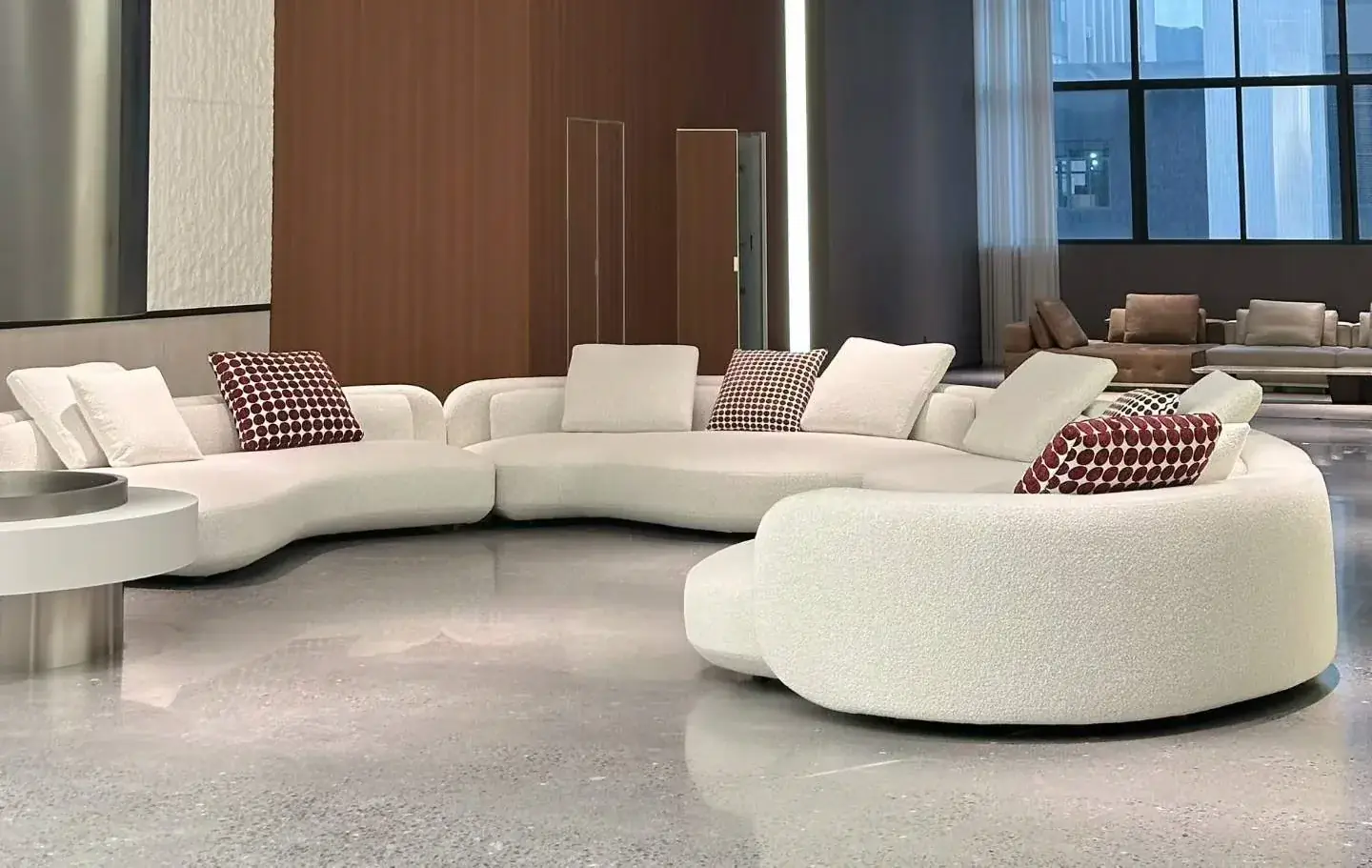
The curved sectional is listed at 300 × 180 × 80 cm, with boucle fabric and solid wood. Its organic shape can make a conversation area feel different from a straight arrangement. That shape also affects the relationship between seated people, the central table and the passage around the group. A buyer should not assume that the outside curve translates directly into a continuous usable sitting length.
In a room used mainly for conversation, review whether the chosen arrangement places people naturally toward one another. In a room used for screen viewing, review the actual sight lines instead of assuming that a curved design solves them automatically. The same sectional can be considered for both settings, but the plan should demonstrate the intended relationship. Do not turn a style preference into a claim of universal application.
Ask for the component dimensions and relevant seat measurements for the selected version. The published 80 cm overall height is not the seated height, and the 180 cm outside depth is not the depth of every cushion. Those distinctions become important when comparing the sofa with the accent chairs. The furniture should be evaluated as a usable seating group, not as a row of isolated overall dimensions.
Frequent use makes the curved sofa’s upholstery junctions relevant
Review the actual seams, curved edges and cushion arrangement on the sample. Ask how the supplied components are maintained and whether any covers or cushions are removable; do not infer removability because a seam is visible. If a user expects to refresh or replace a particular part, establish whether that is supported for the selected version. A supplier should answer the product-specific question rather than relying on a general statement about customization.
ACT’s abrasion guidance warns against equating a laboratory abrasion number with a fixed service life. Consider the relevant fabric information alongside the way the sofa will actually be used. The buyer still needs the material identity and care instructions; a large test number cannot compensate for an unsuitable maintenance expectation.
The travertine table changes how the seating group is used and moved
The irregular travertine coffee table is listed at 120 × 60 × 40 cm and 55 kg, with travertine and metal. Its stone top introduces a harder surface among the upholstered pieces. The weight is a published product reference, not a packed shipping weight or a handling instruction. Do not decide the number of people or lifting method from that figure alone. Obtain the actual packing and handling information for the supplied table.
In an occasional entertaining space, the table’s appearance may be a major part of the selection. In a daily family room, the buyer should also think about what is placed on the surface, how spills are addressed and whether the table is expected to move frequently. A heavy stone table is a poor choice for a brief that assumes one person can casually rearrange the room unless an appropriate, verified arrangement supports that use.
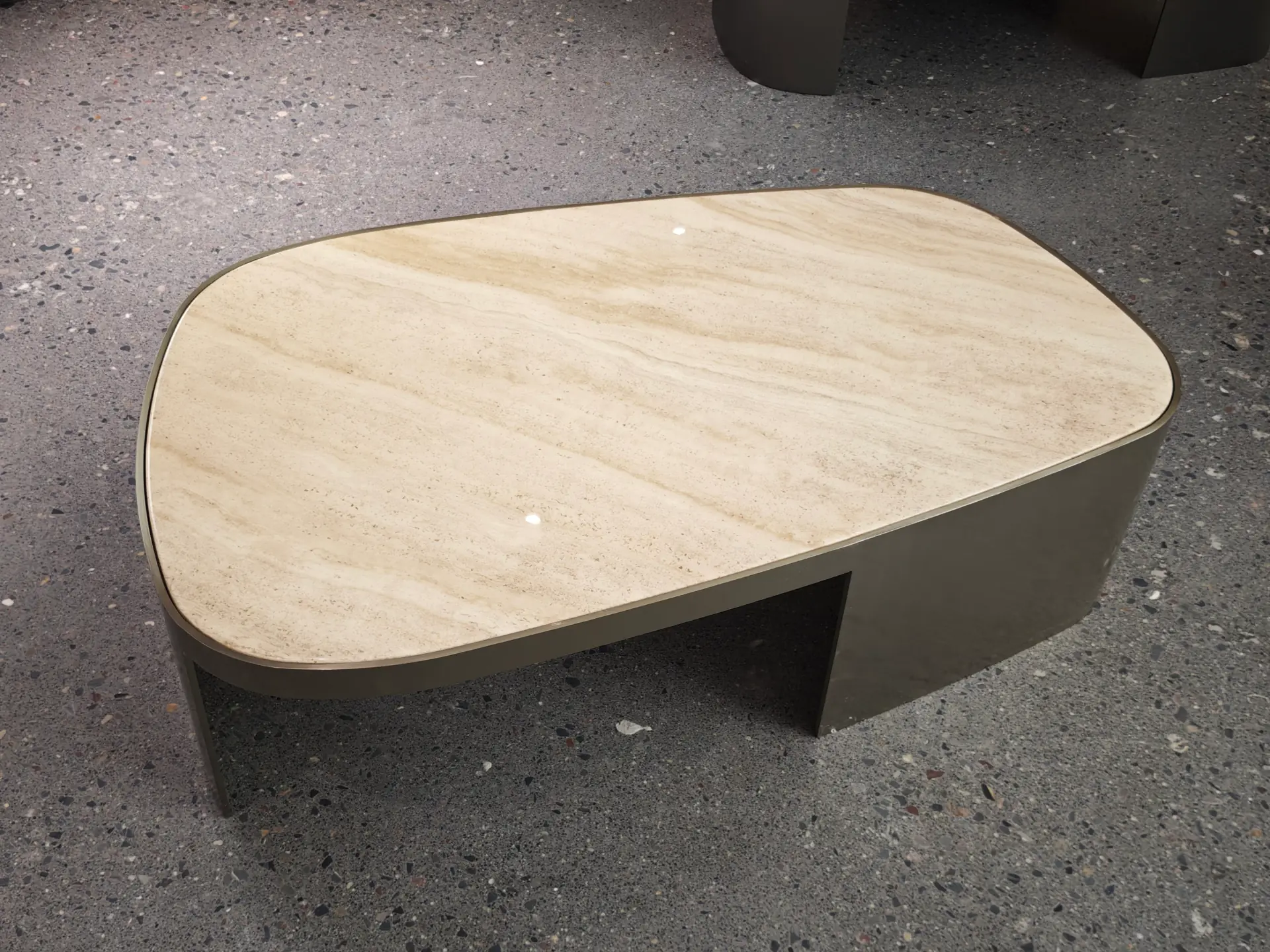
The irregular outline also affects reach. Show the table beside the actual curved sectional and determine which parts of the top are conveniently accessible from the intended seats. The closest edge may not be the same distance from every person. A plan that uses only the 120 × 60 cm outside rectangle can hide that difference. Use an accurate outline or an approved sample arrangement when the relationship is important.
Stone care belongs in the daily-use decision before delivery
The Natural Stone Institute explains that appropriate cleaning depends on the stone and that sealing does not make stone stain-proof. Request the guidance applicable to the selected travertine finish. The furniture brief should not assume that any household cleaner is suitable or that a protective treatment removes every consequence of a spill. That is a practical purchasing consideration, not a reason to reject natural stone automatically.
If the owner wants a table that is repeatedly moved for children’s activities or events, discuss that requirement before confirming the stone design. The supplier may propose another product or a different arrangement, but the buyer should evaluate the specific proposal. Do not ask the delivered table to perform a role that was never part of its approved use.
The low leather bed should be chosen for the bedroom’s users
The beige Nappa platform bed is listed at 220 × 180 × 85 cm, with solid wood and Queen/King availability. Its low visual profile can support a restrained bedroom scheme. That does not establish the final height of the sleeping surface or how easily a particular user can sit down and rise. The actual mattress and support arrangement must be considered with the bed frame.
A designer furnishing a display suite may prioritize the uninterrupted wall above the headboard. A household buyer may care more about making the bed, reaching nearby objects and using the surrounding storage. Review both where the same piece must serve them. The public outer dimensions can support the first layout study, but the final decision needs the relevant internal and assembled dimensions.
A change of mattress can affect the visible relationship between the upholstered frame, headboard and bedding. Confirm the actual mattress specification rather than assuming a Queen or King label settles the matter. If the bed is proposed for different rooms or buyers, keep those versions distinct. A low-profile appearance should not become a reason to ignore the person who will use the furniture every day.
Approve a modern luxury furniture scheme through the routines it must survive
Include the person responsible for cleaning in the review when the furniture will be maintained by someone other than its purchaser. The sculptural chair’s curved surfaces, the swivel chair’s exposed structure and the sectional’s upholstery junctions present different access questions. Ask which cleaning instructions apply and whether the expected equipment can reach the relevant areas without moving furniture in an unsuitable way. This is more useful than adding an unsupported easy-clean description to the order.
The stone table deserves a separate maintenance decision because it is not a light accessory that should be repeatedly shifted to solve access problems. Review the surrounding floor and the proposed position before delivery. If the table must be moved for routine work, obtain the applicable handling guidance and plan for that movement. Its listed 55 kg does not provide a safe lifting procedure.
For the low bed, consider who changes the bedding and whether the proposed room arrangement permits that task. A photograph of a tightly styled bedroom can conceal an awkward route along one side. Resolve the actual arrangement with the bed and mattress dimensions rather than relying on the visual simplicity of the frame.
Walk through the proposed interior as a sequence of ordinary actions. Enter the curved seating group, sit in the intended chair, turn where rotation is required, place an object on the stone table and move through the room without shifting furniture unnecessarily. In the bedroom, review the actual bed and mattress arrangement. These activities expose different design questions from a photograph taken from the room’s most flattering angle.
Ask the manufacturer for evidence where the activity depends on an unpublished detail. That could be the swivel chair’s movement, the sofa’s cushion construction, the table’s permitted handling or the bed’s support arrangement. Do not treat missing information as proof that the product is unsuitable, but do not replace it with an optimistic assumption. A conditional selection is more useful than an unconditional promise built on a vague description.
HEZEN’s bed and mattress coordination guide develops the bedroom side of this decision. Apply the same discipline across the living space: choose the sculptural chair for a defined role, the swivel chair for a verified movement, the sectional for its actual arrangement and the travertine table for a use pattern that respects its material and handling needs. The result can remain visually distinctive while making sense after the room becomes part of everyday life.