Bedroom planning · Design coordination
What an Upholstered Bed Manufacturer Needs Before a Bedroom Order Can Be Approved
“King size” is not a production drawing. A bedroom contractor or furniture importer working with an upholstered bed manufacturer needs the actual mattress size, the finished bed envelope and the headboard’s relationship to the room before confirming an order. HEZEN CASA’s low-profile boucle platform bed, velvet bed with a matching bench and wingback linen bed with reading lamps illustrate why beds that share a size label still require different planning decisions.
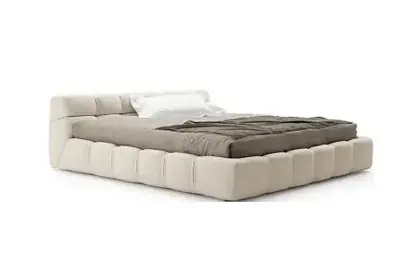
A bed order starts with the mattress that will actually be supplied
The mattress is the reference object inside the bed, while the upholstery, rails and headboard occupy space outside it. These dimensions should be written separately. An overall width does not establish the internal mattress opening, and the total bed height does not reveal the height of the surface on which someone will sit.
Imagine an importer ordering bed frames in China while mattresses are purchased in the destination market. If both purchase orders say only “king,” the two suppliers may reasonably work to different dimensions. The mismatch might remain invisible until the bedroom is assembled. Record the mattress length, width and thickness from the chosen mattress specification, then require the bed drawing to show the compatible opening and support arrangement.
The same distinction matters for a villa refurbishment using existing mattresses. Measuring the old frame gives the size of the furniture being removed, not necessarily the mattress itself. The buyer should measure or identify the retained mattress and describe any required replacement allowance. Do not enlarge the new frame simply because a room has space; a loose fit can create an unwanted gap around the sleeping surface.
The 210 × 180 × 100 cm boucle bed needs an internal opening dimension
The Cream Tufted Boucle Fabric Low Profile Platform Bed is listed with boucle and solid wood, a low-profile form and overall dimensions of 210 × 180 × 100 cm. Its size field states Queen/King Available. These details establish a starting design and available size direction; they do not tell a buyer that the mattress itself measures 180 cm across.
For this model, ask for a dimensioned plan showing the mattress opening, upholstered side rails and the furthest point of the headboard. The soft outer edges may be the parts that come closest to a wall or bedside unit. Specify which points the finished dimensions refer to so that a fabric-covered edge is not measured differently by the factory and the receiving team.
A low-profile bed can suit a calm, visually open bedroom. It may be less suitable when the intended user needs a higher sitting surface or when an existing mattress creates an unexpectedly low or high result. Evaluate the combined bed-and-mattress height with the intended user; the descriptive term “low profile” cannot settle that decision.
Give the upholstered bed manufacturer a section through the bed, not just a floor plan
A vertical section explains how the mattress, support and headboard meet. This matters particularly when a thick mattress could conceal a large part of the headboard or when a thin mattress might leave an awkward exposed area. The plan view can look correct while the assembled bed has a very different visual balance.
Use the actual mattress thickness in that section. Show the support level, the mattress top and the visible portion of the headboard. If the bedroom includes wall lighting or artwork, add those positions too. The bed then becomes part of the room’s vertical composition, rather than an isolated piece of furniture placed below items that were fixed earlier.
Nappa leather platform beds with 85 cm and 105 cm listed heights will frame the mattress differently
The Beige Plain Smooth Nappa Leather Low Platform Bed is listed at 220 × 180 × 85 cm and described with Nappa leather, solid wood and a flat minimalist headboard. The Light Grey Dual Pillow Nappa Leather Floating Bed is listed at 220 × 180 × 105 cm, with a metal structure in its material specification. Both offer Queen/King options, but the published height difference is relevant when studying headboard exposure.
Do not convert those total heights into a seat-height comparison. The public summaries do not give the support-platform level. Instead, request sections for the versions being considered and place the same mattress specification into each. This lets the buyer compare the visible headboard, the rail-to-mattress relationship and the overall bedroom composition on a consistent basis.
For a retailer choosing one bedroom display, the lower headboard may suit a restrained wall treatment. A project with pillows, reading support and a more prominent bed wall may call for a different profile. Neither outcome can be inferred from the word Nappa; upholstery material and bed geometry are separate decisions.
Bed-frame support must follow the selected mattress requirements
For the low Nappa platform bed, clarify where the mattress rests relative to the upholstered side rail. For the dual-pillow bed, also confirm how much of the pillow-shaped headboard remains exposed with the chosen mattress. A section should show these relationships directly so that the purchasing team does not infer them from a styled photograph with unknown bedding thickness.
The support arrangement needs its own confirmation. Ask whether the supplied bed uses slats, a platform or another structure, and obtain the relevant dimensions and assembly instructions. Those details are not consistently specified in the public bed summaries. A buyer should not assume that a frame visible in a photograph is suitable for every mattress type.
Mattress manufacturers can define their own foundation requirements; Tempur-Pedic’s foundation information is one example of product-specific support design. For a HEZEN CASA bed order, use the instructions for the mattress actually selected. Another manufacturer’s support dimensions or warranty conditions are not automatically applicable.
If an adjustable foundation is proposed, treat it as an additional engineered component requiring explicit compatibility confirmation. Check its movement envelope and its relationship to the upholstered rails and headboard. The presence of a large enough mattress opening does not by itself establish compatibility, and the current bed descriptions should not be read as such a promise.
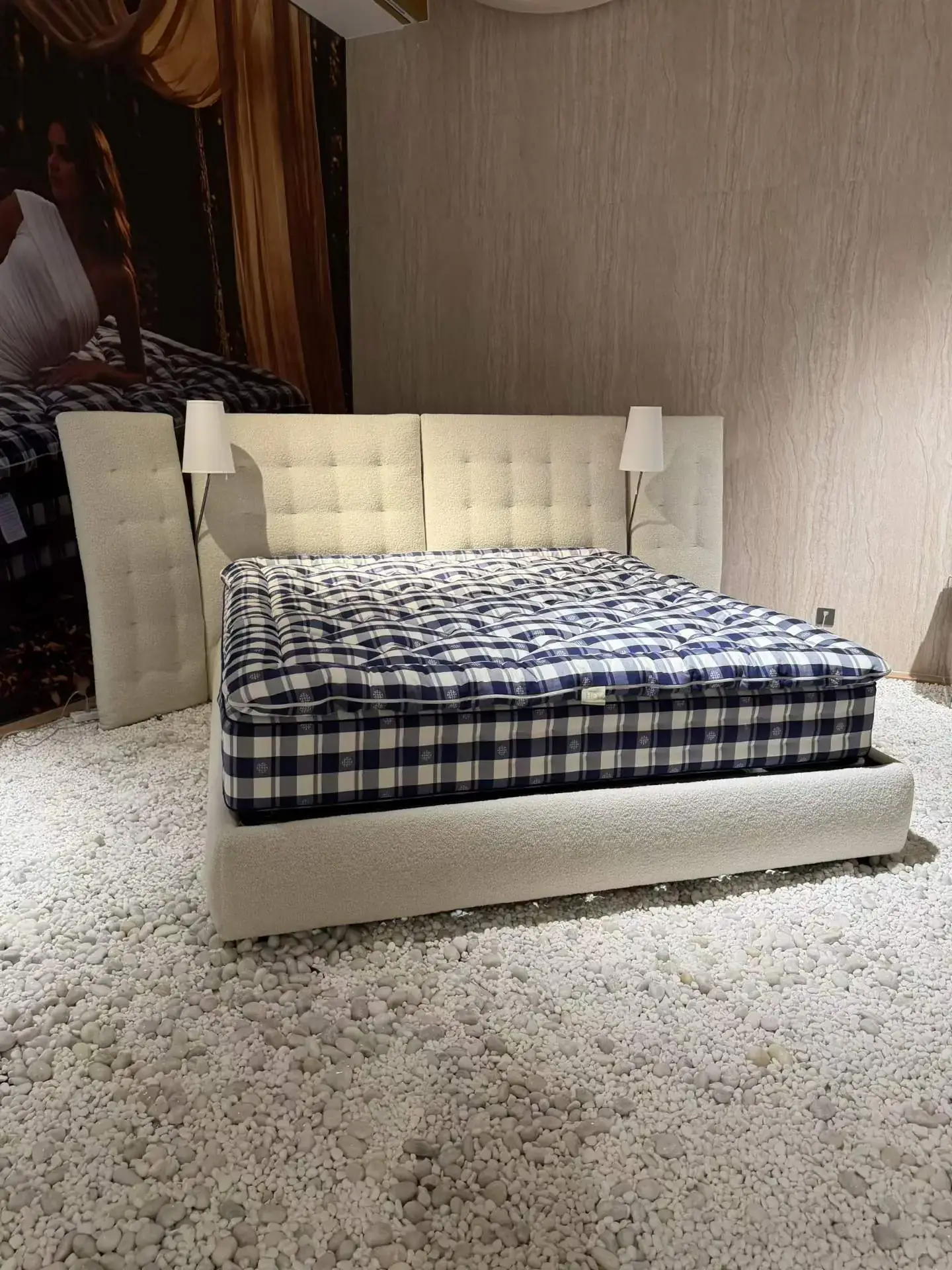
The wingback headboard and matching bench change the room envelope
The wingback linen bed and the velvet bed with a bench introduce room-planning questions that do not arise in the same way with a plain platform bed. Consider every supplied component and every projection, rather than stopping at the bed-frame rectangle.
The Off-White Wingback Tufted Linen Bed with Built-in Lamps is listed at 230 × 190 × 130 cm, with linen, solid wood, an extended headboard and reading lamps. A design team needs to confirm the full headboard width, the position and reach of the lamps, and the relationship to bedside furniture. A wing can interrupt access to a socket even when the main bed frame clears it.
For a bedroom project with finished electrical positions, overlay the headboard drawing onto the bed-wall elevation before ordering. Confirm what electrical components are supplied, the required connections and the applicable destination requirements with the responsible project professional. The product description does not establish a voltage, plug type or electrical certification, so none should be assumed.
The Dark Grey Button Tufted Velvet Bed with Matching Bench is listed at 220 × 180 × 120 cm, with velvet and metal. Its bench is visually useful at the foot of the bed, but the published overall bed dimensions do not establish the bench’s separate size or whether a particular quotation includes it. Confirm both points before treating the photograph as the complete order.
In a narrow bedroom, place the proposed bench outline on the floor plan and test the walking route around it. If a wardrobe door opens toward the foot of the bed, show that movement as well. Omitting the bench may be the better decision if it reduces access, even when the full pictured arrangement is appealing.
Upholstery approval should show the actual headboard shape
The wingback linen bed also needs a material review around the lamp mounting areas and the edges of the wings. Confirm how those visible details will be finished on the ordered version. A broad headboard view may conceal the transitions that sit closest to someone reading in bed; include clear detail views before approving the upholstered assembly.
A flat swatch communicates color and surface feel, but the boucle grid, velvet tufting and smooth leather headboards present material differently. For the boucle platform bed, review the textile over a representative padded corner and tufted area. For the velvet bed, examine the direction of the pile across adjoining sections. For the smooth leather design, study the seams and how the surface is supported over broad areas.
These observations are requests for sample approval, not claims that a particular flaw exists. Their purpose is to define the finish the buyer expects on the selected shape. A material substitution should be reviewed on that shape again; approving a color alone does not approve how the replacement material will behave around the same upholstered edge.
Cleaning expectations also belong in this decision. The Association for Contract Textiles treats abrasion, colorfastness, physical properties and other performance aspects separately. For the proposed boucle or velvet, ask for the available textile information and care instructions relevant to the intended bedroom. A fabric name is not a performance report.
For guestrooms or other repeated-use settings, define the applicable project requirements before accepting a residential-looking bed. The listed style and materials do not demonstrate contract-use testing. If documentation is required, it should identify the actual product and upholstery combination being purchased, rather than an unrelated fabric sample or a different frame.
Confirm bed components, headboard access and assembly before dispatch
Before packing, identify the headboard, rails, supports, legs and any separately supplied bench or lamps against the approved drawing. Ask how each part is protected, which hardware travels with it and what instructions the installer receives. A missing connection piece can delay an otherwise complete bedroom just as effectively as a missing large component.
Check the packed headboard dimensions against the actual delivery route. Upholstery protection increases the handling envelope, and a wide wingback headboard may be the limiting component even when the rails are easy to carry. The receiving team should confirm access using the packing information rather than assume that a disassembled bed will fit through every doorway.
HEZEN CASA’s guide to inspecting furniture before shipment can support the wider order review. For these beds, the decisive evidence is narrower: the agreed dimensions, the mattress-support interface, the upholstered finish, the complete component set and the position of any reading lights.
Approve the bed only when the chosen mattress, visible headboard and bedroom layout agree with one another. That may mean selecting the simple low platform, retaining the velvet bench arrangement, or requesting a revised wingback drawing. The useful outcome is a bedroom that can be assembled and used as intended, with no important measurement left hidden behind the words Queen or King.