Below the tabletop
Ask a Marble Dining Table Manufacturer About the Base Before Approving the Seating
A round marble top can have enough surface area and still create an awkward dining arrangement below it. Project buyers, designers and retailers should review the base, underside and chair approach with the marble dining table manufacturer before ordering a set. HEZEN CASA’s metal-base tables and dark-wood-frame two-tier design need different questions about how the complete assembly works.
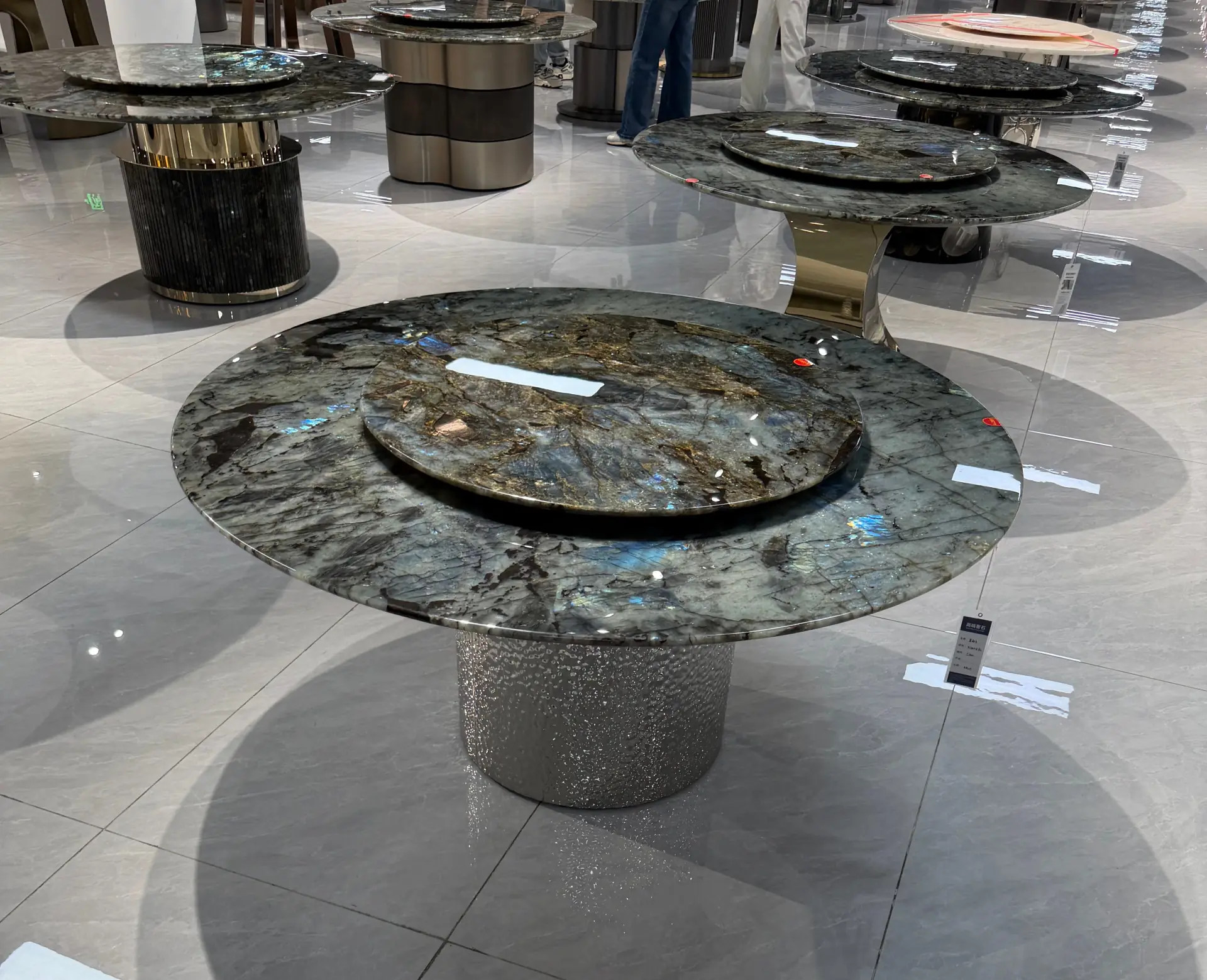
Start with the natural marble table with a lazy Susan, the dark-wood-frame marble dining table and the light crystal marble table with a gold-colored base. Review them alongside the curved-back dining chair and upholstered dining chair. These actual products let the buyer ask about a specific pairing rather than an abstract number of seats.
The marble dining table manufacturer should show the space beneath the surface
The three tables are listed at Ø150 × 75 cm, Ø160 × 75 cm and Ø140 × 75 cm respectively. The common 75 cm overall height does not establish a common underside height. A frame, support element or other part of the supplied construction can change the space available below the top. Request the relevant dimensions and views for each proposed version.
For a dining room with chairs already selected, this information can decide whether a table remains on the shortlist. For a retailer selling a complete dining group, it helps explain why two visually similar tables should not automatically be offered with the same chair arrangement. The useful comparison includes the occupied chair and the supporting structure.
The chair’s total height does not answer the knee-space question
The curved-back chair is listed at 52 × 55 × 91 cm with fabric and solid wood. The upholstered chair is listed at 54 × 56 × 93 cm with the same broad material categories. These overall dimensions do not tell the buyer the seat height, the seated user’s position or the space beneath the tabletop. Obtain the missing information or assess the actual pairing.
A taller overall chair can simply have a taller back. Do not use the 91 or 93 cm total height to estimate how the user meets the table. Keep the seat measurement, table underside and base position as distinct pieces of information. That prevents a comparison sheet from appearing complete while the decisive dimensions remain absent.
A base footprint can matter even when the tabletop is generous
Ask for the base’s actual outline at floor level and at the points relevant to seated use. The product photographs and published top diameter cannot supply every detail. Consider where the user’s feet, chair legs and movement will occur. A support that looks compact from one camera angle may be more prominent from a particular seat.
In a household dining room, someone may habitually use the same position. In a project dining area, different users may occupy every position in turn. Review the arrangement according to that use. Do not accept a pairing merely because one demonstration chair fits comfortably at the most convenient point around the table.
A different chair position can reveal a different part of the table base
When the table is round, buyers may assume that every position around it behaves identically. That needs to be checked against the actual base and lower structure. Review the chair at the positions proposed for the room, including the approach from a nearby doorway. The top’s circular outline alone does not prove that the space beneath it is equivalent everywhere.
For a showroom demonstration, it can be useful to move the same selected chair between proposed positions, following the applicable handling guidance. This keeps the chair constant while the relationship to the table changes. Record the specific observation rather than describing the table as comfortable or uncomfortable in general. The issue may belong to one placement or to one chair-and-base combination.
In a villa where the dining group stands near a wall, distinguish a base conflict from a room-clearance conflict. The first concerns the furniture itself; the second concerns where the group has been placed. A larger room will not correct an incompatible underside relationship, while a different position in the room may resolve a route problem without changing the table.
Bring the accepted positions into the final drawing with the actual chair form identified. If a later revision changes the base or substitutes another chair, the buyer can see which relationship needs review. A generic circle surrounded by identical symbols would hide that useful decision.
The two-tier marble table deserves a separate underside review
HEZEN’s Ø160 cm table is described with a dark wood frame, natural marble and a two-tier construction. Obtain the relevant view or drawing of that actual arrangement. A lower tier may affect how the table is approached and how the space beneath it is used. Its presence should be understood before the chair positions are finalized.
Do not infer the tier’s load capacity, intended storage function or clearance from the product name. Ask what use the supplier supports and what instructions accompany it. If the buyer intends to place objects there, describe those objects and the intended action. A visible horizontal surface is not automatically an approved storage shelf for any load.
Try moving the chair toward the dark-wood-frame table
Observe the whole motion of approaching, sitting and returning the chair. Look at the relevant points where the chair or user might meet the table structure. If an actual sample pairing is not available, ask for dimensions and views sufficient to assess the proposed relationship. Record what remains uncertain instead of treating a rendering as a physical trial.
A designer may prefer the dark wood frame because it relates to other furniture in the room. Keep that visual reason, but review it alongside the practical underside arrangement. If the selected chairs cannot work as intended, a different chair or table may preserve the design direction more successfully than a compromise that diners encounter at every meal.
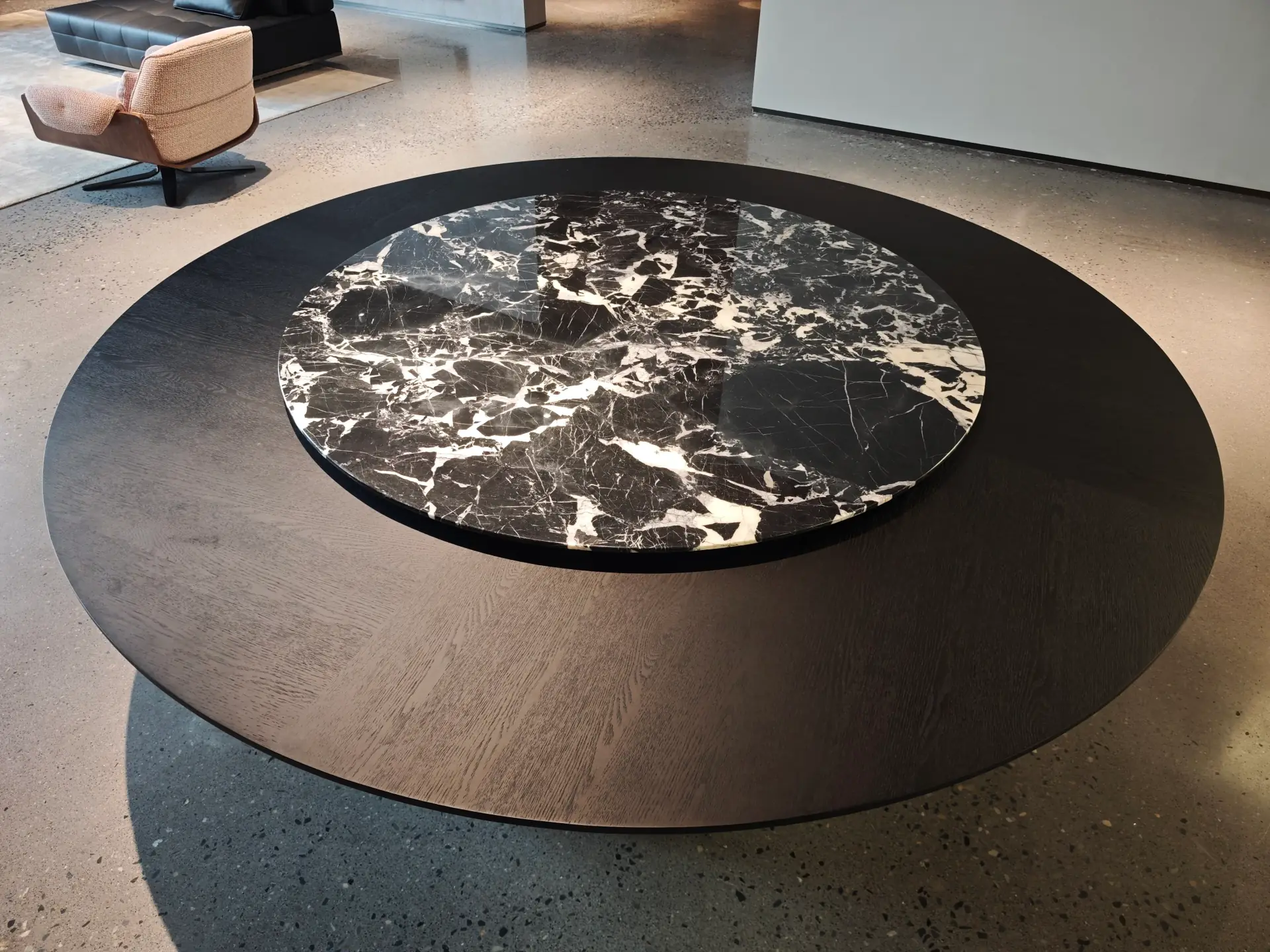
Compare the metal-base dining tables as complete assemblies
The Ø150 cm natural marble table is listed with a metal base and a lazy Susan. The Ø140 cm light crystal marble table is listed with a glossy marble surface, a gold-colored metal base and a lazy Susan. Compare the actual support arrangement of each. Sharing a material category does not establish that the bases have the same geometry or connections.
A buyer may prefer the smaller table because the room has less available space. Confirm that choice with the intended chairs and the base included. Reducing the top diameter does not automatically improve every aspect of the seated arrangement. The relevant question is how the complete table and chair group works in the room.
The rotating surface needs its own operating information
Confirm the lazy Susan’s supplied dimensions and how it relates to the main top. Ask for its operating and care instructions. The published table diameter is not the diameter of the rotating surface, and the listing does not establish every mechanical detail. Avoid specifying a load or use condition that the supplier has not supported.
For a family expecting to use the rotating surface during shared meals, consider the actual serving objects and how people will reach them. For a showroom, demonstrate only the function confirmed for the supplied version. A decorative arrangement on the display should not imply a use or capacity that has not been established.
Keep the table’s connection details separate from its material description
Natural marble, dark wood and metal describe important parts of the tables, but those words do not reveal the connection system. Ask what assembly is required and which components or hardware are supplied. The buyer needs instructions appropriate to the actual version, especially where stone and a separate base must be brought together at the destination.
The US Forest Service’s Wood Handbook treats material properties, fastenings and dimensional behavior as distinct technical subjects. That distinction is useful background: a material name alone cannot prove how a particular furniture joint is designed. HEZEN’s actual assembly information must govern this order.
A replacement base is not automatically compatible with the original top
If a buyer requests another base design or finish, identify which parts of the proposal change. A finish-only request and a different support arrangement are not the same decision. Ask whether the proposed change affects the connections, dimensions or supplied instructions. Do not match a new base to an existing top solely by diameter.
The same care applies when a project wants a spare component. Obtain confirmation of what can be supplied and how it relates to the approved table version. This does not require promising long-term spare availability. It requires a clear answer about the specific component under discussion and the conditions of the current offer.
Review assembly access where the marble table will stand
A table that fits the finished room may still require space for its actual assembly sequence. Ask the supplier how the proposed version arrives and what the receiving team needs to prepare. The public assembled dimensions should not be substituted for packed dimensions or the space needed to handle separate components safely.
For a villa dining room reached through a narrow hallway, identify the largest supplied component before dispatch. For a retailer receiving several tables together, keep the top and base identities connected through unpacking. The receiving team should not need to compare photographs and guess which visually similar parts belong together.
The lower tier should remain part of the two-tier table’s assembly record
When reviewing the dark-wood-frame option, ask the supplier to identify all included parts and the applicable assembly sequence. The lower tier should not disappear from the record because the main stone surface attracts most of the buyer’s attention. A complete part list helps the team recognize whether the delivery is ready for assembly.
Do not prescribe fasteners, tightening methods or a lifting sequence from the appearance of the table. Those decisions depend on the actual construction and instructions. If the supplier’s information is incomplete, resolve the missing point before assembly rather than substituting a method used for a different furniture design.
Make the accepted chair-and-table pairing visible in the final order
Record the selected table version and the actual chair proposed with it. Include the relevant underside and base information that resolved the decision. This is especially useful when the buyer has compared the 52 cm wide curved-back chair with the 54 cm wide upholstered chair. Their similar material descriptions do not make the completed arrangements identical.
If the chair selection changes after the table is approved, reopen the affected fit questions. Keep the original pairing as a reference, but do not treat its acceptance as approval of every later chair. A new seat height, frame shape or overall footprint may require a different review even when the upholstery color remains the same.
The stone table supply guide follows the surface and components through approval and receipt. Before reaching that stage, settle what happens underneath the table: how the chairs approach, where the support stands and how the parts connect. Approve the marble dining table as a complete piece of furniture, with an intended seating arrangement that its actual structure can accommodate.