Luxury Sofa and Rug Pairing That Works at the Edge of the Room
Plan the edge of the rug before you fall for its pattern. In a furnished villa, a showroom or an open-plan apartment, a luxury sofa and rug pairing works when the rug supports the seating you actually want to use and ends where guests can step on or around it comfortably. Trace the sofa, mark where its feet will sit and check a nearby door or major walking route. HEZEN CASA's curved and square sectionals give you two useful footprints to compare with its textured area rugs. If the rug is near the doorway, check pile, backing and any pad separately before committing to the size.
Imagine laying a rug far enough under a curved sofa to keep the inner row of seats feeling connected. It looks right in the middle of the room. Then you open a terrace door and discover the rug edge sits directly in its path. Moving the rug back toward the sofa may be an easy correction. Another option is to leave that approach completely clear and use the rug to hold a coffee table and a separate chair rather than insisting that the full seating arrangement be inside it. The right position depends on who walks across the floor and when.
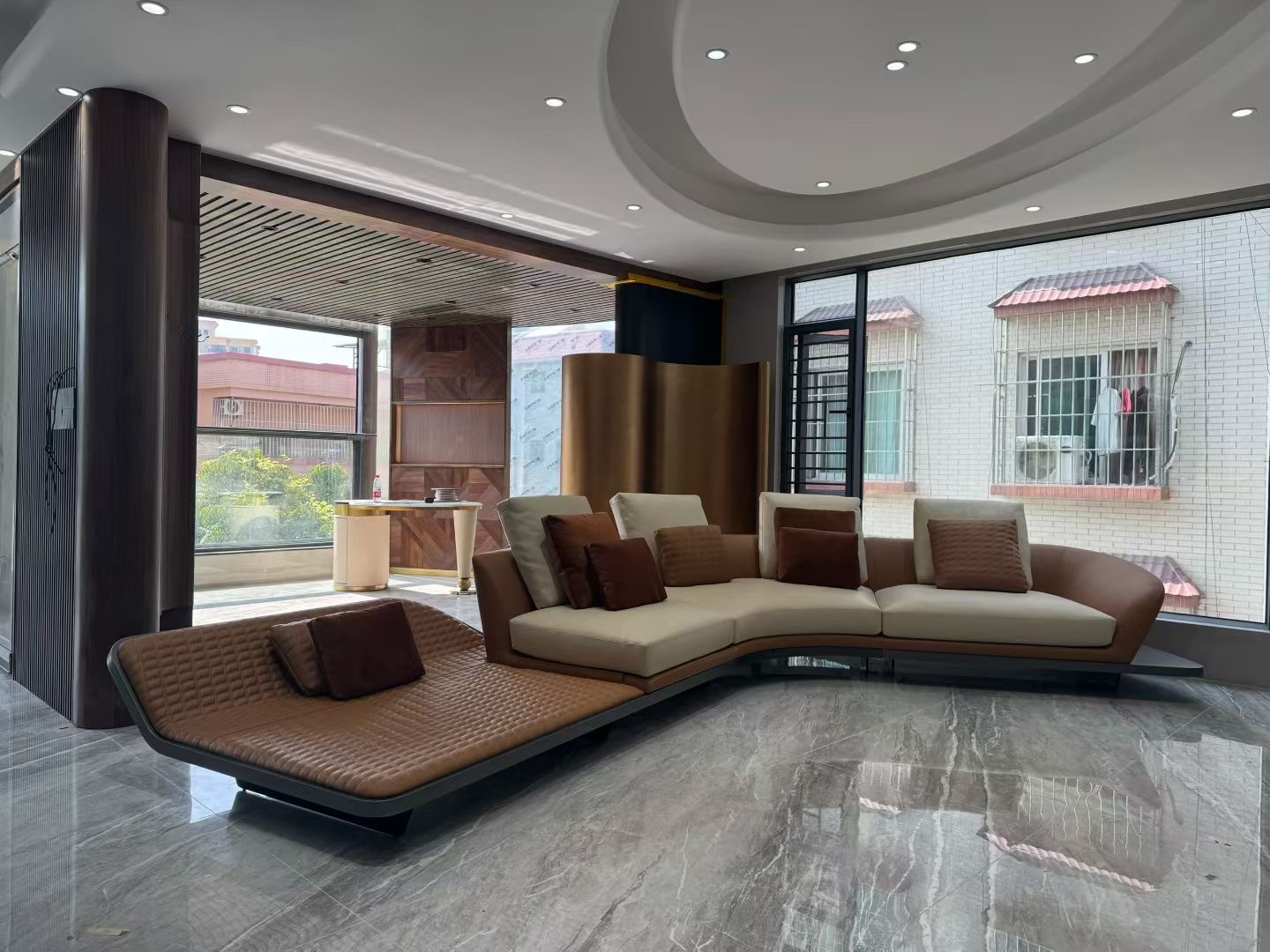
Choose which parts of the sofa should sit on the rug
Lay the rug outline down first, then mark the individual furniture supports on top of that outline. Some buyers want all feet on the rug. Others can use the front supports on it if the supplier's product setup allows that and the difference in height is acceptable. A rug can also be centred in the open area where no sofa feet are on it. Whichever scheme you choose, check support placement on the actual configured sofa. Measuring the edges of an upholstered arm will not tell you where a support touches the floor.
Draw the curved sectional over the off-white ribbed rug
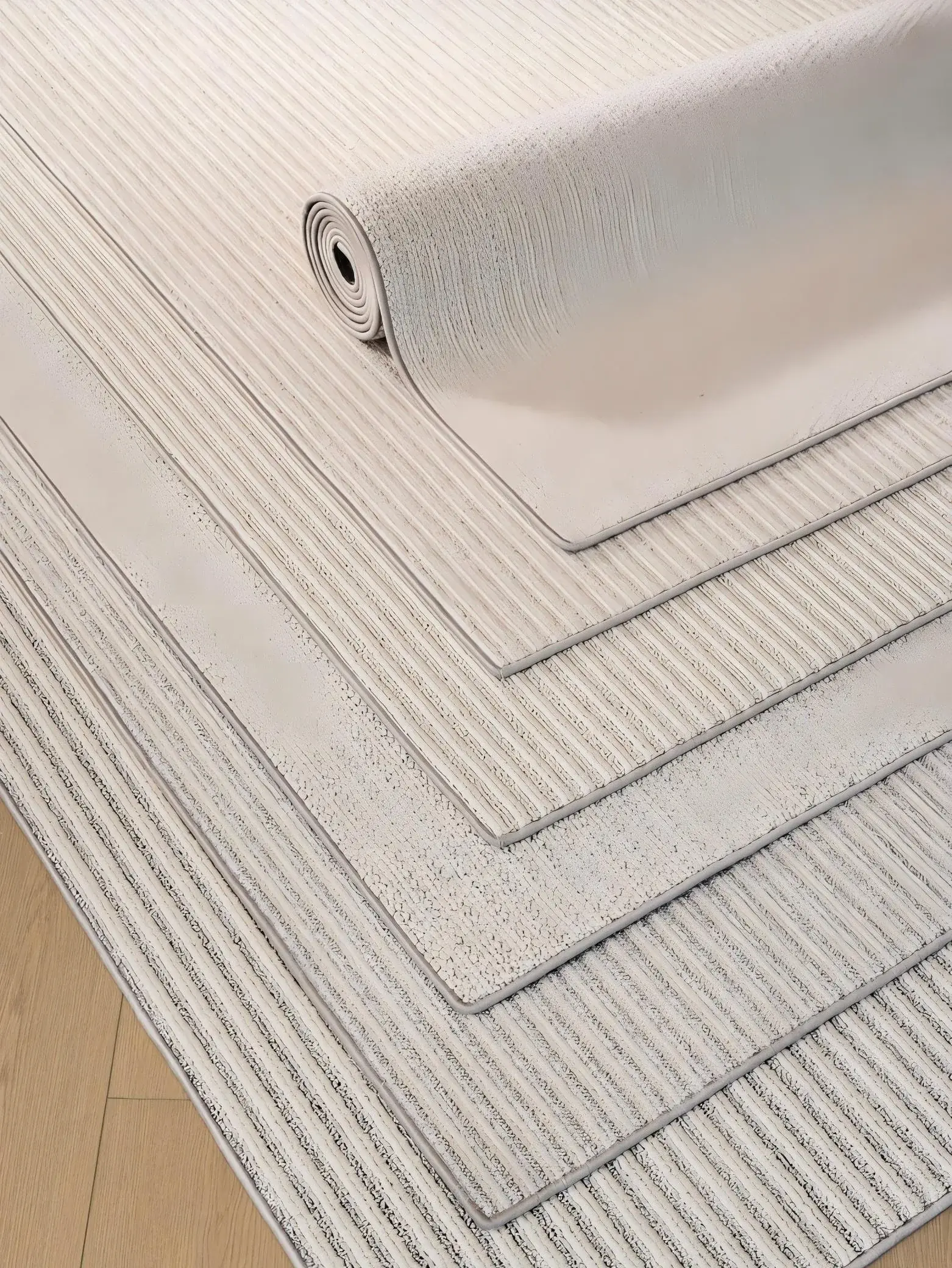
HEZEN CASA's Off-White Large Curved Sectional Sofa is listed at 300 × 180 × 80 cm and uses bouclé with solid wood. The Vertical Linear Textured Solid Area Rug has a 200 × 300 cm listed size and a 22 mm pile. A 300 cm rug side is the same length as the sectional's published outer width. If you center those outlines, there is no extra length for the rug to extend beyond both outer sofa edges. That comparison is available before you decide if some supports can stay on the floor or the rug should turn. Use the true footprint at the upholstery and the real support positions to make the final choice.
For a villa with a door near one end of this curve, try the 300 cm edge along the longer sofa run first. Draw the sweep of the door with the expected rug thickness including any planned pad. Mark the area immediately beyond the door where a person would turn toward the seats. If that brings the edge into their path, leave more floor showing on the door side and shift the sofa group before changing the color or texture. A small sample by the actual threshold tells you more about clearance than the rug photo.
Let the full-grain cube sofa keep a deliberate strip of floor
The Black Full Grain Leather Tufted Cube Sectional Sofa measures 320 × 180 × 80 cm in its listing, with full-grain leather and solid wood. It has a wider listed run than the off-white model. A shorter rug under the inner area can still work if the floor beyond both ends looks intentional. Try using the darker sofa as the fixed outline and choosing the rug position by the supports nearest the main sitting area. It may be useful to keep a strip of exposed floor near one end where people can turn without stepping over an edge.
A floor display for a dealer illustrates the difference. In a tight consultation bay, visitors often approach the black sectional from the end and stop to look at its seam lines. Put the rug's edge too close to that end and they will stand on the edge while looking at the upholstery. Mark the route with tape and stand where someone would naturally stop. Bring the rug farther into the furniture arrangement if it needs to leave that position open. Then see if the nearer edge still makes a useful boundary under the coffee table. The buyer learns more when a floor sample is easy to approach.
Use the rug edge to distinguish lounging from circulation
Try the different alignments with the plan seen from the entrance and from the seats. The larger rug can extend the seating area on one side; a smaller rug can leave more clear floor. If the longer edge runs across a busy route, a large rug may be better turned before choosing another size. Mark the route a person takes carrying a tray and the point where they first turn toward a seat. The edge is most useful when neither person has to think about it.
Compare the low-pile grid with the thicker ribbed rug near doors
The Vintage Distressed Grid Embossed Area Rug is listed at 160 × 230 cm in polypropylene and cotton with a 12 mm pile. You get a shorter and narrower outline as well as a lower listed pile than the ribbed 200 × 300 cm rug. Visualize this rug around a quieter, more compact conversation area or under a low coffee table in front of the sectional. In a wide furniture group it may look as though the table is the only object attached to it. That could be exactly right if the sofa has to stay off the rug and the room needs a clear perimeter.
The 12 mm number is a pile dimension, not a promise of the total thickness at the edge or where layers overlap. If a door is involved, check a finish sample, the actual door gap and the edge construction. With a pad, check the build-up in the location the door passes. If the swing is close enough that a few millimeters would matter, leave more distance on the plan. At a threshold where the carpet should not continue, show its end relative to one fixed wall or jamb rather than centering it by eye after delivery.
Use the medium brush-stroke rug when a narrow area needs more length
With a listed size of 180 × 270 cm and a pile of 14 mm, the Gradient Brush Stroke Textured Plush Rug sits between the 160 × 230 and 200 × 300 examples. The product specifies microfiber and polyester. Its longer run can tie a table to a seat where the smallest rug would stop short. The 180 cm side may be easier to place than a 200 cm edge where a passing route runs parallel to the sofa. Mark the supports and then switch the rug's direction. A mottled pattern seen across the room may change character when turned, so check the intended orientation while you are comparing the travel paths.
Where two adjoining floors meet, let the room itself decide where a more expressive rug should end. A small drawing often flattens the change between smooth boards and textured stone. Bring a representative rug sample near that join and look back from the group. If both the textile and the flooring naturally pull attention toward their own separate edge, you may prefer a calmer pattern or to move the carpet fully to one side. In a buyer's drawing, the reason can be as concrete as preserving a visible strip of the client's existing floor rather than replacing a product based on a screen sample.
Look at both directions of the ribbed texture before you pick the rug's orientation with the 300 cm sectional. Ribs drawn toward the window can make a short gap between the carpet and glass seem very deliberate. Pull the same ribs across the room and they may lead from seat to seat without drawing attention to an adjoining door. The 200 × 300 cm outline may fit the space in both positions on paper, although only one leaves the main supports and route where you need them. If the motif has a clear direction, note that on a drawing alongside the long side of the rug. “Place under sofa” is open to a ninety-degree interpretation when the installers begin in an empty space.
Check the sofa and rug pairing in use before signing the layout
Manufacturer examples such as Mohawk Home's rug size guide illustrate different relationships between rugs and furniture legs. Their examples are a useful visual starting point. A purchase still comes down to the actual HEZEN CASA product dimensions, the selected setup and the real flooring. Use the confirmed order information from the Foshan furniture maker and draw the specified floor pieces for your own room. It is easy to mix a catalog outline from one example with a material sample from another when two alternatives are being considered at the same time.
Watch the gap where rug, table and sofa meet
Put both furniture and rug on the mock-up. Check the raised line of the carpet near the coffee table and around the after-dinner approach to the seats. If the table is moved regularly for gatherings, mark a position where it sits firmly on the planned surface. Check how a pad and the rug come together at that edge. A support placed partly across the edge may no longer sit the way it did during the trial on a hard floor. Keep any care, grip or compatibility check with the exact rug and floor finish.
Ask someone to sit in the deepest part of the sectional, then stand up and walk to another room. They may step exactly where the rug turns or where a long edge has been drawn across their exit. Try the same route with a hand occupied by a book or a mug. You may find the short grid rug should sit farther under the table or that the long ribbed rug would be less useful in the original position. If the route turns across a modular corner, check it with the modular sofa layout guide before changing only the soft floor covering.
Keep the housekeeping route in this drawing if the display floor will see frequent furniture changes. Ask whether the coffee table has to move to clean both sides and whether the rug could be returned to the same place afterward. If the black sectional and one of the smaller rugs will be paired for short promotions, a simple offset from the near end of the 320 cm sofa makes the old placement reproducible. Gather the flooring and rug care information with the display record so staff know which surfaces they are working on. A cleaning step suitable for the exposed hard floor does not automatically belong at the fiber edge. Check the maker's instructions, particularly if the showroom wants a pad that will remain when the furniture changes.
On a floor plan that will circulate to a buyer and an installer, use separate lines for the full upholstered width, where the feet land and the final rug boundary. Set out the rug from a fixed surface with the chosen long side marked. Add the specific thickness or door check only when it has been confirmed on a physical sample. The next person can then see both how the furniture should sit and which edge is intentionally exposed.
Leave the tape on the floor until somebody has walked through the room as they would on delivery day. If the door opens fully and the two most useful seats still belong to the same visual group, you have a practical reason to order that rug size. Give the manufacturer the exact product and orientation references that made it work. A sample under your feet is often the quickest way to settle the last few centimeters.