Luxury Coffee Tables for Formal Living Rooms Where People Actually Sit
Before you choose a formal coffee table, put out the tray and glasses you would serve to a guest. See how much surface they need beside anything that will stay on the table. A villa living room, private reception room or hotel residence can use the table as a focal piece and give each guest a comfortable place to set a drink. Decide which furniture belongs within reach from the seats you actually use. The marble, travertine and solid wood tables from HEZEN CASA, a Foshan furniture manufacturer and supplier, offer ways to make the middle of the room useful while giving it a clear visual purpose.
Start with what a luxury coffee table will hold during a visit
Some formal living rooms need a tabletop for most of the visit. Others need it for the first two minutes, when someone brings in a tray and everyone finds a place to put a cup. In either case, compare furniture with the finished room rather than the amount of open floor. Set down the intended service tray somewhere you can see it easily. Put nearby the books, flowers or decorative pieces that are normally in the room. If one group covers the other, choose something that moves easily and a surface where it can go. The table should still look right in the ordinary empty-room view.
For a quiet first impression, pick the viewpoint where a guest usually stops before sitting down. If it is the threshold, the top and the edge of the table will both come into view. If it is a narrow turn near the sofa, the edge may be all they see until they move across the room. Put the height of the tallest permanent object into that sketch. A high arrangement that looks appropriate from the door could come between two guests once they sit. Decide whether the main design feature is the tabletop itself, an object on it or the conversation across it.
Let a green marble coffee table show its surface around the tray
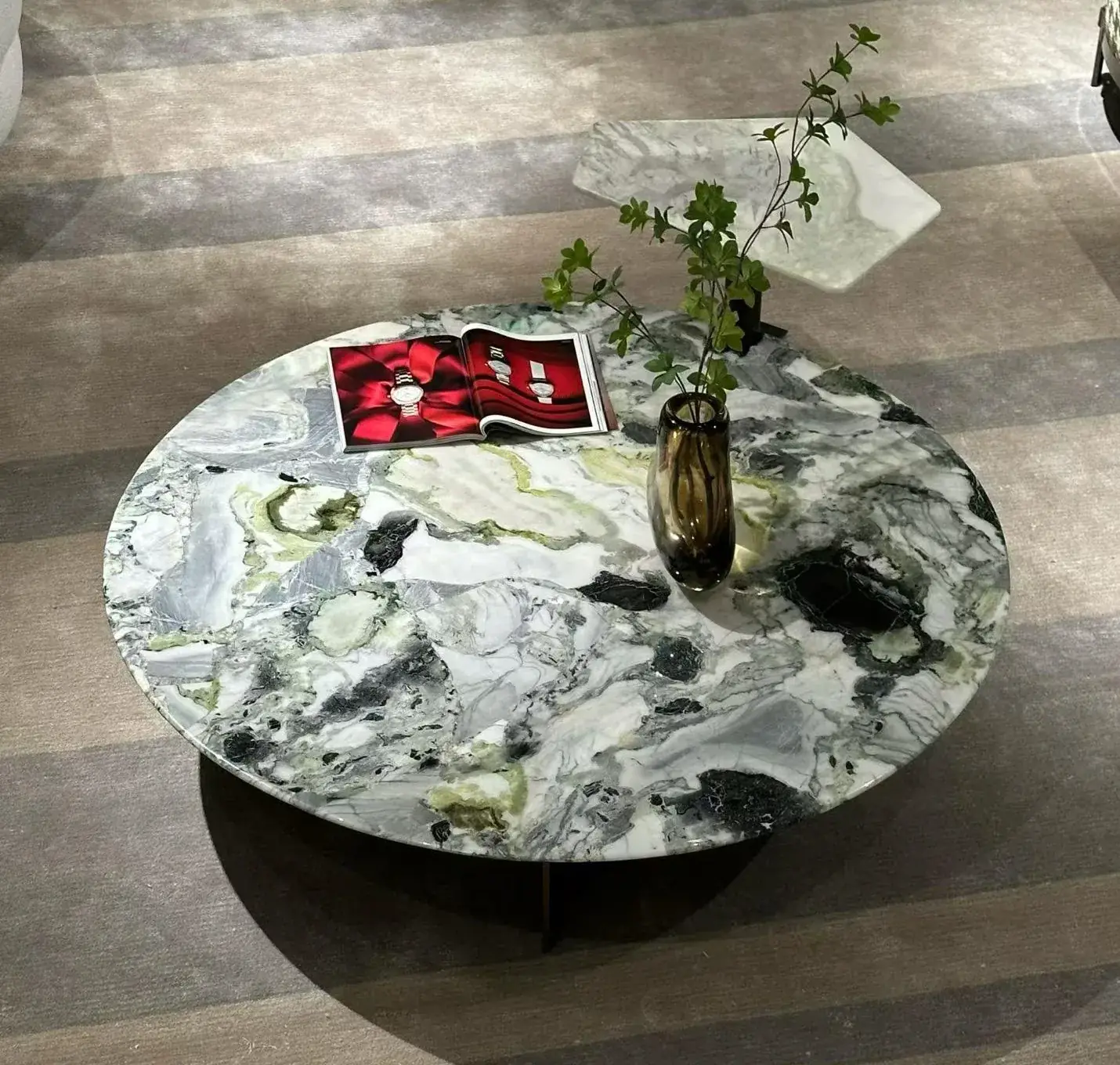
The catalog photo of the Round Green Vein Marble Coffee Table shows a strongly veined green top with small objects on it. The model is listed at 90 cm in diameter and 40 cm high, in natural marble and metal, with a published weight of 40 kg. It makes sense where the client wants the material to hold a viewer's attention as they approach. Put the tray you plan to use on a 90 cm circle drawn at full size. Off center, a broad rectangular tray can leave points where a cup fits easily and others where the useful surface is very narrow.
Imagine a villa reception group set around two facing sofas. If the centerpiece has strong green marble, a low bowl at one edge may show more of the stone from the entry and leave a clear place for glasses. Sit in the farthest chair used for conversation and see whether a guest could set a glass down while remaining seated. If that seat is too far from the circle, add a small surface nearby. Changing to a larger coffee table might give the far seat more reach at the cost of making the area by the closer sofa harder to enter.
When someone serves drinks from the front of the seating group, use the photo to check what part of the marble still reads under the tray. From a standing position, you see most of the round top. At sofa height, a busy arrangement can put objects across the first band of veining. Look from both positions with the proposed tray in the sample layout. If the stone is the reason for the table, its strongest feature deserves enough space to be visible at the visit's busiest point as well as in a spare room before anyone arrives.
Use the irregular travertine table where the tray has a broad landing point
HEZEN CASA’s Irregular Travertine Stone Metal Coffee Table pairs a natural travertine top with a curved metal frame. Its published overall dimensions are 120 × 60 × 40 cm and the listed weight is 55 kg. That envelope is helpful for early planning. The photo shows an outline with narrower and wider areas, so a serving tray needs its own check. Mark the intended landing point on a full-size outline or ask the supplier how wide the top is at that position. A person walking toward the table with a loaded tray should be able to see where its four corners can rest.
That model can suit an interior where the client prefers a restrained stone appearance and still wants an identifiable profile. Imagine a bay with upholstered seats facing an outer view and a side chair at one end. The longest part of the irregular table could face the seats most often used for coffee. The narrower portion leaves the adjacent chair a different surface to reach. Rotate the outline on the drawing before deciding which way the table faces. The shallow edge that makes the view from the door feel open may be where someone expected to set something down during a visit.
Once the orientation is settled, ask how the selected table and base are delivered into the room. The product weight can flag an issue early, even though it does not establish package dimensions, packaging method or whether the top and base arrive together. Look at the narrowest turn and the protective staging area before you buy. A buyer who wants a 120 cm feature table toward the back of a private lounge should check that the delivery team can handle the specific package and set the top down in its final direction without shifting other finished furniture.
Choose a formal living room coffee table with the guest’s seat in mind
In a formal room, a guest can be too far from the central table even when it looks properly centered on a plan. Get someone to approach and sit in each of the important positions. Ask where they would instinctively put down a glass. A pair of deep sofas and a single lounge chair can have very different reaches. Keep a note of which seats are used for drinks and which are mostly for short conversations. The solution may be a more useful central shape, or the central table with a separate place for the farthest guest to use.
Compare two lower tables when the room finishes are already strong
The Italian Minimalist Marble Top Coffee Table is listed in marble and metal at 115 × 68 × 36 cm. The Italian Minimalist Solid Wood Coffee Table is listed at 120 × 70 × 38 cm. Both can be considered where a designer wants a lower profile to leave the furniture grouping and sightlines uninterrupted. Ask for a drawing and a finish sample for the specific piece. The material and overall dimensions tell you which type to start comparing. The side profile and actual usable surface give you a better sense of what it can do at the center of a room.
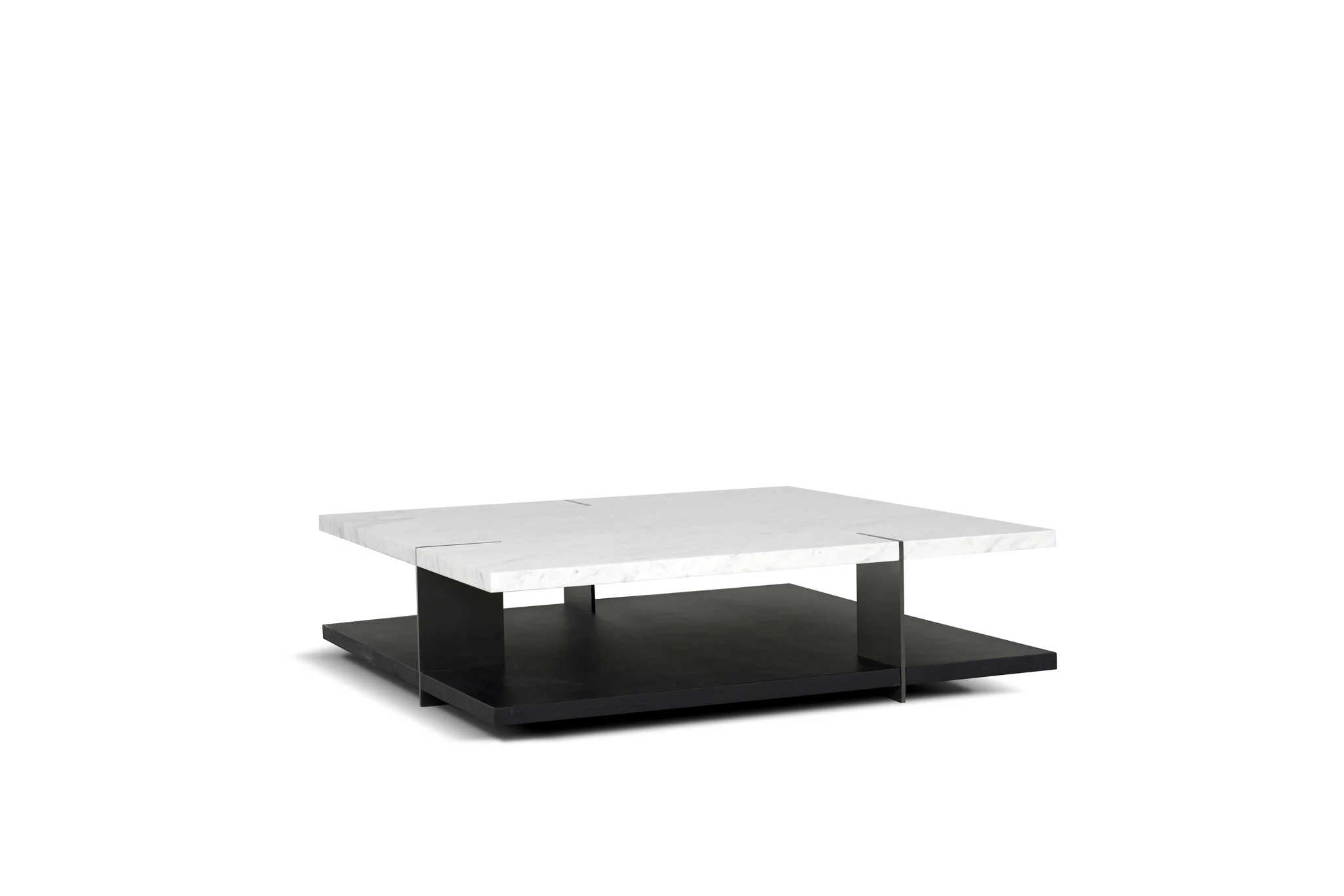
A hospitality designer furnishing a private lounge may want the lighting and textile finish to carry most of the room's color. In that case, compare a solid wood candidate and a marble top from the seats first. Set one neutral tray at the same position on each sample. Stand back by the doorway and consider whether the table has enough definition against the floor without a styled arrangement. The actual wood finish can bring a warmer note to a room already furnished with metal and stone, while a marble option may feel particularly appropriate when a few visible veins are part of the palette.
Height also determines what it feels like to pick up a cup. The table's height from the floor is set, but deep seats and softer cushions change how a guest's body meets it. A table two centimeters higher on paper might still require more reach if the chairs are set farther away or have deeper arms. Keep the catalog height on the selection list and test the reaching motion at a mock-up. HEZEN CASA’s coffee table size guide helps check the overall footprint. Here the crucial comparison is whether a guest can reach the specific clear part of the top.
Give the guest at the end of the sofa a place for a glass
Look at a separate side surface if someone at the end has to lean all the way forward to reach the center. The Italian Minimalist Side Storage Table is listed at 45 × 40 × 55 cm in solid wood, with a single storage drawer. For a chair near the room edge, that scale could leave the coffee table free for shared service. Ask the supplier to confirm the top form, footprint and drawer opening on the selected configuration. The drawer could hold a spare coaster, but its position should leave a clear route past the chair.
Room & Board’s accent table planning guide compares placing tables next to seats with putting them in the center. Work out the exact side and height for your chair. A side surface should be within easy reach of the arm from a seated position, and the visitor should still have a clear place to stand. Test an existing side table or a stable mock-up, then put down one coaster and the widest glass that will usually be served.
A side table can also prevent the coffee table from taking on a storage job. Move remotes and small odds and ends to the side if the furniture provides a place to put them. That leaves the main surface available for serving and gives the stone or wood a clearer view. In a formal room that also hosts family use, a second surface can make the group look ordered without asking everyone to clear the central table between casual and formal visits.
Leave a rough floor outline for the separate table during the seating test. A chair placed at an angle often leaves a small patch of unused floor on one side. If the side table goes there, a guest can still use it when the chair moves for a larger group. When the space between seats becomes a main walkway, keep the small table away from the path. Check the way a sleeve or a bag moves past the tabletop with the glass already on it. This test can make a narrow side surface more valuable than a large center table nobody can reach.
Set up the coffee table once for service and once for the room view
Make two arrangements with the sample or a full-size mock-up. In the first, put out whatever lives on the table most days. In the second, move those objects to their planned place and bring in the tray, glasses and dish the room will use at a reception. Natural stone finishes merit a little more attention as you test the second plan. The Natural Stone Institute’s care guidance explains why coasters and suitable mats are helpful in regular use. Ask HEZEN CASA for finish-specific care instructions and check your intended accessories against those instructions before they go in the furniture order.
For a hotel residence or club, tell the person setting up the room which of the two layouts they should leave at the end of service. A marked photo can identify a coaster set that stays in the side drawer or a tray that only comes out when drinks are served. When material options are close, choose the top that is most convincing in the reset photo. It will spend much more time in that condition than it will in a photo taken for opening day.
Put the serving plan in the same order notes as the table model and dimensions. Keep a photo of the approach and one from an occupied seat. Mark whether the tray always lands in the center, whether the most distant guest uses a side table and what part of the top should remain in view. The room will probably be quieter with fewer things permanently on the table. When someone brings in a tray, there should already be a place for it without anyone having to hold a vase while the drinks are poured.