Living room surfaces
Choosing a Luxury Coffee Table Supplier Around Reach, Movement and Real Use
A coffee table should earn its position between the seats. For a designer, villa buyer or furniture retailer, begin with what people will place on it, how they will reach it and whether it will stay in one location. HEZEN CASA’s travertine, green-vein marble and low wood-and-metal tables offer different answers. Confirm their actual outlines and handling information before approving the room arrangement.
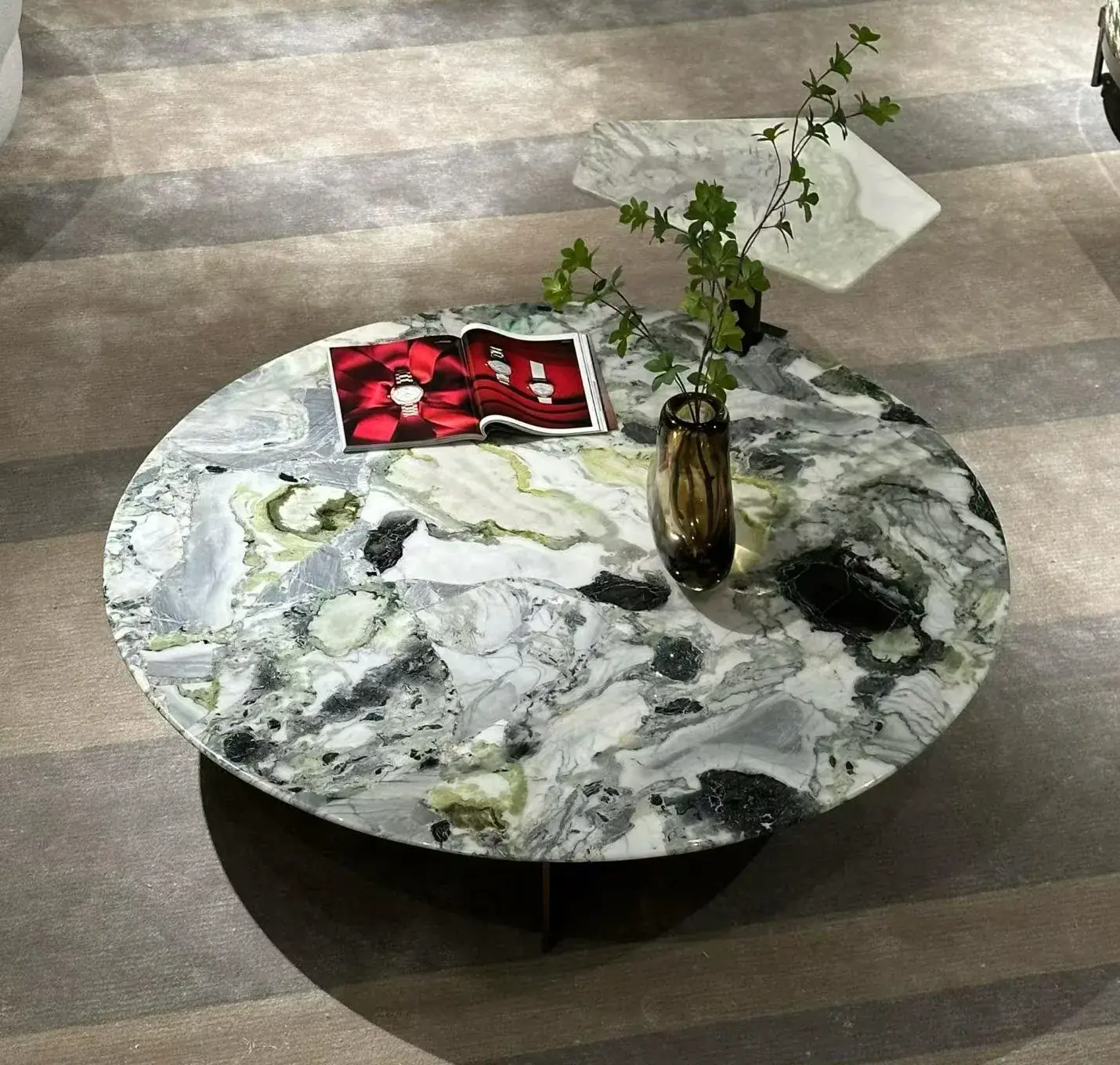
The relevant choices include the irregular travertine coffee table, round green-vein marble coffee table and low wood-and-metal coffee table. Compare them with the burgundy-and-white sectional or off-white curved bouclé sectional in the same plan. A beautiful isolated table is not yet a usable seating group.
Ask a luxury coffee table supplier for the surface people will actually use
The first question is not which material looks most expensive. It is whether the table supports the intended activity. A quiet reading seat, a family conversation area and a formal reception lounge place different demands on the surface. Identify the activities that genuinely belong there, then decide whether one central table can serve them or whether the arrangement needs to change.
For a family lounge, imagine a person placing a drink while another stands up from the sectional. For a furnished display suite, imagine visitors walking around the seating without using the table at all. The first scenario emphasizes reach and shared use; the second makes circulation and the clarity of the room important. Neither can be judged from the table’s finish alone.
The 32 cm wood table sits differently beside a sofa
HEZEN’s designer low coffee table is listed at 110 × 65 × 32 cm with a solid-wood-and-metal construction. That 32 cm height deserves attention when the table is paired with the selected sofa. Obtain the relevant seat information or assess a representative arrangement. Overall sofa height is not seat height, so comparing the table with the sofa’s published total height would be misleading.
A low profile can suit the visual composition, but the buyer should still test the intended reach. If the table will mainly hold decorative objects, the use differs from a table that someone will repeatedly reach for while seated. Do not describe one as universally better. Match the form to the activity and be explicit about the tradeoff the room accepts.
The travertine table’s 120 cm length does not describe every edge
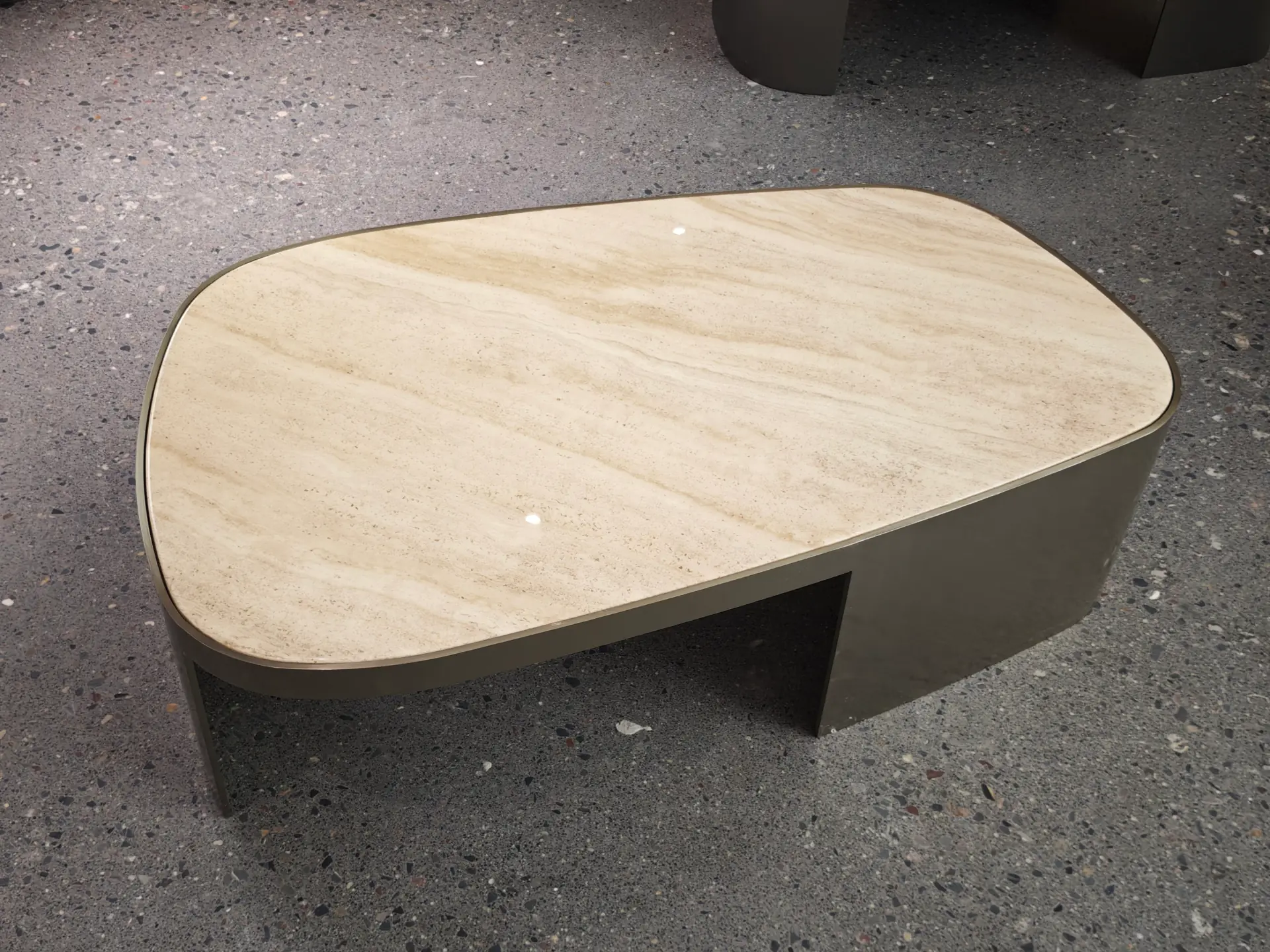
The irregular travertine-and-metal table is listed at 120 × 60 × 40 cm and 55 kg. Its irregular outline means the maximum dimensions alone do not explain the usable surface at every point. Request an outline or suitable views if the table must sit close to a curved sofa. A rectangular envelope can help reserve space, but it cannot establish every reach distance.
The listed 55 kg is a product weight, not a confirmed packed weight or a handling method. If the room will be rearranged often, discuss that practical condition before choosing it. Obtain the supplier’s instructions for moving the actual table and its components. An occasional room refresh should not depend on an improvised lifting plan.
Compare round marble and irregular travertine beside a curved sofa
The green-vein marble coffee table is listed at Ø90 × 40 cm with a metal base and a product weight of 40 kg. Its circular outline provides a different relationship to the seating than the elongated travertine option. Draw both with the actual sofa outline. A circle may simplify the visual relationship, but it does not automatically create enough space around every seat.
The off-white bouclé sectional is listed at 300 × 180 × 80 cm, while the two-tone Nappa sectional is listed at 320 × 180 × 85 cm. These are different furniture envelopes, and their forms should be reviewed separately. Do not position the same coffee table at the center of both bounding rectangles and assume the seated relationship will be equivalent.
The chaise seat and the inward-facing seat may need different reach
A person using the chaise may approach the table from a different direction from someone sitting along the main section. Identify the seats expected to use the central surface. If the proposed table serves only one position comfortably, decide whether that is acceptable or whether the arrangement needs another solution. Do not force the table closer if that blocks the route into the sofa.
For a villa lounge intended mainly for conversation, the table can help define the group without being equally accessible from every position. For a compact apartment where the same surface carries more daily use, uneven access may be a bigger compromise. The buyer’s routine should determine which concern receives priority.
Place the actual objects expected on the table in the review, even if only as measured outlines. A tray, books or decorative piece reduces the remaining usable area. Avoid judging surface capacity from a photograph with one carefully positioned object. The purpose is to understand the table’s role, not to fill it to its edges.
Stone coffee table selection needs an appearance decision and a care decision
Travertine and green-vein marble should not be treated as interchangeable because both are stone. Examine the proposed material appearance and ask for the care guidance applicable to the supplied finish. The Natural Stone Institute’s care guidance supports using stone-appropriate cleaning methods; it does not certify the finish or treatment on these particular tables.
A green-vein surface can become a strong visual element in a quiet room. Review the proposed appearance with the sofa covering and nearby finishes. Ask how the supplied stone will be represented for approval and what variation the supplier expects. A reference photograph should not be mistaken for a promise that every future tabletop will reproduce the same pattern.
Keep the travertine surface reference connected to the ordered top
For the irregular table, identify which images or samples describe the proposed top and which are general references. Ask the supplier to clarify the surface treatment and edge appearance. The buyer should be able to compare the delivered piece with an agreed reference without inventing an acceptance standard after arrival.
In a reception lounge, the person choosing the table may not be the person maintaining it. Pass the applicable care information to the team that will use it. Do not select a cleaning method solely because it works on another stone item elsewhere in the building. The table’s material and finish need their own supported instructions.
The wood-and-metal table needs its own care discussion as well. Its lower weight cannot be assumed because no verified weight is being used here, and its finish should not be described as resistant to a particular exposure without evidence. Compare the actual information supplied for each option rather than filling gaps with expectations about the material category.
Choose a coffee table for its expected moves as well as its permanent position
A retailer may rearrange a sofa display to introduce a new covering or chair. Before selecting the 55 kg travertine table for that position, discuss how the actual table may be moved and what resources the showroom can provide. The decision is not that stone must be avoided; it is that repeated movement belongs in the purchasing brief from the start.
By contrast, a villa buyer may intend the green-vein marble table to remain in one carefully planned position. The main concern may be the view of the stone, the reach from the sectional and the space for cleaning around it. Review that arrangement on its own terms rather than transferring the showroom’s priorities to a permanent domestic setting.
The low wood-and-metal table can be evaluated as another design route, but missing weight or handling data must still be requested. A material category is not an operating instruction. Ask about the actual supplied construction and how it should be lifted or assembled. Avoid treating an apparently lighter visual form as permission to move it casually.
If the table will be relocated between rooms, retain the approved placement and handling information with its identity. That helps the next room planner understand which decisions need reopening, including the relationship to a different sofa height or a narrower route. A successful first arrangement does not establish that every later location will work equally well.
Confirm what arrives before assigning the coffee table to an upper floor
A project buyer may approve the table from a room plan and later discover that the delivery route was never reviewed. Ask whether the selected table is supplied assembled or in components, together with actual packed dimensions and handling instructions. The published furniture dimensions are useful for placement but do not define the shipment.
For the 55 kg travertine table and 40 kg marble table, keep product weight separate from packed weight. Confirm the support and protection proposed for the actual top and base. Do not prescribe a crate or a lifting method from the public listing. The supplier and receiving team need to agree a handling approach appropriate to the supplied furniture.
A stone top and its base must remain identifiable through unpacking
If the components arrive separately, the receiving record should connect the correct top, base and supplied hardware. Ask for the assembly information before the delivery is opened. A visually similar base should not be matched by guesswork when several furniture items arrive together. Clear identification helps preserve the relationship approved during purchasing.
Plan a suitable place for inspection and temporary storage according to the supplier’s instructions. The receiving team should not need to balance an unassembled stone surface while searching for its paperwork. If the permanent room is not ready, discuss the interim arrangement before dispatch rather than treating the corridor as an automatic storage location.
A retailer expecting to move a display between floors should raise that use during selection. The decision includes repeated handling, not just the first arrival. Ask what the actual construction permits and which instructions apply. A table that works well in a permanent villa position may be a less practical choice for a display that is frequently rearranged.
Approve the coffee table from the seat and from the walking route
The final review needs two viewpoints. From the seat, consider the surface height, reach and objects placed on it. From the route, consider the outline and the space people need to enter or leave the seating group. These views can reveal different problems, especially when a curved sectional surrounds only part of the table.
The curved sofa room-planning guide considers the path around the seating itself. Combine that thinking with the chosen table’s real outline. If the arrangement requires a smaller or different surface, resolve that before the sofa and table orders become separate commitments.
Choose the travertine table for a room that can support its shape, appearance and handling requirements; consider the round marble option where its circular surface serves the group; assess the low wood table where that lower relationship is intentional. Keep the decision tied to how the room will be used. The strongest composition is the one whose attractive objects still make sense after people sit down.