Left Facing vs Right Facing Sectional: Confirm the View Before Ordering
Stand in front of the sectional and look toward its seats. That is the usual reference for “left-arm facing” and “right-arm facing”: the arm is on your left or right from that viewpoint. It is not the view of someone sitting on the sofa. When comparing a left facing vs right facing sectional, confirm whether the label refers to an individual arm, a chaise or the complete arrangement, then mark the chosen configuration on a room plan.
This matters especially when ordering remotely for a villa, apartment or showroom. HEZEN CASA's modular and chaise designs offer several possible shapes to discuss, but a product photograph does not establish that the opposite arrangement is available. Send the selected design with a viewing arrow and room references. A confirmed drawing is much harder to misread than a message that says only “left side.”
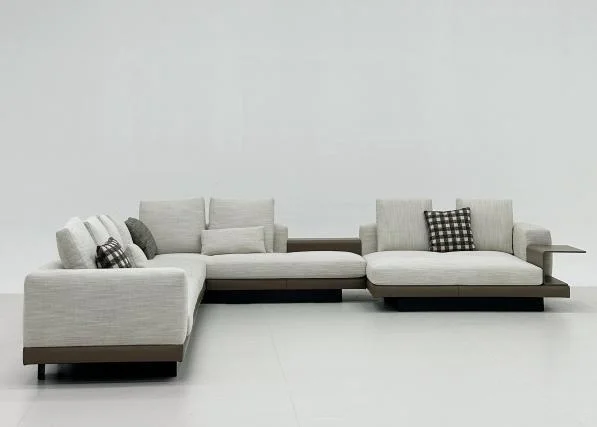
Left facing vs right facing sectional depends on where you stand
The same physical end changes sides when you move from facing the sofa to sitting on it. That simple reversal causes surprisingly expensive confusion. A designer may describe the view from the room entrance while the buyer imagines sitting in the centre, and both can believe the direction has been agreed.
Use an explicit sentence with the image: “Viewed from the front, looking toward the seats.” Draw an arrow if the image is angled. Then identify the actual feature: an arm, an extended chaise, a corner or a side table. This separates the viewing convention from the furniture feature being ordered.
The facing convention is explained in Crate & Barrel's sectional selection guide. It is useful background terminology. For a HEZEN order, the supplied configuration still needs to be confirmed directly; do not assume that another retailer's naming system defines the selected product.
| Phrase in a discussion | What remains unclear | A clearer record |
|---|---|---|
| Chaise on the left | Left from the front or from a sitting position? | Chaise marked on a front-view image and room plan |
| Left-arm facing component | Which component, and how does it join the others? | Component reference with the arm shown on its drawing |
| Same as the photograph | Which image, and has it been mirrored? | Saved reference image linked to the approved arrangement |
| Reverse the sofa | Mirror the design, rotate it in the room or rearrange modules? | A revised configuration drawing stating the intended change |
Mark the return on the minimalist linen sectional
The Minimalist Linen Fabric Modular Sectional Sofa is listed at 280 × 160 × 75 cm. Those dimensions help establish the space the listed arrangement occupies. They do not tell a purchaser that its return can be moved to either end.
Circle the projecting section in the reference image and place the same mark on the plan. If a different orientation is required, ask for that exact offered arrangement to be shown. Do not approve a reversed illustration as proof that the furniture can be supplied or assembled that way.
For an apartment buyer, the return may need to sit away from the entrance so that a person can approach the main seats directly. Put the entrance on the plan as a fixed reference. “Return toward the window, clear of the entrance route” adds useful context, but the drawing should still locate it precisely.
Identify the sectional component before naming its direction
An arm-facing label belongs to the position of an arm on a particular piece. It does not always describe the side on which the complete sectional's longest return appears. In a multi-piece arrangement, a left-arm component and a right-arm component may both be present.
This is why a complete order needs more than one directional word. List the components that make the offered configuration, using the supplier's confirmed references, and show how they relate. If component references are not yet available, keep the arrangement provisional rather than creating invented model codes.
The linen sofa's side-storage element needs a direction of its own
The Off-white Linen Fabric Modular Sofa with Side Storage Table is listed at 280 × 160 × 75 cm. Its side element gives the order another detail to locate. A buyer can approve the correct return while still misunderstanding where the storage surface will sit.
Mark the storage element separately from the chaise or corner. Note which seat it serves and which room feature is beside it. If it sits near a curtain or a passage, assess that relationship in the proposed orientation. Do not assume the element can move independently because the sofa is described as modular.
A designer coordinating several rooms should keep a separate drawing for each arrangement of this design. Similar room names and identical overall dimensions make it easy to copy a configuration into the wrong room. Add the room reference to the actual drawing, not just to the email that carries it.
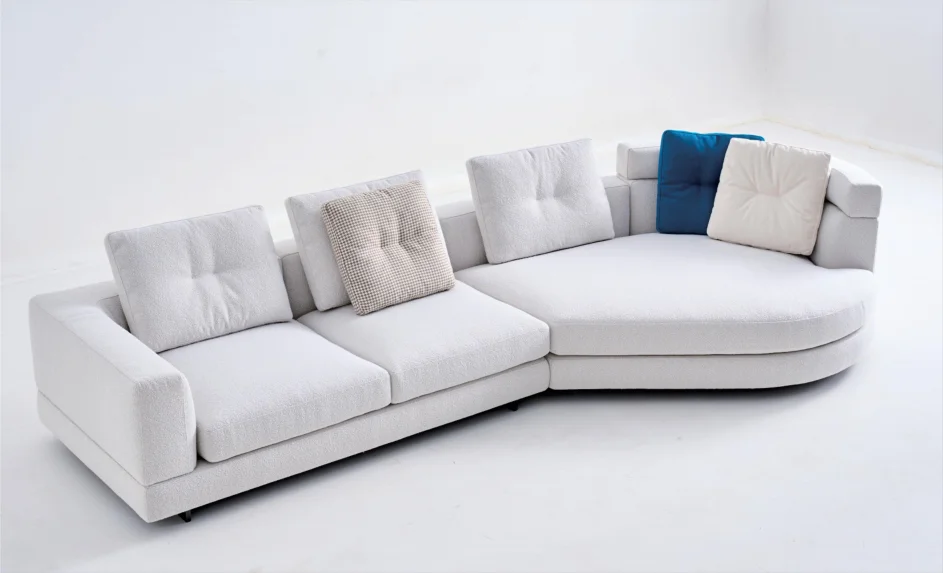
A mirrored picture does not create a reversible sectional
Flipping a photograph takes seconds. Reversing a physical sofa may involve different arms, bases, upholstery panels or connections. The fact that a mirrored image looks convincing says nothing about whether the offered construction can be changed.
There are also details that a mirror image can disguise. An integrated surface changes sides, stitching details are reversed and the relationship between corner pieces may no longer represent the supplied components. Treat a flipped image as a sketch of a request, clearly marked as such, until a corresponding configuration is confirmed.
Ask how the tufted modular arrangement would actually change
The Camel Suede and Black Leather Tufted Modular Sofa is listed at 300 × 180 × 85 cm. If the room needs the return on the opposite side of the proposed arrangement, identify which modules, arms and upholstered surfaces would be affected.
Ask whether the alternative is an available configuration, a different set of components or a construction change requiring a new approval. These are different purchasing situations. The word “modular” does not resolve them, and the outside dimensions could remain similar even when the component set changes.
For a dealer ordering a showroom piece and a separate home installation, do not copy the showroom's orientation without checking the home. The display may be approached from an open aisle on both sides, while the home has one fixed doorway. The same sofa model can therefore need a different discussion for each destination.
Use the room to resolve a left-or-right sectional choice
Once the viewing convention is clear, stop debating the words and test the arrangement. Place the confirmed sofa outline on the plan, then mark doors, windows and the route to the next room. Include the space occupied by a person getting into and out of the return seat.
A chaise placed toward a quiet corner may leave the main route open. The opposite orientation could be better if that corner contains a terrace door or a cabinet that needs access. There is no universal answer that the return always belongs beside the window or against the longest wall.
The suede chaise option needs the same room-specific check
The Suede Lounge Chaise Sofa is listed at 290 × 170 × 80 cm. That gives a buyer another listed footprint to compare with the 280 × 160 cm linen and 300 × 180 cm tufted arrangements. It does not establish the availability of both orientations.
If the projecting part of the offered chaise design extends into a busy route, first confirm whether a suitable alternative arrangement exists. If it does not, another model may be a better fit. Do not force the room to accommodate the wrong side merely because the length along the wall looks right.
For a household sharing the room, check more than the route of the person who prefers the chaise. Another occupant may need to reach the adjoining seat or walk behind the sofa. The best orientation should make those everyday movements straightforward without requiring the furniture to be shifted.
Keep one approved sofa drawing attached to the order
After the orientation is resolved, replace the working sketches with one clear approved reference. It should identify the model, the offered component arrangement, the viewing direction and the room. Include the overall dimensions and any separate dimensions needed to understand the return.
For the side-storage linen design, show the side surface explicitly. For the tufted modular design, retain the component references supplied for that arrangement. For the chaise option, keep the exact projecting section visible. These details make the record useful to the person placing the order and the person receiving the furniture.
Record revisions when the room changes. If a terrace door is moved or the television wall changes, the previous orientation may no longer suit the layout. Describe whether the change affects only placement within the room or the furniture configuration itself. Rotating a complete sectional is different from changing which end carries the return.
Suppose two apartments use the same linen sofa but have mirrored plans. It is tempting to duplicate the order line and add “opposite hand.” Instead, create two marked arrangements and obtain confirmation for both. The integrated side-storage element may have a different relationship with a wall socket or curtain in the second apartment, even if the room outline looks like a perfect mirror.
For the suede chaise option, a similar check applies if the room entrance changes during design development. A revised furniture position might solve the route without changing the sofa itself. In that case, keep the supplied configuration unchanged and revise the room placement. If the return must physically change ends, record that as a product question requiring confirmation. Distinguishing those two changes prevents an installer from being asked to achieve a layout that the ordered components cannot create.
The furniture order list guide explains how to keep room references and revisions attached to the same physical item. Use HEZEN CASA's furnishing service to confirm the proposed configuration before treating it as an approved order.
When the sofa arrives, the receiving team should have the same drawing, including the front-view arrow. They can then compare the supplied components with an identifiable arrangement rather than interpreting “left” afresh. If anything is unclear, resolve the discrepancy before forcing parts into an assumed layout.
The final check is simple: two people should be able to look at the drawing separately and point to the same return, the same arm and the same side element. Once they can, the words “left” and “right” become helpful shorthand instead of the only evidence of what was ordered.