Choosing an Italian Style Furniture Supplier for a Cohesive Retail Collection
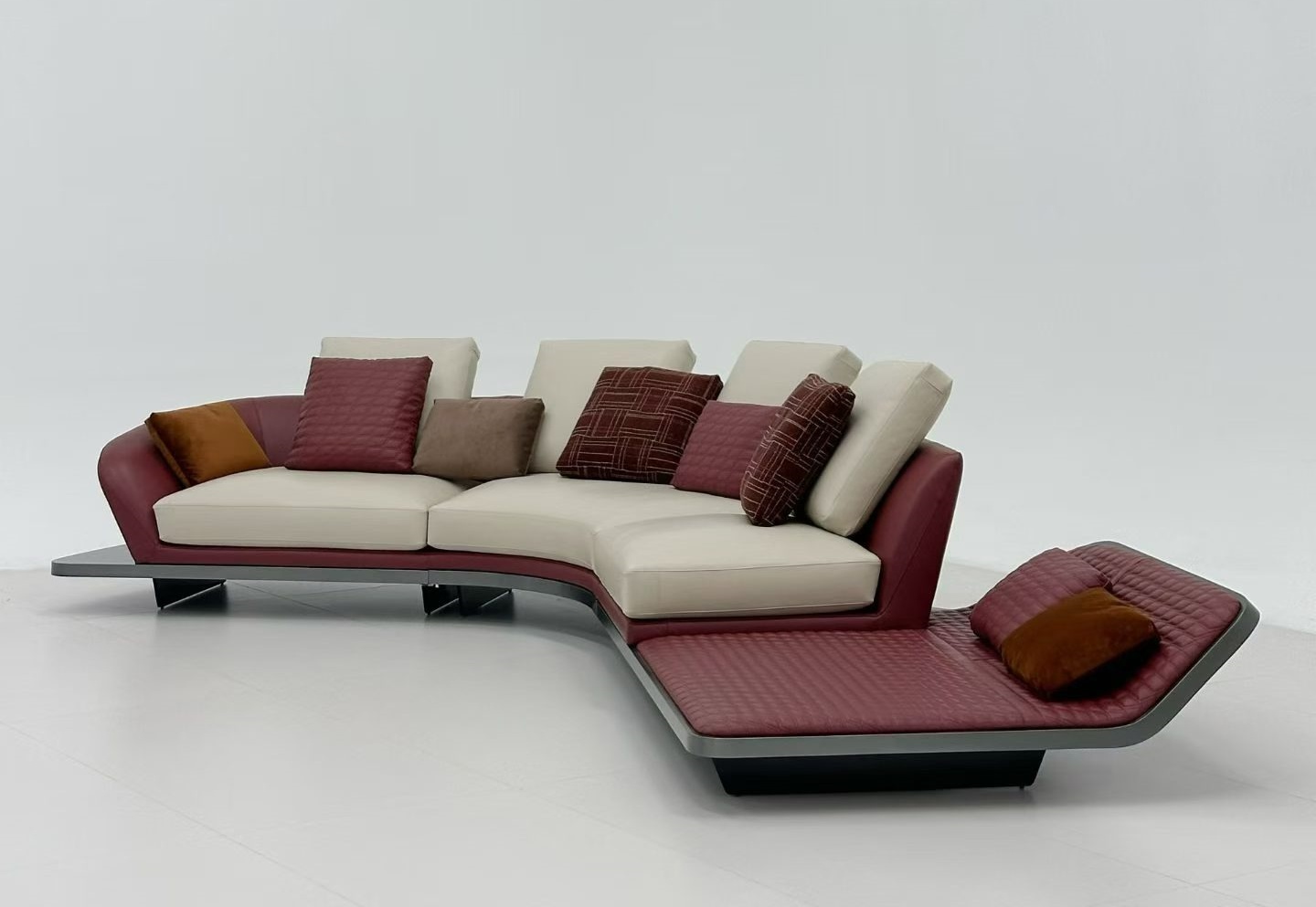
A retail floor can contain attractive furniture and still leave customers unsure how to combine it. For a dealer choosing an Italian style furniture supplier, the collection should offer understandable room stories rather than a loose set of similar-looking objects. HEZEN CASA’s burgundy and white sectional, beige low platform bed, dark wood credenza, contoured dining chair and low wood-and-metal coffee table can be assessed as distinct anchors. Decide which combinations staff can explain clearly before expanding the selection.
Make the Italian style furniture supplier’s range legible in three settings
One useful retail approach is to separate a statement living room, a quieter bedroom and a dining or storage setting. This does not mean building three unrelated collections. It means giving each area a clear purpose while repeating selected visual cues. The supplier’s product range should support those cues through actual materials and proportions, not through a promise that everything matches because it shares a style description.
The Nappa sectional is listed at 320 × 180 × 85 cm. Its contrasting colors make it a natural candidate for a visually prominent display. The low bed, listed at 220 × 180 × 85 cm, uses a much quieter beige leather appearance. The identical published overall height does not mean the two pieces have the same visual role. One organizes a seating composition; the other establishes the low horizontal base of a bedroom.
A new showroom owner might be tempted to make every setting equally dramatic. That can weaken the distinction between them. Let the two-tone sofa carry the stronger contrast while the bedroom demonstrates a more restrained option. The retailer then has a reason to move a visitor from one setting to the next: not to show more of the same, but to explain another way the collection can be used.
The burgundy sectional needs companions that leave its contrast readable
The sectional’s burgundy and white upholstery already divides the seating area visually. Place the proposed coffee table in the drawing at its real scale and review whether it supports or interrupts that composition. The low table is listed at 110 × 65 × 32 cm, with solid wood and metal. Its horizontal form offers a different kind of presence from the sofa. Do not enlarge its image on a presentation board until the two seem artificially balanced.
For the sales team, prepare a precise explanation of what is being demonstrated. The display might show how a low table leaves the sofa’s upholstery visible, while the table’s wood brings another surface into the room. That is a defensible design observation. A claim that this combination is universally popular or guaranteed to sell would require evidence the product listings do not provide.
Use the bedroom to demonstrate restraint without making it anonymous
The beige Nappa platform bed is listed with solid wood and Queen/King availability. Its low 85 cm overall height is relevant to the way the bed sits against a wall, but the actual mattress and finished bedding will affect the composition. Confirm the display mattress dimensions and the supplied bed version before building the setting. A beautifully styled mattress that does not represent the intended fit teaches staff the wrong product relationship.
Give the bedroom a material story that can be repeated accurately. If the leather’s color is intended to relate to the living-room setting, identify the approved references rather than relying on the word beige. Different materials and lighting can produce different appearances. A retail collection can remain coherent through deliberate contrast, but accidental near-matches are harder for staff to explain and for buyers to reproduce at home.
The low leather bed should be shown with its actual surrounding space
Do not push the bed into an artificially generous display bay and then describe it as compact without qualification. Its listed 220 × 180 cm envelope still needs to be considered in the buyer’s room. Use the display to show how the bed is approached and how the selected mattress relates to the upholstered frame. The retailer can communicate the design’s low profile while remaining accurate about its footprint.
A dealer serving both apartment buyers and villa projects may use this setting to discuss scale. The bed can be a reference for a restrained bedroom, while the final suitability depends on the room and mattress. That conversation is more useful than presenting Queen and King as universally interchangeable dimensions. The supplier should provide the actual specification for each version the retailer intends to offer.
Connect the dark wood credenza to a dining story, not a leftover wall
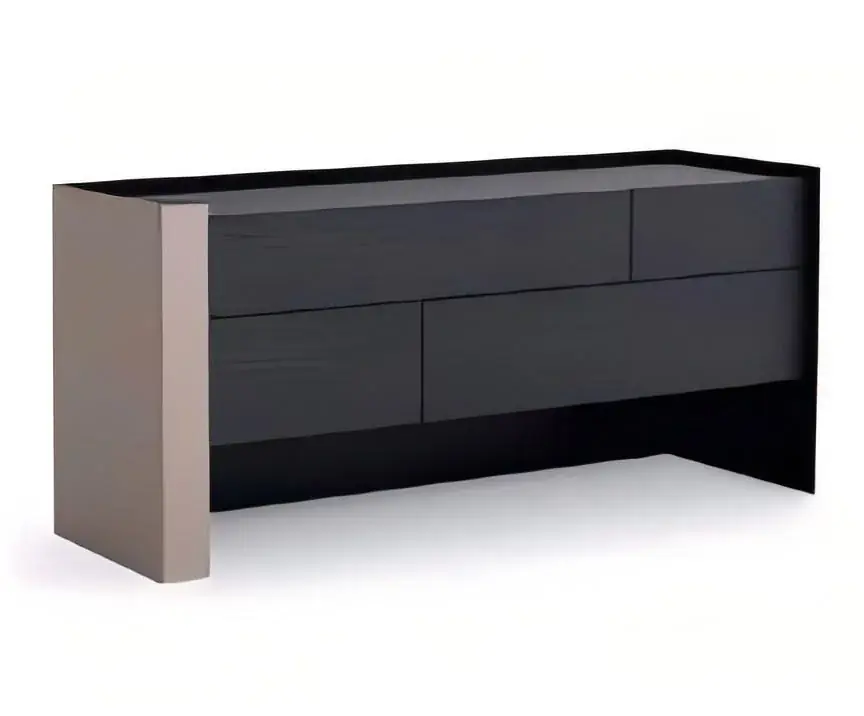
The asymmetrical credenza is listed at 180 × 45 × 80 cm, with dark wood veneer, solid wood and multiple compartments. It can help connect a dining setting to the rest of a display because it offers both a surface and storage. Give it a reason to be there. Show the kinds of objects the proposed compartment arrangement is intended to hold, after confirming the actual internal configuration, rather than treating it only as a place to put accessories.
The contoured dining chair is listed at 52 × 55 × 92 cm, with fabric and solid wood. Its wood structure can be considered alongside the credenza, but the two items should not be described as an identical wood finish unless that has been confirmed. Ask the supplier for the proposed finish references. A controlled relationship between different tones is often more honest than a vague matching set label.
The contoured chair needs a table relationship even in a collection display
A chair displayed beside the credenza can communicate shape and upholstery, but it cannot demonstrate dining fit without a table. If the retailer uses a table from another range, identify that choice and evaluate the actual chair-to-table relationship. Overall chair height is not seat height, and outside width is not a guarantee of comfortable spacing. Staff should know which relationships have been demonstrated and which need checking for a buyer’s own table.
For a small showroom, one carefully explained chair can be more useful than several almost-identical seats. Present its contour, material and dimensions accurately, then show the available confirmed finish options separately. Do not imply that every displayed fabric swatch is already approved for that chair’s construction. The supplier’s actual offering should determine what the retailer can promise.
Ask the Italian style furniture supplier for a disciplined finish selection
A cohesive collection does not require every product in every color. Too many untested combinations make the display harder to explain and the offer harder to reproduce. Start with the materials actually approved for the sectional, bed, chair, credenza and coffee table. Identify which choices are fixed for the display and which can be developed for an individual order. This keeps a useful distinction between the collection visitors see and a custom proposal that still needs confirmation.
For example, the sectional’s two-tone design should not become an unrestricted promise that any two leathers can be combined without another review. The chair’s fabric should not be described as the same material as the bed’s leather simply because the colors coordinate. The credenza’s veneer should be assessed on adjoining fronts and visible sides. Each material choice has a product-specific expression that a small swatch alone cannot settle.
ACT’s textile guidance distinguishes appearance from several performance properties. Ask for relevant information on the proposed chair upholstery rather than selecting it solely because it matches the showroom palette. The retailer should be able to explain the approved material and its care information without inventing a durability rating or treating a style designation as a performance standard.
Keep one clear reference for each approved display finish and identify the furniture to which it applies. If the supplier later proposes a replacement, review the effect on the complete setting. A different chair fabric may work as an intentional update, but it may also weaken the relationship with the dark wood cabinet. The decision should be made before the retailer presents the revised combination as unchanged.
Train staff to explain sofas, beds and storage as a collection
The collection becomes more useful when its explanation is specific. Staff can point to the sectional’s contrasting upholstery, the low table’s horizontal form, the bed’s restrained outline and the credenza’s storage arrangement. They can explain how the contoured chair belongs in a dining scheme once table fit has been checked. These observations give customers something to evaluate beyond a broad claim of premium quality.
Be equally clear about origin and customization. Italian style does not, by itself, mean Italian manufacture or a licensed designer product. Present HEZEN’s Foshan supply context accurately and distinguish a listed design from a proposed custom version. If a visitor brings a third-party designer image, discuss the desired proportions or function without promising an unauthorized copy or implying a brand relationship that has not been established.
Use the display to collect meaningful buyer questions. Requests about the bed’s mattress fit, the credenza’s usable storage or the sofa’s room footprint reveal what the collection explanation needs to clarify. They do not automatically prove demand for a new variant. Review the questions with the supplier and develop a defined proposal where appropriate. A coherent range can evolve without becoming an uncontrolled catalogue of hypothetical options.
Keep the retail furniture collection coherent as individual orders change
Photograph the completed display with its approved furniture identities and material references attached to the internal record. When a floor sample is sold or replaced, the team can restore the intended arrangement without guessing which beige leather or dark wood tone was used. This is particularly useful for the quiet bedroom setting, where a small finish change can alter the relationship between the bed and surrounding pieces even though the overall layout remains the same.
Custom orders will sometimes depart from the display. A buyer may select a different leather for the bed or need another sectional arrangement. Explain which parts of the showroom relationship remain relevant and which must be reviewed again. The display is a reference for design and use, not a guarantee that every altered version will create the same effect.
HEZEN’s wholesale range planning article addresses the separate question of display, repeat-order and project roles. Keep that commercial decision connected to the visual collection, but do not confuse the two. A strong display piece may not be the furniture a dealer chooses to hold routinely, and a quieter repeat-order item may still deserve a clear place in the story.
Approve the opening collection as a set of explainable relationships: the sectional and low table in the living area, the correctly fitted leather bed in the bedroom, and the credenza with a properly evaluated dining chair. Ask the supplier to preserve the agreed references for those pieces. The resulting retail floor can show variety while giving staff and buyers a reliable path from an attractive setting to a defined furniture order.