How to Arrange Nesting Coffee Tables for Daily Use and Extra Seats
Arrange the main table for the people who sit there every day, then use the second table to extend the useful surface where it is needed. That is the most practical starting point for how to arrange nesting coffee tables. Check the selected pair's intended overlap, height relationship and expanded footprint before moving anything. A photograph of two overlapping tables does not prove that the smaller one slides completely underneath the larger one.
HEZEN CASA's public occasional-furniture catalogue includes overlapping oval-and-round groups and round tables at different heights. These are useful layout references, alongside the individual coffee tables in the collection. Choose the actual pair first; do not assume that any two separately listed tables can be combined into a nesting set.
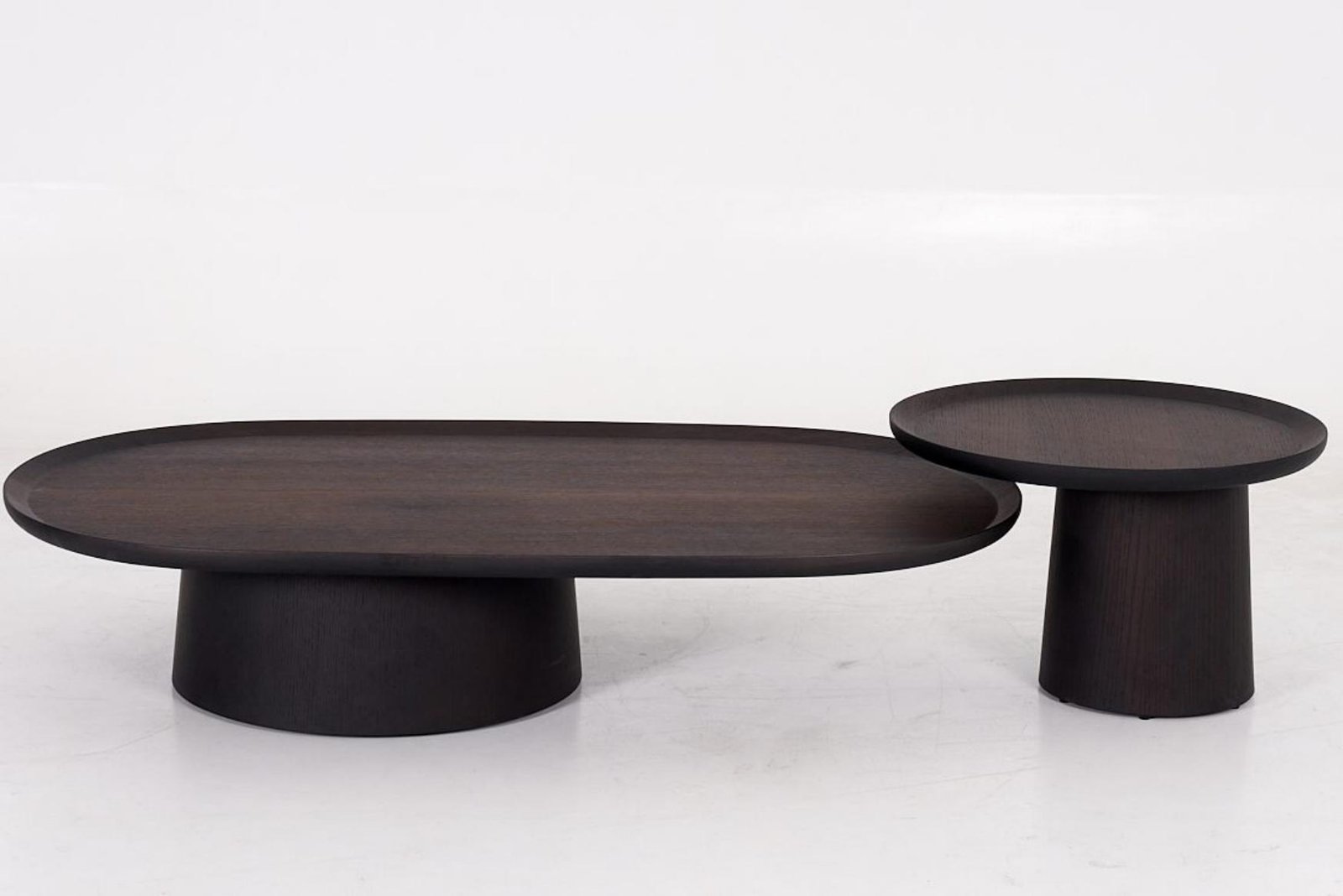
Establish what the chosen nesting-table pair can actually do
The oval-and-round catalogue group shown above has a broad, low oval surface beside a smaller, higher round surface. The difference in height creates a layered arrangement. Before ordering that direction, establish the two tables' dimensions, support positions and intended relationship. The small round top appearing above the oval is not evidence of a concealed mechanism or full tuck-under function.
Look at the pair from above and from the side. The top edges may appear to clear each other while a pedestal or support prevents further movement. Confirm how the tables are intended to be arranged and handled, rather than pushing one farther simply because more of its top could theoretically overlap.
Leave usable surface exposed on the oval-and-round group
Start with the oval as the main surface and decide which seat the higher round table will serve. Keep enough of that round surface accessible for its intended use. If most of it is hidden behind another top, or its visible edge is too far from the person using it, the layered arrangement may be visually pleasing but inconvenient.
For a living room used by two people most evenings, the smaller surface might belong near the regular end seat. It does not have to be positioned symmetrically. Try the arrangement with the actual objects that will be placed there, then check the walk past the exposed round edge. Decorative balance and useful reach should be assessed together.
Keep the actual oval outline in that test. Its curved ends do not occupy the same area as a rectangle with the same maximum length and width. A simple bounding box is useful early in planning, but the final position of the smaller round top needs the real shape and pedestal locations, not an imagined empty corner inside that box.
IKEA's LACK nesting-table information explicitly describes separate, combined and tuck-under uses for that particular set. It illustrates why the intended operation should be stated by the supplier. It does not establish the same movement, materials or dimensions for a HEZEN catalogue pair.
Plan the tables around the linen modular sofa's real arrangement
The Off-white Linen Fabric Modular Sofa With Side Storage Table is listed at 280 × 160 × 75 cm, with linen-blend upholstery and solid wood. Its return and side-storage element affect where a central table group is useful. Begin with the selected sofa configuration rather than drawing two tables in the middle of its full outside rectangle.
Identify the main sitting row, the return position and the approach into the group. The larger table can serve the main row while the smaller one reaches towards another seat, provided the chosen pair supports that relationship. Keep the expanded group out of the route used to enter or leave the return.
Use the sofa's side table before adding more central surface
If the ordered linen arrangement already places its side-storage table beside the seat that needs a cup surface, the smaller coffee table may be more useful elsewhere within the group. Confirm the integrated element's location and usable surface first. Otherwise, you can end up with several surfaces serving one person while another seat still has nothing within comfortable reach.
Imagine a family using the return to stretch out in the evening. A higher round table positioned at that corner may obstruct getting up even if it looks good in the empty-room view. Try the action with someone seated. Move the proposed table position on the plan before changing the whole sofa arrangement around it.
The sofa's listed 75 cm overall height does not identify its seat height. Compare the selected pair's tabletop levels with the finished seats, not with the top of the sofa back. Two different table heights are useful only if the surfaces remain convenient for their actual jobs.
How to arrange nesting coffee tables when visitors join the group
Mark two states: the ordinary arrangement and the larger gathering. In the ordinary state, the oval-and-round pair may remain partly overlapped. When an extra chair joins, the smaller surface may need a different position, if the chosen set is designed to be moved and separated that way. Test that expanded state before relying on it.
Keep the route through the room visible on the plan in both states. The group does not become space-saving merely because the tables overlap in the catalogue picture. Its useful footprint includes the furthest top edge, the supports and the gaps needed around occupied seating. A table moved towards a visitor can also move into the main walking route.
For a villa lounge used for occasional gatherings, decide where the smaller table returns after everyone leaves. That location should make sense for the daily seats, without requiring a heavy object to be moved repeatedly. If the intended pair is difficult to handle in the room, a simpler fixed arrangement may work better.
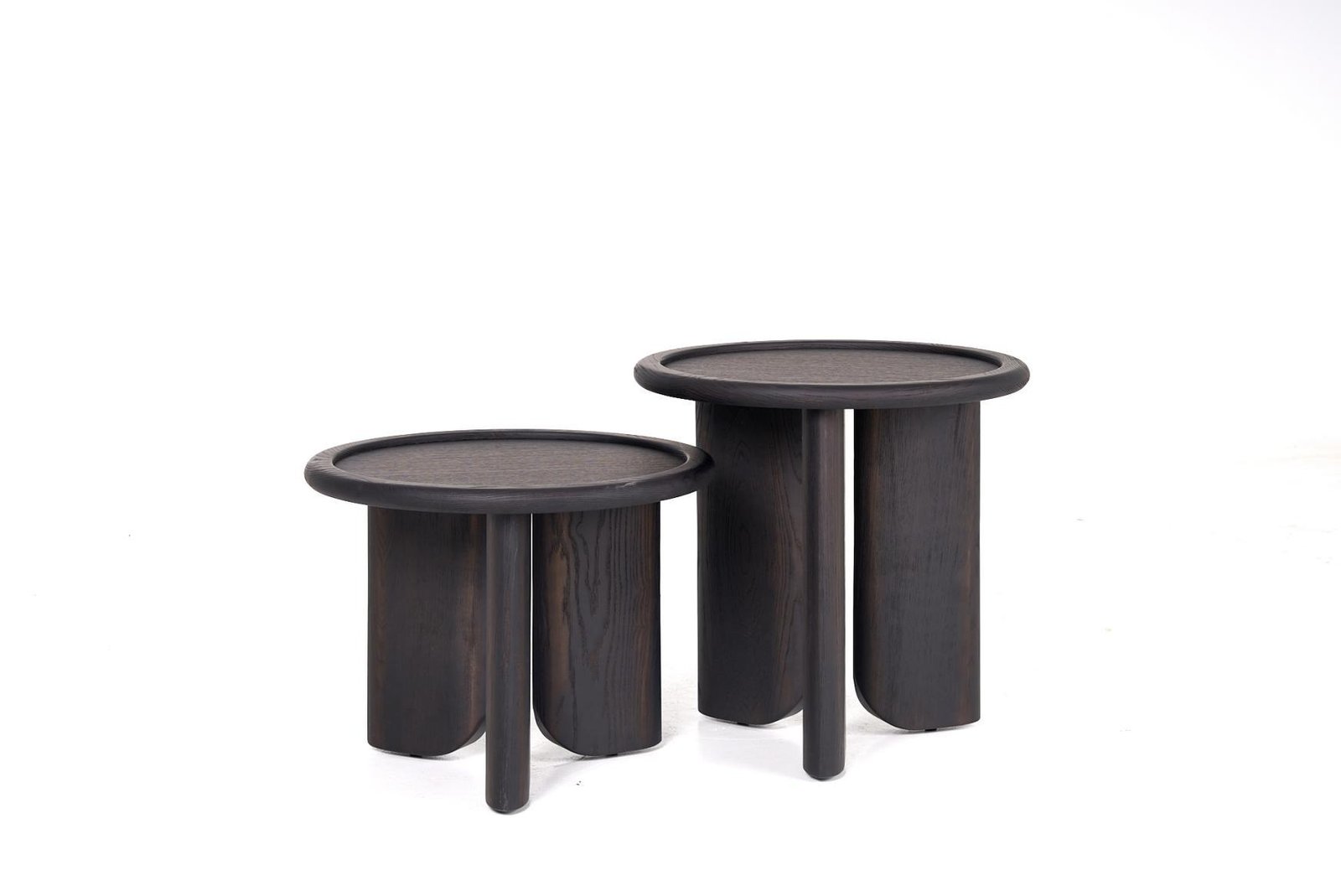
Two round nesting tables create a different centre from an oval pair
The round-and-round catalogue reference above presents two circular surfaces, with one appearing higher than the other. Their relationship is worth testing from angled seats. Compared with the elongated oval group, two circles can create a different outline at the ends and a different opening between their supports.
Check both exposed round edges from the occupied chairs
Do not measure only the larger circle and forget the smaller one. Place both complete outlines on the room plan, then test standing up from the nearest seat and passing beside the pair. Depending on the approved arrangement, the smaller top may extend beyond the larger one in exactly the place where a person turns into the seating group.
Keep objects on surfaces that remain easy to use. A decorative bowl can sit on one table while drinks use the other, but that division should not force someone to reach across a taller top. Let the actual exposed area guide the arrangement instead of placing accessories as if both tables were one continuous level.
For the round pair, do not treat the higher surface as a place to rest something spanning both tables. Different heights mean the tops are not one level support. Keep trays and other objects on a suitable single surface, within the use guidance for the selected table, rather than bridging the group to create an improvised larger top.
Compare the table group with a single confirmed coffee-table size
Before committing to two pieces, compare them with a single table that has a known outside size. HEZEN CASA's Round Green Vein Marble Coffee Table is listed at 90 cm in diameter and 40 cm high. It provides one continuous round surface, with a listed weight of 40 kg. It is a separate product, not a confirmed member of either pictured nesting group.
The Italian Minimalist Designer Low Coffee Table is listed at 110 × 65 × 32 cm, with solid wood and metal. The Italian Minimalist Solid Wood Coffee Table is listed at 120 × 70 × 38 cm. These are two more individual options for comparing length, depth and height against the full proposed two-table arrangement.
Do not add the widths of a pair and call the result its footprint, or subtract the apparent overlap seen in a photograph. The real position of the bases controls which relationships are possible. Ask for the selected pair's dimensions in the intended arrangement, then compare that outline with the individual table candidates.
For a narrow space beside the linen sofa, the 65 cm listed depth of the designer low table may be a useful comparison. A two-table group could occupy more depth when spread out, even if it looks compact when overlapped. Conversely, the pair may serve two separated sitting positions more effectively. Let the actual room test decide which benefit matters.
The individual candidates also help make the height discussion concrete: the low designer table is listed at 32 cm, the solid wood option at 38 cm and the round marble table at 40 cm. These are three distinct product levels, not the dimensions of a nesting set. Use them to describe the kind of reach you prefer, then obtain the actual pair's own heights.
Keep the arrangement practical after the photographs are taken
Ask how the selected tables should be moved and supported before making regular repositioning part of the plan. Do not lift a piece by an unsupported top or drag it against another table. The correct handling depends on the ordered construction; a sculptural pedestal and a slim open frame should not be assumed to behave identically.
Also consider cleaning access between the two pieces. If the overlap hides a surface that needs routine attention, establish how it can be reached using the approved handling method. An arrangement that is awkward to reset after cleaning may not remain as intended in daily use.
The coffee-table size guide helps compare the measured candidates. Bring the chosen catalogue group, the linen sofa layout and the intended daily and visitor states to HEZEN CASA's furnishing service. Ask about that exact pair rather than requesting a generic small table to fit under a larger one.
Keep the larger surface where it serves the regular seats, and give the second piece a clear purpose. If the extra table improves reach without complicating movement through the room, the pair earns its place. If it only adds another edge to walk around, return to the single-table options before ordering.