Dining Table Size Guide for Chairs, Movement and Real Room Space
A dining table fits when the complete dining arrangement works, not just when its top fits between the walls. In this dining table size guide, start with everyday seating, draw the chairs in use and add the routes and storage that share the room. Then compare actual tables. HEZEN CASA's round marble designs provide useful diameter choices, but the final decision still depends on the selected chairs, base and room layout.
For a project buyer, the most important first measurement is often the usable dining area after doors, sideboards and other fixed features are considered. For a homeowner, it is whether someone can leave the table without the whole room rearranging itself. Both questions are more useful than starting with the largest table the empty room can hold.
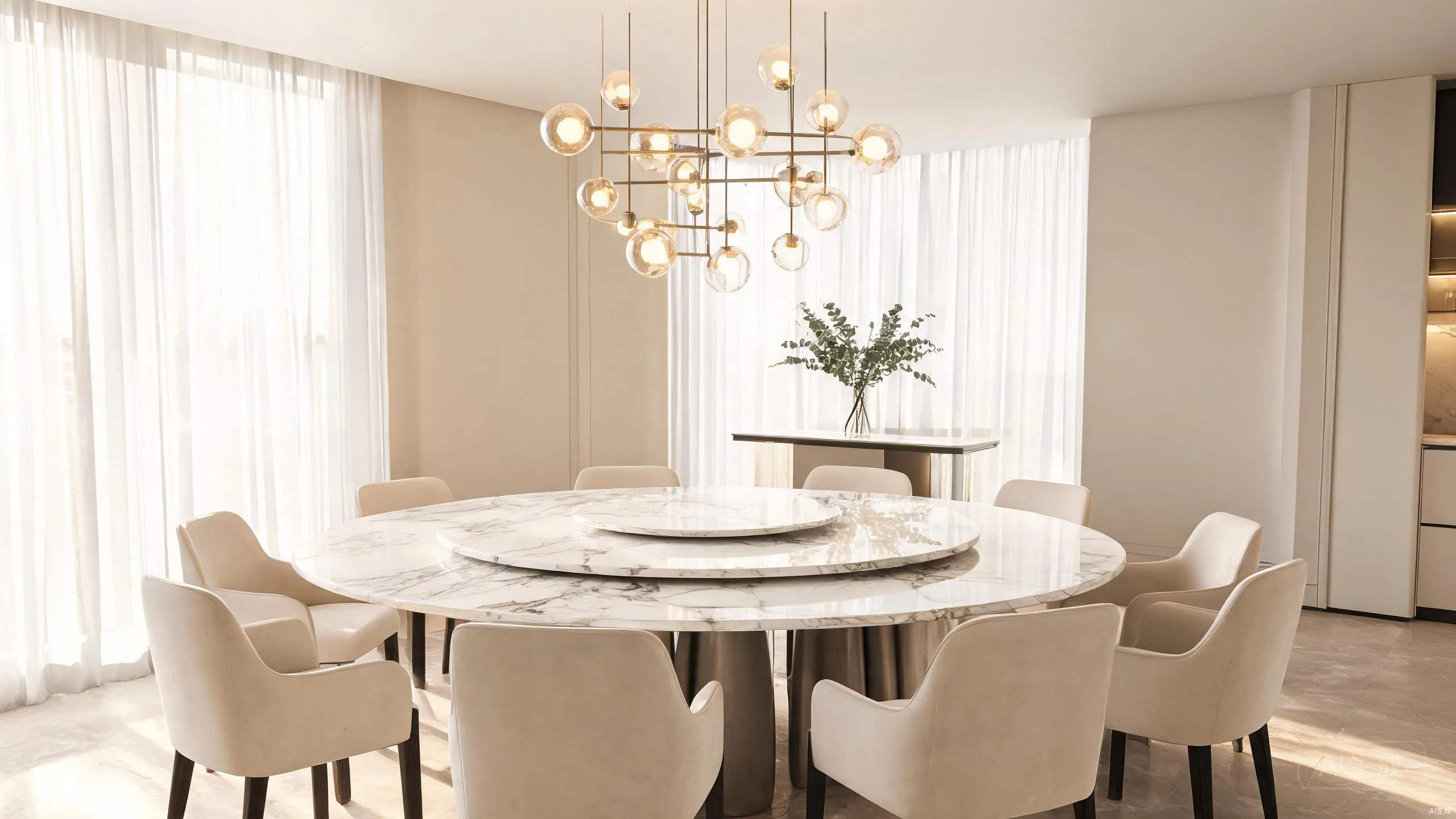
A dining table size guide should include the space around the chairs
Mark the tabletop on a measured plan, then draw each chair in its normal seated position and its pulled-back position. Add the main route through the room. A chair can fit under a table and still block a doorway when someone stands up. The tabletop outline cannot show that on its own.
Do not leave adjacent furniture until the end. A sideboard, cabinet or door can claim the same space as a chair. If the room connects the kitchen to a living area, identify that through-route before you settle the dining arrangement. It may be better to use a smaller table in a comfortable position than a larger one that makes every movement awkward.
Test the 150 cm round marble table as a whole dining zone
The Round Natural Marble Dining Table with Lazy Susan is listed at 150 cm in diameter and 75 cm high, with natural marble and metal. The 150 cm circle is a starting point. It does not include seated people, chair movement or a route behind the chairs.
For a simple planning illustration, choosing 90 cm of space beyond the tabletop on two opposite sides creates a 330 cm overall zone: 150 + 90 + 90. That is an example allowance, not a universal standard or a guarantee of accessibility. The actual chairs, door positions, intended movement and project requirements still need checking.
A buyer choosing this table for everyday family meals should test the usual seating arrangement first. If the room occasionally hosts more people, consider what must move on those occasions. Do not let an occasional maximum headcount make the ordinary room uncomfortable for the rest of the year.
Where the dining area has a door on one side and a cabinet on the other, the two sides do not have equivalent demands. The door may need a continuous route; the cabinet may need occasional access while people are seated. Mark both uses rather than applying the same empty strip all around the circle. If the table must shift off the room's centre to work properly, assess the lighting position and the visual balance with that real location in mind.
Compare round-table diameters before comparing the styling
Small diameter differences can change the feel of a room because the difference applies across the whole tabletop. HEZEN CASA's listed round designs allow a useful comparison at 140, 150 and 160 cm. Begin with the usable dining zone, then consider the surface, base and appearance that suit it.
The 140 cm table gives space back to a constrained dining area
The Light Crystal Marble Round Dining Table with Lazy Susan is listed at 140 cm in diameter and 75 cm high, with glossy marble and gold-finished metal. Compared with a 160 cm diameter, the top is 20 cm smaller across. Centred in the same place, that releases 10 cm on each side before any other part of the arrangement changes.
That extra space can be useful, but do not exaggerate it. It will not solve a badly positioned door or make an unsuitable chair arrangement comfortable automatically. Test the complete setting with the intended chairs. The smaller table may be the better everyday choice even if the larger one looks more impressive in an empty-room photograph.
Also check the rotating centre and how the table will be used. Serving dishes, place settings and the selected chairs all affect the experience. A product's seating description should begin the discussion rather than end it.
The 160 cm marble table needs room for its chairs and base
The Round Dark Wood Frame Marble Dining Table is listed at 160 cm in diameter and 75 cm high, with dark wood and natural marble. It can be considered where the room has a sufficiently generous dining zone and the larger top supports the intended use. Its footprint deserves the same careful room test as a larger sofa.
Ask for the relevant base measurements before approving the chair layout. The top diameter does not establish knee space or where chair legs will meet the support. If the chosen chairs have arms or a wide stance, check those features against the actual base rather than relying on a general table capacity.
For a developer fitting several similar dining rooms, do not assume that an arrangement successful in one plan will work in a mirrored or slightly narrower room. Columns, doors and adjacent storage can make the difference. Keep the room reference attached to the proposed table size.
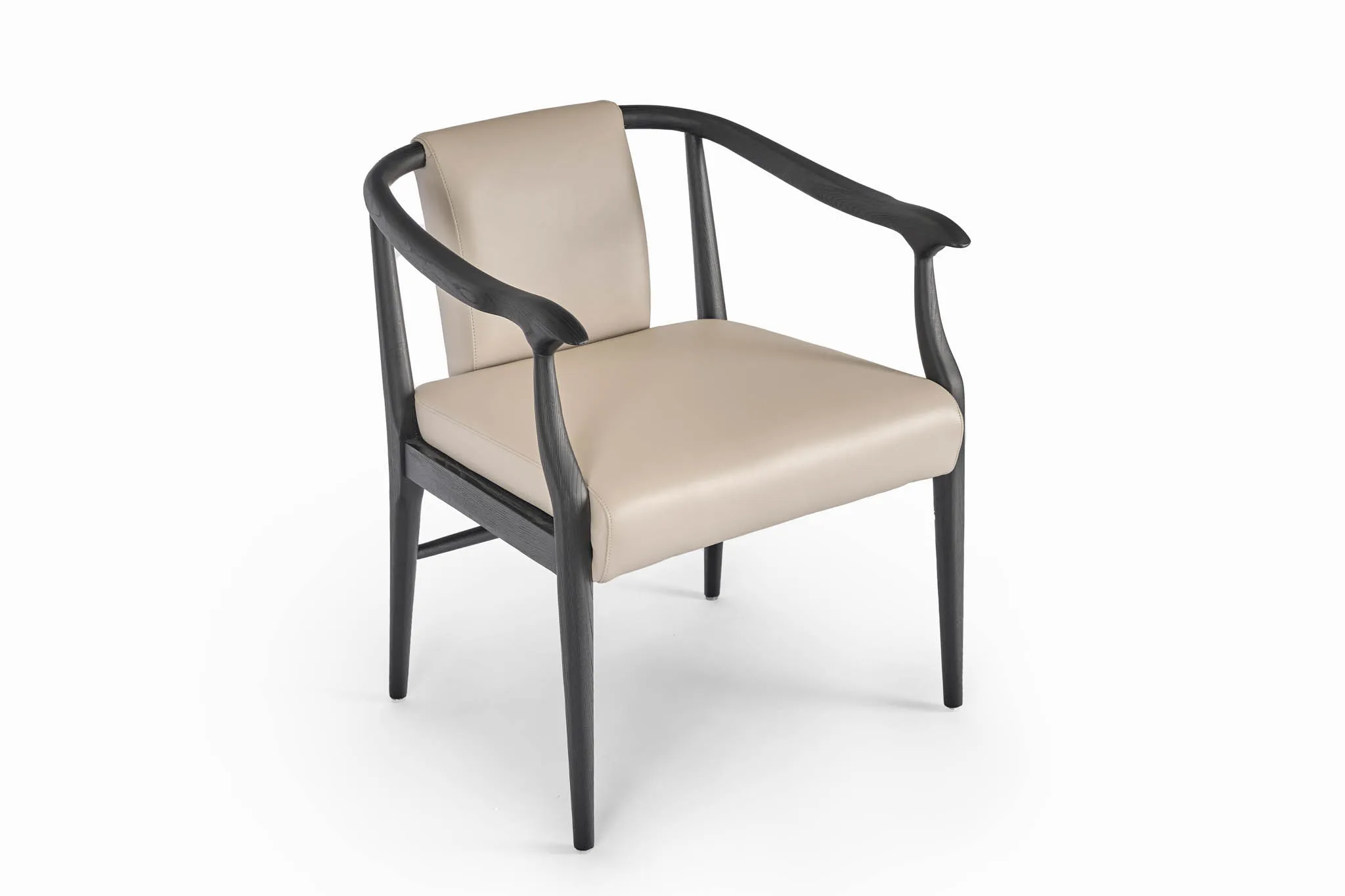
Choose the chair before treating the seating count as settled
Browse the chair collection alongside the table. A compact side chair and a broad armchair occupy different space, even if both are visually compatible with the marble top. Seat width, overall chair width and arm position are not interchangeable measurements.
Draw the actual chairs around the circle. Look at the room needed by neighbouring people, the ability to approach each seat and the relationship between the chair legs and table base. A round top can encourage an open conversation, but the usable arrangement still depends on the furniture underneath and around it.
Check the height relationship independently. All three listed tables are 75 cm high overall, but that does not establish the clear height under every edge or support. An armchair can have an appropriate seat height yet fail to tuck in because its arms meet the underside. Obtain the relevant dimensions of the selected combination. Do not substitute the chair's overall back height for its seat height when comparing the figures.
For a dealer preparing a display, leave enough working space that a visitor can pull a chair back and sit. A tightly arranged display may look coordinated while hiding the fit problems a buyer needs to evaluate. The point of showing the set is to let people understand it, not merely count how many chairs can be placed around it.
As general design background, Room & Board's table finder considers both tabletop size and the distance between supports when discussing seating. Its examples relate to its own range. The useful principle here is to verify the selected HEZEN CASA table-and-chair combination rather than treating the top diameter as the only relevant measurement.
Include the sideboard when you size the dining arrangement
The Rounded Marble Top Light Oak Storage Sideboard is listed at 180 × 45 × 80 cm. Its 45 cm depth is easy to overlook when a dining room is first drawn as an empty rectangle. Add its full footprint before deciding which table diameter the room can comfortably use.
Then consider the cabinet in use. Someone opening a door or reaching for serving pieces occupies more space than the closed cabinet. If a seated diner and an open door need the same area, the room can become awkward even though the furniture outlines do not overlap on the initial plan.
A buyer may prefer the 140 cm table with useful storage to a larger table that leaves no sensible place for the sideboard. Another room may have enough space for the larger diameter without that compromise. The decision is about the room's working arrangement, not a general hierarchy in which a larger table is always better.
Consider where serving pieces will be placed during a meal. If the sideboard is intended to support the table, someone needs to reach it without stepping into a narrow squeeze behind another diner. If it is mainly long-term storage, access may be less frequent but still needs to work. Explain that intended use in the layout discussion instead of reserving the cabinet footprint without considering the activity around it.
Compare the candidate sizes using one room drawing
| Listed table | Diameter and height | Room question to test |
|---|---|---|
| Light Crystal Marble Round Dining Table | 140 cm diameter × 75 cm high | Does the smaller top leave a useful route without compromising ordinary seating? |
| Natural Marble Dining Table with Lazy Susan | 150 cm diameter × 75 cm high | Can the selected chairs move comfortably beside the room's storage? |
| Dark Wood Frame Marble Dining Table | 160 cm diameter × 75 cm high | Does the full dining zone remain usable around the larger top and actual base? |
Draw the alternatives in the same position instead of comparing unrelated room photographs. Keep the chairs and adjacent furniture consistent while testing each diameter. That makes the trade-off easier to see. If a larger top only works after the sideboard or a main route is removed, decide whether that change is acceptable before approving the table.
Keep the selected chair reference beside that drawing so a later upholstery discussion does not obscure the dimensional decision.
Approve the dining room you will use, not the empty-room outline
Walk the planned route, pull the intended chairs back and open the nearby doors. Where the room is not yet available, use measured drawings and identify the dimensions that remain provisional. Confirm the actual table and chair information before treating the layout as final.
The earlier dining-table base discussion goes further into support and seating relationships. Use it alongside the room-scale decision, rather than as a substitute for one. A well-chosen table should fit the furniture around it as convincingly as it fits the overall style.
If the smaller diameter makes everyday meals easier and leaves the room useful, it may be the stronger choice. If the larger table serves a real need and the complete setting works, the extra size has a purpose. Make that decision with the chairs, storage and movement in view.