Start with the objects
Choose a Custom Cabinet Supplier Around What the Furniture Must Store
A cabinet’s outer dimensions tell a buyer where it might stand; the objects inside determine whether it earns that space. Designers, villa owners and project buyers should show a custom cabinet supplier what needs storing, how often it is used and who will access it. HEZEN CASA’s sideboards, tall leather chest and wide dressers provide useful starting forms, but their internal arrangements must be confirmed for the intended task.
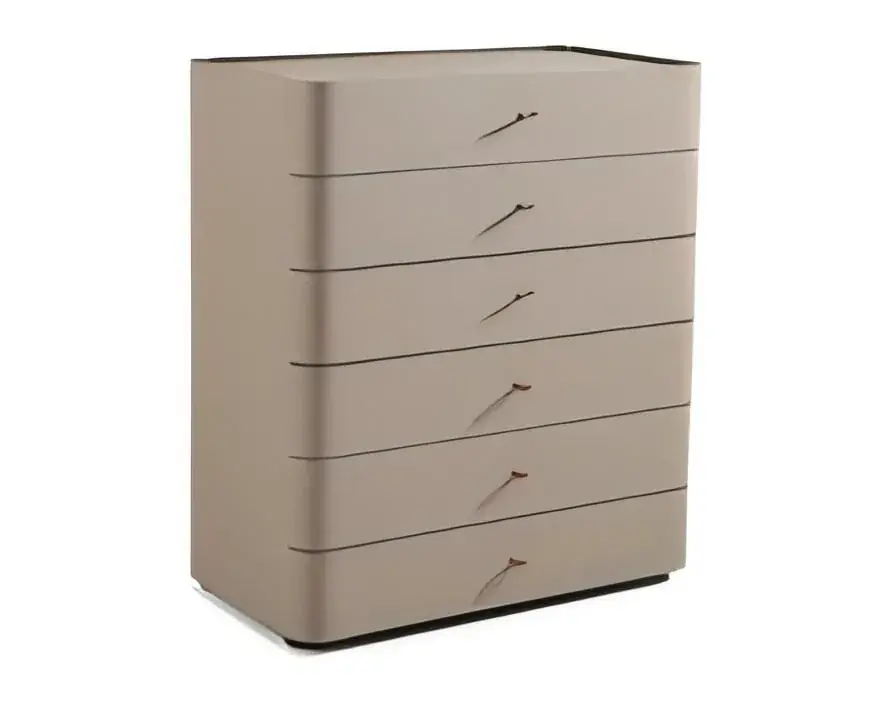
Compare the asymmetrical dark wood sideboard, dark wood sliding-door sideboard, curved six-drawer tall chest, stacked irregular accent dresser and wide six-drawer leather dresser. These are distinct freestanding furniture forms. A request for fitted cabinetry or a revised interior needs a separate, confirmed proposal rather than an assumption that every listed piece can be converted.
A custom cabinet supplier needs the stored objects as well as the room drawing
Begin with representative items or accurate measurements of them. Folded clothing, serving pieces, documents and display objects create different requirements. Identify which items should be concealed, which need frequent access and which should not share a compartment. This gives the supplier a concrete problem to address instead of a vague request for more storage.
For a dining room, a large serving dish may determine a useful compartment opening. For a bedroom, the way garments are folded may matter more than the cabinet’s overall width. For an entrance, the buyer may want a small group of frequently handled items close to the route. The right brief describes these actions without prescribing an unsupported internal design.
The 180 cm sideboard is not 180 cm of uninterrupted internal space
The asymmetrical dark wood sideboard is listed at 180 × 45 × 80 cm with dark wood veneer, solid wood and multiple compartments. Its outside width includes the furniture’s structure and design arrangement. Do not treat it as a clear internal opening. Ask for the actual compartment dimensions and access information needed for the intended objects.
A buyer storing large serving pieces should compare the objects with the usable openings, not merely the exterior depth. The item must pass through the opening and occupy the intended space in a supported way. If the listing does not provide that information, keep the fit unconfirmed until the supplier supplies an appropriate drawing or measurement.
The sliding-door sideboard needs an access demonstration
The larger dark wood sideboard is listed at 200 × 45 × 90 cm with two sliding doors and three drawers. Confirm the operation of the supplied version. A closed photograph does not show which compartments can be accessed together or how the doors overlap. The buyer needs to understand the actual opening sequence for the intended use.
In a dining room, two people may prepare the table at the same time. One might use a drawer while another accesses a larger compartment. Explain that scenario to the supplier and review the proposed operation. A greater overall width does not automatically resolve an access conflict if the moving parts serve the space differently.
Choose drawer furniture by reach and contents rather than drawer count alone
The curved tall leather chest and wide leather dresser each list six drawers, yet they distribute storage differently. The tall chest is 60 × 45 × 130 cm, while the wide dresser is 160 × 45 × 85 cm. Both list leather and solid wood. Their equal drawer count should not be mistaken for equal usable capacity or an identical daily routine.
Ask for the internal drawer dimensions and applicable use information for each proposed piece. Consider how the intended user will reach and open the drawers. The tall form may suit a shorter wall, while the broad form may suit a longer dressing area. Those are layout possibilities to examine, not proof that either is suitable for every person or storage load.
The tall leather chest concentrates storage vertically
For a bedroom with limited wall length, the 60 cm wide chest can be a useful starting point. Review the position of its upper drawers and the space required to operate them. If frequently used items would end up in an inconvenient location, reconsider the allocation or the furniture choice. The narrow footprint is only one part of its usefulness.
A project buyer furnishing several room types should not assume every room needs the same chest. Compare the actual dressing route and the user’s access to other storage. Where the chest is proposed beside a bed, check that drawer movement does not interrupt the route or conflict with the intended bedside arrangement.
The wide leather dresser can divide contents without defining their capacity
The 160 cm wide dresser offers a different arrangement for a longer wall. A buyer may wish to divide its drawers between two users or between different categories of clothing. Obtain the real interior information before assigning those roles. The broad exterior and six-drawer description do not establish how every item will fit.
Consider the simultaneous use of nearby furniture. Opening a dresser drawer may affect access to a bed, a wardrobe or a doorway. Review the room in its working condition, with the drawer operation understood. A neatly closed cabinet can look well placed in a drawing while becoming awkward during the routine it was purchased to support.
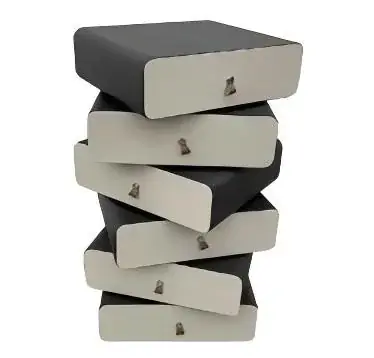
The irregular accent dresser should justify both its shape and its storage role
The stacked irregular dresser is listed at 120 × 45 × 110 cm with solid wood, veneer and five drawers. Its staggered two-tone appearance can make it a focal piece. Decide whether that visual role is central to the room, then verify how its actual drawer arrangement supports the objects the buyer intends to store.
For an entrance or bedroom where the furniture is seen from several directions, review the relevant views and the surrounding path. The maximum exterior dimensions provide an envelope, but the staggered form may place different parts of the furniture differently within that envelope. Obtain suitable drawings or views when the fit depends on a close relationship to another item.
A statement dresser should not become the room’s only unverified storage
A designer may accept a more specific drawer arrangement because the piece contributes strongly to the composition. That can be a reasonable choice if the remaining storage needs are met elsewhere. It becomes a problem when the sculptural piece is expected to carry the entire room’s storage brief without its usable interiors having been checked.
Explain which objects must fit and which can be assigned to another cabinet. This helps distinguish a necessary custom request from an avoidable attempt to make one form do every job. If a revised interior is proposed, ask the supplier to show what changes and what remains fixed in the exterior design.
Discuss custom cabinet interiors without assuming the listed construction can be altered
A request to change a compartment, drawer or door arrangement needs a specific feasibility response. Provide the intended objects and access requirement, then ask what the supplier can offer. Do not remove a divider or resize a drawer in a sketch and assume that the furniture’s construction, operation and appearance remain unaffected.
The distinction is particularly important between the asymmetrical sideboard and the staggered dresser. Their arrangement is part of the visible design. A change intended to improve storage may also change that appearance. Review the revised proposal as a whole rather than approving the interior separately and expecting the original exterior to remain identical.
Wood and veneer descriptions do not establish a shelf’s load rating
Material names are useful, but they do not supply a capacity for a particular shelf, drawer or top. The US Forest Service’s Wood Handbook distinguishes material properties from the design of wood components and connections. For this furniture, any required load or use condition needs the supplier’s actual supported information.
If a buyer intends to store heavy serving pieces or other concentrated loads, describe that use explicitly. Ask for confirmation of the proposed arrangement instead of deriving a capacity from the phrase solid wood. The supplier may recommend another configuration or may need more information. An unresolved loading question should not disappear into a general material approval.
Separate display objects from objects that must be reached every day
The top of a sideboard can become a display surface, while its compartments serve daily storage. Review those two uses together. A large decorative object should not prevent the intended operation or make the cabinet difficult to inspect and maintain. Ask about supported use of the top rather than assigning a capacity from its visible size.
For the asymmetrical sideboard, the buyer may want the exterior design to remain visually quiet. That can favor concealing everyday items, but the contents still need practical access. Show the supplier what those items are and how they are used. A decision to hide them does not remove the need to confirm usable compartment dimensions.
The irregular accent dresser may serve a more expressive role. A designer can allow its staggered form to be the focal point without expecting the top to carry a large collection of unrelated objects. Define the intended display and storage functions separately, then check that both are supported by the actual supplied furniture.
For a shared room, agree who needs access to which contents. Two users opening nearby drawers or compartments can reveal a conflict that is absent when the cabinet is viewed closed. The right custom discussion begins with that specific action and the selected cabinet form, rather than a general request to increase capacity.
Keep cabinet installation and room access tied to the selected form
Obtain the applicable installation and stability instructions for the actual chest, dresser or sideboard. General furniture anchoring guidance explains the importance of tip-over prevention; the specific supplied furniture and wall conditions determine the appropriate installation discussion. Do not invent a fixing specification from the exterior height.
For the tall chest, confirm the required installation arrangement before placing it in a narrow position that is difficult to access. For the broad sideboards, consider how the furniture reaches the room and whether assembly or adjustment is required. Published outer dimensions are not a complete description of the packed delivery or handling process.
Inspect the sliding doors and drawers before filling the sideboard
At receipt, identify the supplied version and review its operation according to the applicable instructions. For the sliding-door design, confirm that the actual movement corresponds to the approved offer. For the drawer furniture, check the relevant fronts, openings and supplied components before filling the interiors with the intended contents.
If a question arises, record the specific cabinet, drawer or door involved and the condition observed. Keep the order reference and relevant photographs together. Do not attempt an unsupported adjustment simply because a different cabinet in the room uses a familiar mechanism. The public product listings do not identify every hardware system.
The freestanding and fitted storage guide explains the boundary between a listed furniture piece and a separate cabinetry proposal. For this selection, return to the objects and the actions that started the brief. Choose the cabinet whose confirmed interiors and operation serve those needs, then preserve the actual version that made the decision work.