Dining spaces · Trade buying
Working With a Marble Dining Table Manufacturer on Size, Seating and Stone Approval
A round marble table can fit on a drawing and still make a dining room awkward to use. For villa designers, furniture importers and project buyers, choosing a marble dining table manufacturer should begin with the table-and-chair arrangement, the actual stone selection and the delivery route. HEZEN CASA’s 140 cm marble table, 150 cm round table with a lazy Susan and 160 cm wood-and-marble table offer three useful starting points, with different implications for seating and presentation.
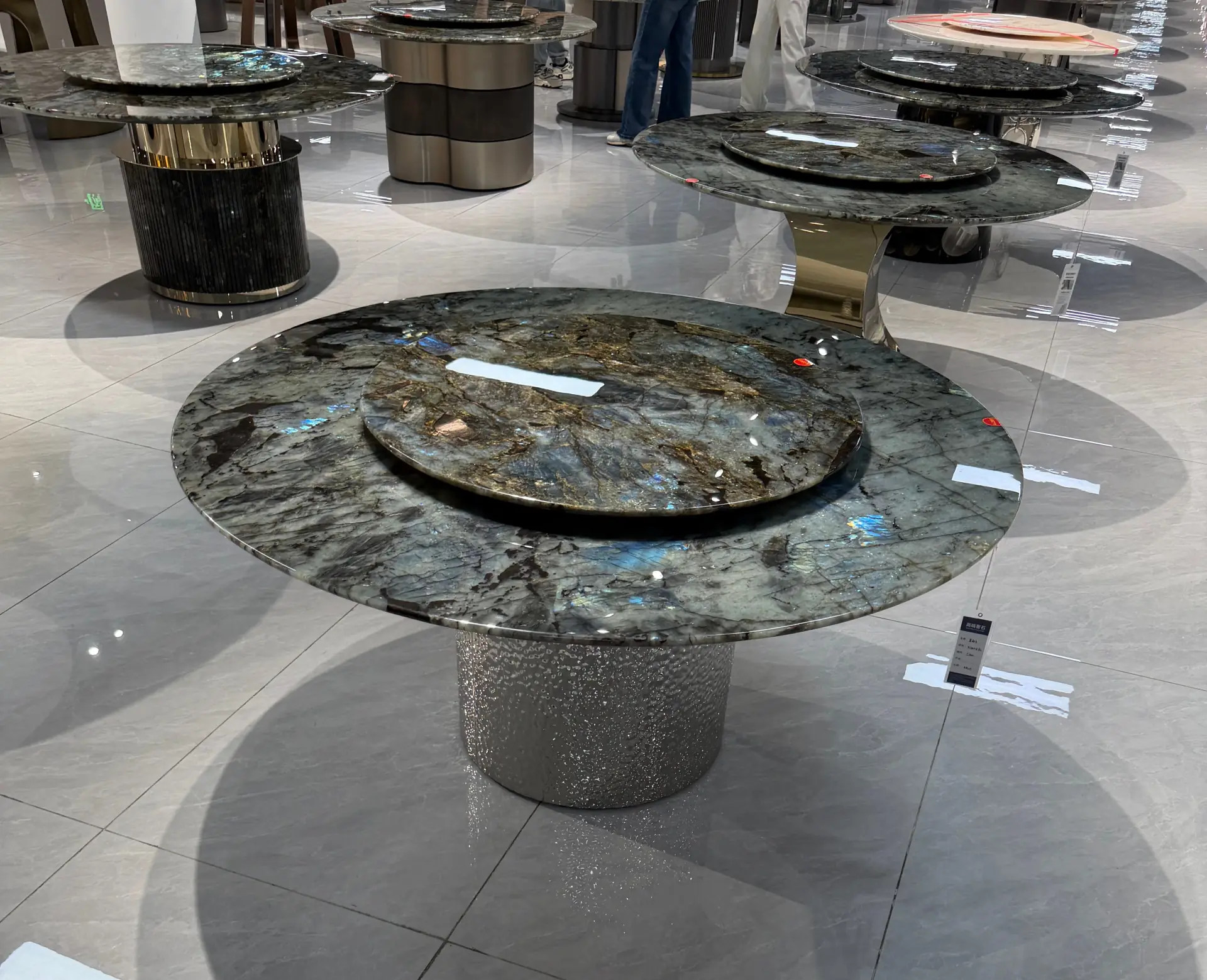
Ask a marble dining table manufacturer to prove the dining arrangement
The first approval should show how people will use the table, not only how the tabletop looks. Put the proposed chair outlines around the circular top, then add the space needed to sit down, stand up and pass behind occupied chairs. A table drawn as an isolated circle conceals the largest part of the dining arrangement: the people and furniture outside its edge.
Consider a villa dining room that also provides the route to a terrace. A larger table might be attractive for occasional entertaining, yet the chair nearest that route could obstruct circulation every day. In that situation, a smaller top or a different chair arrangement deserves consideration before the stone is selected. Moving the table later may disturb the relationship with the pendant light and sideboard.
For a distributor assembling a dining set, the equivalent problem appears in the sales description. A table’s listed seating range should not become an unconditional promise that every chair in the collection will fit. Photograph and measure the actual combination intended for sale. Customers need to see the chair backs, the table base and the available knee space, rather than a tightly cropped picture of the stone.
The 140 cm glossy marble table suits a different brief from the 160 cm wood-framed design
The Light Crystal Marble Round Dining Table with Lazy Susan is listed at diameter 140 × 75 cm, with glossy marble, a gold-colored metal base and a rotating tray. The Round Dark Wood Frame Marble Dining Table is listed at diameter 160 × 75 cm and combines a dark wood outer area with a natural marble center. Its two-tier construction changes the way the tabletop is divided; it should not be treated as an enlarged version of the first table.
A buyer seeking a predominantly stone dining surface may prefer to investigate the 140 cm or 150 cm designs. A room scheme built around dark timber could instead benefit from the wood-framed option. Neither choice is automatically more luxurious. The relevant question is whether the material arrangement supports the way the table will be laid, cleaned and viewed from adjoining rooms.
| HEZEN CASA table | Listed size | Construction described | Resolve before approval |
|---|---|---|---|
| Light Crystal Marble Round Dining Table | Ø140 × 75 cm | Glossy marble, gold metal base, rotating tray | Tray size and place-setting space |
| Round Natural Marble Dining Table | Ø150 × 75 cm | Natural marble, metal base, built-in lazy Susan | Chair arrangement and base clearance |
| Round Dark Wood Frame Marble Dining Table | Ø160 × 75 cm | Dark wood outer frame, marble center, two tiers | Usable zones and transitions between materials |
These are the published reference dimensions, not approved dimensions for a custom order. The listed seating descriptions are six, six to eight, and eight to ten people respectively. Confirm them using the selected chairs and place settings; the descriptions alone do not establish comfortable capacity.
Round marble table size is only one part of seating capacity
Increasing a round top from 140 to 160 cm adds 10 cm of radius on every side. If its center stays in the same position, each surrounding passage loses that amount before any change to the chairs is considered. This simple comparison helps a buyer understand why a seemingly modest diameter change can matter in a finished room.
A 150 cm tabletop does not establish the correct chair count
As a geometric illustration, a 150 cm circle has a circumference of approximately 471 cm. Dividing that by eight gives about 59 cm of arc per position. That calculation is not a seating standard: chair backs do not follow the circle exactly, elbows need room, and the table base can affect foot placement. It is a way to spot a combination that deserves a full-scale trial.
HEZEN CASA’s Italian Minimalist Solid Wood Dining Chair is listed at 50 × 55 × 90 cm, while the Italian Minimalist Upholstered Dining Chair is listed at 54 × 56 × 93 cm. Those are overall product dimensions, not seat heights or guaranteed spacing allowances. The wider chair changes the arrangement even if both chairs are described as dining chairs.
Try the intended chair at the intended table with someone seated. Check whether the chair can move close enough for eating, whether knees encounter the base, and whether adjacent chair backs touch when people leave their seats. A narrow-looking pedestal can still occupy space where feet naturally rest. Ask for the base dimensions and an underside view rather than making that judgment from the tabletop photograph.
A lazy Susan needs a usable ring of table around it
The 140 cm and 150 cm designs both include a rotating serving element. Its usefulness depends on what remains between the rotating section and the outer edge. Lay out dinner plates, glasses and serving dishes at the sizes the project expects to use. A large centerpiece may look impressive while reducing the room available for individual settings.
Confirm the rotating section’s diameter, edge detail, support and removal method. The published summaries do not provide all of these measurements. For a hospitality-style dining room within a private residence, also consider who will clean underneath it and where the removable component will be placed. Do not assume that a tray can be lifted or serviced in a particular way until its construction is confirmed.
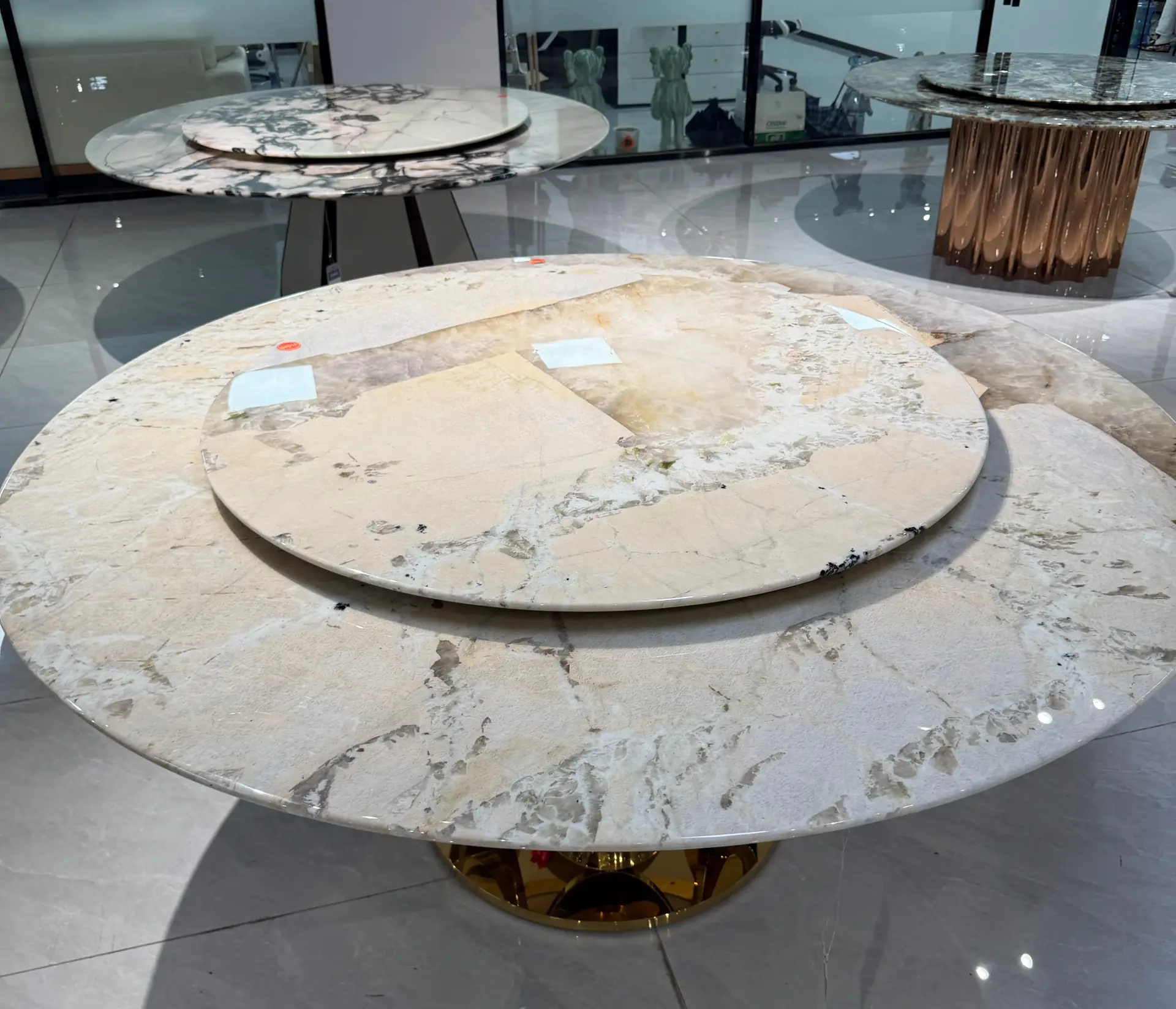
The 140 cm and 150 cm lazy Susan designs also deserve an operational demonstration with representative serving dishes, within the manufacturer’s stated loading instructions. Check whether an overhanging dish or handle can meet nearby glasses as the center rotates. An empty tray turning freely does not show whether the intended place settings will work during a meal.
Approve the stone surface separately from the table silhouette
A manufacturer can reproduce an agreed outline more consistently than the exact movement of natural stone. The table photograph therefore answers a design question, while photographs of the stone proposed for the order answer a material-selection question. Treating those two approvals as interchangeable creates avoidable disappointment.
For the natural marble table, request a view of the complete proposed top under neutral lighting and a close view of the edge. If a separate rotating tray is included, review it alongside the main top. Ask whether the pieces will be selected for visual coordination, and agree what level of difference is acceptable. Matching does not mean identical veining.
The wood-framed 160 cm design needs an additional decision: how the dark outer material and marble center meet visually and physically. Review the junction, the relative surface levels and the edge finish. A sample of marble on its own cannot show whether the assembled transition is satisfactory. Likewise, a wood finish sample should be viewed beside the stone intended for that order.
For a multi-property purchase, decide whether a close visual family is more important than dramatic individual slabs. A strongly figured display table can make an effective showroom centerpiece, but buyers must not expect each delivered top to repeat its exact pattern. The approved range of variation belongs in the order description, supported by representative images.
Keep approval of the 150 cm top connected to the actual slab and cutting position. A small sample cannot show where a prominent vein will cross the full circle or how the rotating tray will appear over it. If the slab selection changes, obtain the revised full-top view before carrying the earlier material approval forward.
Marble care should influence a frequently used dining table
The Natural Stone Institute’s care guidance explains that acidic substances can etch calcium-carbonate-based stones and that sealing does not make stone stain-proof. This is a reason to establish a suitable cleaning routine and use protective accessories, rather than describe a marble dining surface as maintenance-free.
For the glossy 140 cm model, ask for care instructions for the supplied stone and finish, including any treatment applied before dispatch. For the wood-and-marble design, instructions should address both materials. A product suitable for one surface may be inappropriate for the other. The person responsible for the dining room needs a clear method that does not depend on remembering several informal messages.
If the project requires staff to use a strong standard cleaner across every surface, resolve that conflict before approving marble. It is better to change the cleaning process or reconsider the material than to promise that an unverified finish will tolerate it. HEZEN CASA’s published table summaries do not establish chemical resistance for a particular cleaning product.
The marble tabletop and base need a coordinated delivery plan
For all three designs, establish which components ship separately and how they are joined at the destination. A table that appears simple in a photograph can involve a top, base, rotating element and hardware that must arrive together. The order should identify those parts without assuming a particular packing method that has not been agreed.
The diameter is not the packed width. Request the actual packed dimensions and gross weight of each component, then compare them with the unloading and internal access route. A round top may pass through one doorway but still be impossible to turn at the next landing. The receiving team needs to assess the protected package, not calculate from the bare tabletop alone.
For a villa with finished stone floors, determine where the crate can be opened and how the components will reach the dining room without resting against vulnerable finishes. Ask for the manufacturer’s handling and assembly instructions. The lifting equipment, personnel and support method should be selected by the responsible delivery team using the actual weights and instructions; a visual estimate is inadequate.
Before dispatch, the inspection record should show the approved top, its edge, the underside attachment points and the matching base. For the lazy Susan models, include the serving element and its operation. HEZEN CASA’s pre-shipment furniture inspection guide gives broader context; the inspection for this order should remain specific to the chosen table and its components.
Sign off the dining set with the intended chairs in position
The most useful final approval is a small group of coordinated decisions: the selected table, its actual stone, the selected chair, the seating arrangement and the component delivery plan. Review those together. A perfect marble sample will not correct restricted knee space, and a well-proportioned room layout will not settle an unapproved stone variation.
For a 140 cm table, protect usable dining space before enlarging the rotating tray. For the 150 cm design, validate the proposed number of chairs rather than relying on the upper end of the listed seating range. For the 160 cm wood-framed table, make sure the two-material surface is the feature the room actually needs. Once those choices work as a set, the purchase has a clear definition that the manufacturer, designer and receiving team can all use.