What a Luxury Furniture Factory in China Should Show During a Sample Review
A finished sample can prove that a particular piece exists. It cannot, by itself, prove everything about the proposed order. Buyers evaluating a luxury furniture factory in China should ask what each observation establishes and what still requires a drawing, material record or agreed test. At HEZEN CASA, the sliding-door sideboard, wide leather dresser, round marble table and tufted suede-and-leather sofa call for different demonstrations. Identify the exact sample and the version being purchased before judging the evidence.
Start a luxury furniture factory review by separating the sample from the order
A showroom piece may have been made in another size, finish or configuration from the proposed order. That does not make it useless, but it limits what the buyer can conclude. The camel-and-black sofa is listed at 300 × 180 × 85 cm with suede, top-grain leather and solid wood. If the order changes its materials or dimensions, a demonstration of the listed version cannot automatically approve the altered one.
Ask the supplier to identify which details are shared and which will be developed separately. HEZEN’s custom development service describes production drawings from supplied ideas and dimensions. Use that process to make the proposed differences explicit. A buyer should be able to place the sample reference beside the drawing and understand why they are not identical.
This distinction also matters for repeat orders. An importer may return to a familiar sample and assume the supply specification is unchanged. Confirm the material and construction references applicable to the new order. A piece that looks the same from the front may contain a proposed substitution that deserves its own review. The factory should have a clear opportunity to disclose that proposal rather than being expected to infer the buyer’s assumptions.
Ask the sideboard to demonstrate access, not merely a closed facade
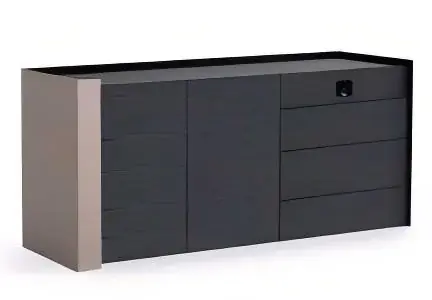
The dark wood sideboard is listed at 200 × 45 × 90 cm, with two sliding doors and three drawers. A closed photograph can show the appearance and arrangement of fronts. It cannot demonstrate the opening sequence, usable access or the behavior of the moving parts. Ask to see the actual sample operate and connect that demonstration to the specified cabinet rather than to a similar-looking item.
Observe the sideboard’s complete door and drawer movement
Watch each relevant part move from closed to its intended open position and back. Ask the supplier to explain any sequence required for access. If the cabinet is to be placed near a wall or another piece, bring that condition into the discussion. An open showroom demonstration may conceal an obstruction that will exist in the final room. The buyer should obtain the operating information needed for the actual placement.
Check the interior against the intended contents. The 45 cm outside depth is not the depth of a shelf or drawer. A dining-room buyer may need to store a particular serving item; another buyer may want to hold documents or equipment. Use those requirements to request the relevant usable dimensions. Do not infer internal capacity from the external cabinet size or from the number of fronts.
For a remote sample review, a continuous video can connect the exterior and interior more clearly than unrelated close-ups. Ask for the sample identity to remain clear. A video of a drawer moving smoothly is less useful if the buyer cannot tell which cabinet it belongs to. The goal is a traceable observation of the selected piece, not a collection of attractive workshop clips.
The leather dresser should show its finish at the places where it changes direction
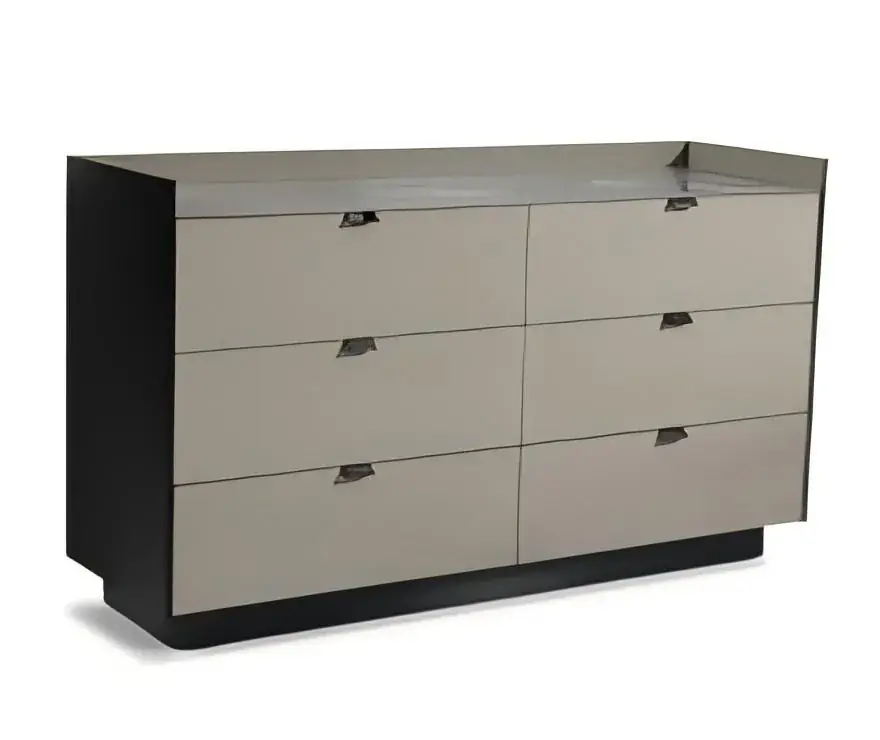
The wide dresser is listed at 160 × 45 × 85 cm with six drawers, leather and solid wood. Its broad front makes alignment and surface relationships visible. Review the drawer fronts both closed and open, then look at edges and corners where the leather turns. These locations can reveal details that a distant frontal photograph does not explain. Ask which approved material reference applies to the sample.
Compare adjoining leather drawer fronts under comparable light
Review the fronts together rather than approving each from a separate photograph with different exposure or lighting. If variation is present, discuss what is intended and what is acceptable for the order. Do not assume that natural-looking variation is a defect, but do not allow the term natural to replace a clear agreement about appearance. The supplier and buyer should be describing the same approved reference.
Ask how the drawer front, handle or opening detail is finished on the proposed version. If the buyer requests a different color or hardware arrangement, identify which part of the sample review no longer applies. The outside dimensions alone cannot resolve those junctions. A sample can support a decision about visible workmanship, while the drawing and material record define what must be repeated.
The same principle applies to the cabinet’s interior. A clean exterior does not establish the proposed drawer-box construction, runner specification or capacity. Request the relevant information when those details matter to the order. Avoid performing an improvised overload test on a showroom item. The supplier should provide the applicable specification or an agreed test approach for the intended requirement.
A marble table sample needs both a surface review and an assembly explanation
The natural marble dining table is listed at 150 cm in diameter and 75 cm high, with a metal base and rotating tray. The buyer should review the stone appearance, edge and relationship to the base. It is also useful to understand how the selected components are identified and assembled. A photograph of the completed table cannot show every connection or explain what will be supplied separately.
Ask whether the sample top is the proposed top or an appearance reference. Natural stone makes this distinction important. A buyer can approve the shape and general material direction while still needing to review the actual order’s stone selection. If the tray and top are expected to have a particular visual relationship, establish how that will be confirmed rather than relying on one favorable viewing angle.
The rotating tray should be reviewed with a dining arrangement
Observe the proposed tray in use with the intended place settings or a meaningful approximation. Ask about its supplied arrangement and care, and identify which components belong to it. The outside table diameter does not describe the remaining usable ring around the tray. The buyer should review the dining function as well as the circular composition, particularly when the table is being purchased as part of a complete room.
The table’s assembly explanation should identify the actual top and base relationship. Do not substitute another model’s attachment detail because both tables use marble and metal. Request the instructions or drawing applicable to this version. The receiving team will need that information when the furniture reaches the property; discovering that it is missing after unpacking defeats much of the value of a careful sample review.
Use the tufted sofa to distinguish a comfort observation from a construction claim
The suede-and-leather sofa can be evaluated through sitting, approach and visual inspection. The buyer can observe the contrast between materials, the tufted divisions and the response of the sample during an agreed sitting trial. Those observations should remain tied to that sample. They do not establish an unpublished foam density, a hidden frame joint or the future service life of every ordered sofa.
Ask for the relevant construction information when the purchasing decision depends on it. If a buyer needs removable components for maintenance, the supplier should demonstrate or document the actual arrangement. If the order changes the cover material, review its suitability separately. A fabric change may preserve the color direction while changing the way the surface behaves on the tufted form.
ACT’s abrasion disclaimer explains why abrasion results should not be converted directly into years of use. A sample review should therefore combine relevant material evidence with the intended activity and maintenance expectations. The buyer should not ask a single number to answer every question about the sofa, nor should the factory rely on a comfortable first impression to answer technical questions that remain open.
For an importer buying several configurations, specify which one the trial represents. A sofa that feels appropriate in the demonstrated arrangement may require another review if the seat geometry, cushions or material are changed. Keep the proposed variants visible in the approval process. It is better to approve a defined first configuration than to assume that one sample settles an entire hypothetical family.
Finish the factory sample review with evidence that can be checked again
When the sample is accepted with reservations, identify the reservation on the corresponding view. A drawer-front adjustment belongs with the dresser evidence, while a changed tray arrangement belongs with the table. Ask how the corrected detail will be shown before the approval is closed. A promise to improve the quality is too broad to demonstrate that the specific issue has been resolved.
For the sofa, distinguish a requested appearance change from a change in sitting behavior. Moving an upholstery division can be reviewed visually, but changing the cushion arrangement may require another physical trial. The buyer should not accept the second change solely through evidence intended for the first. The same reasoning applies to the sideboard: a new front finish may be photographed, while a revised opening arrangement should be demonstrated.
This approach keeps the review proportional to the decision. It does not require every item to undergo an identical ritual. It requires the chosen evidence to answer the particular question that prevents the buyer from approving that piece of furniture.
The result should connect each purchasing decision to something identifiable: the sideboard’s opening demonstration, the dresser’s material reference, the table’s approved stone and assembly information, and the sofa’s defined sample configuration. Mark unresolved questions at the product where they matter. A broad statement that quality was checked is less useful when a later disagreement concerns a specific drawer, surface or component.
HEZEN’s pre-shipment inspection guidance can help organize the later review of actual goods. Keep sample approval and shipment inspection distinct. The first defines or evaluates the proposed reference; the second checks the goods that will leave. A well-presented sample is not evidence that a later shipment has been inspected.
Before accepting the sample review as complete, ask whether another person could use the record without attending the meeting. Could the receiver identify the correct marble top and base? Could the designer recognize the dresser finish? Could the buyer tell which sofa configuration was tried? If those answers depend on someone remembering an informal conversation, the evidence is not yet sufficiently connected to the order.
A luxury furniture factory should be evaluated on the clarity of those connections as well as the appeal of its finished pieces. Approve what the sample and documents actually establish, and keep the remaining conditions explicit. That gives both parties a practical reference for the order without pretending that a showroom review can prove every hidden or future characteristic of the furniture.