Visit a Furniture Manufacturer in Foshan With a Product Trial, Not Just a Tour
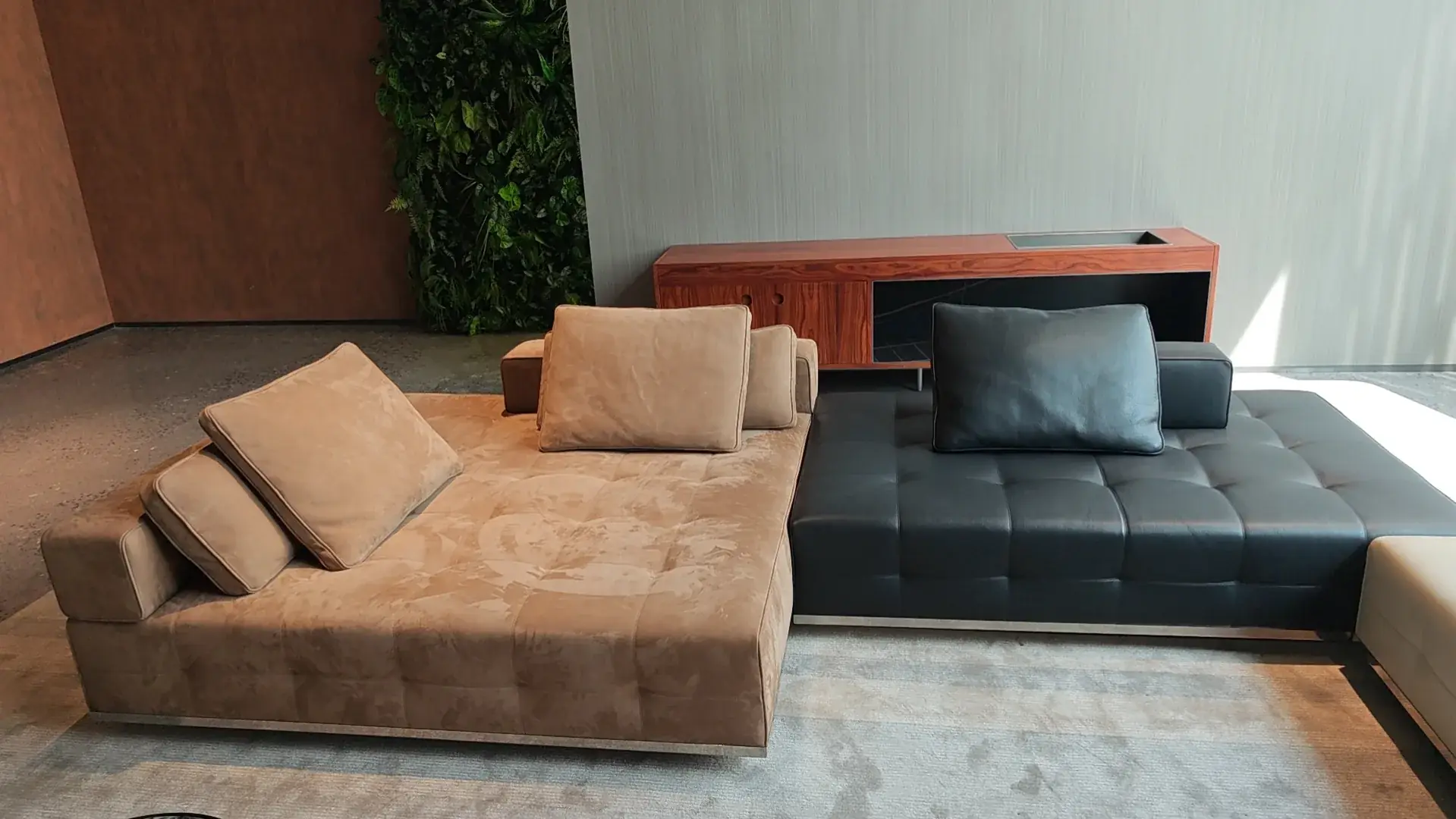
A day in a showroom can produce hundreds of photographs and very few settled purchasing decisions. An importer visiting a furniture manufacturer in Foshan gets more value by arriving with a short list of questions that require a real piece of furniture to answer. For HEZEN CASA, that list might involve the burgundy and white Nappa sectional, camel suede and black leather modular sofa, round marble dining table and dark wood sideboard. Confirm which exact samples can be viewed before arranging the visit.
Choose the furniture questions that can only be answered in person
The two-tone Nappa sofa is listed at 320 × 180 × 85 cm, while the suede-and-leather modular sofa is listed at 300 × 180 × 85 cm. The similar overall depth and height do not establish similar sitting positions. An in-person review can compare the way people approach the seats, settle into them and stand up again. It cannot automatically establish hidden construction, material origin or long-term durability. Separate what you can observe from the evidence that still needs to be supplied.
If the order is for a formal conversation area, bring that use into the trial. Sit upright, turn toward an adjacent person and place the intended kind of object on the nearby surface. If the intended use is relaxed residential seating, evaluate a different posture. Do not let the display arrangement decide the use case for you. A sofa that looks convincing from the aisle may support a different activity from the one your buyer needs.
A distributor comparing both sofas should also decide what would make them distinct offers. The Nappa sectional has a conspicuous burgundy-and-white composition; the other design uses camel suede with black leather and tufted divisions. Those are different stories for a showroom. The visit should establish whether each offers a useful difference in appearance and experience, rather than collecting two nearly interchangeable photographs for a catalogue.
Review the Nappa sofa from the back as well as the front
Open-plan interiors expose surfaces that a wall-facing showroom display may conceal. Walk around the Nappa sectional and ask to see the parts that will remain visible in the proposed room. Observe how the colors continue around the sofa and where the upholstery divisions meet. If the exact ordered version differs from the display, identify which observations remain relevant. A showroom sample is a reference, not automatic evidence of every possible custom configuration.
Compare the modular sofa’s transitions at normal viewing distance
The camel suede and black leather surfaces invite a close inspection, but the design also needs to work across the room. Review the transition between the two materials from both distances. Ask which material reference identifies the sample and which parts of the proposed order will use it. If a different color is requested, keep the observed construction and the proposed finish distinct. The visit has not approved a material that was never shown.
A furniture manufacturer in Foshan should demonstrate the selected moving parts
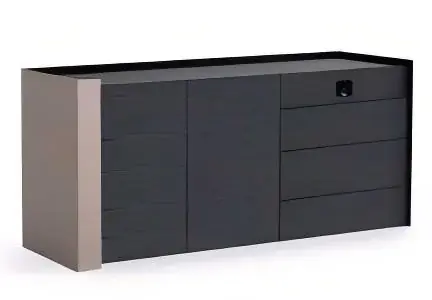
The dark wood sideboard is listed at 200 × 45 × 90 cm, with two sliding doors and three drawers. Its public description makes movement a relevant subject for the visit. Ask to see the actual sample’s doors and drawers operate, then identify the arrangement in a drawing or marked photograph. Do not infer the movement solely from the closed front or from another cabinet displayed nearby.
Place the intended type of object into the storage if an appropriate demonstration is available. A serving item, document box or equipment enclosure creates different access questions. The listed outside depth of 45 cm is not an internal storage measurement. Record the useful opening and usable space for the version being considered, while leaving structural or load questions to the supplier’s applicable specification. A visitor’s quick measurement is a planning observation, not a certified capacity test.
Watch the sideboard doors and drawers interact
Ask whether opening one part restricts access to another, and have the supplier demonstrate the intended sequence. If the cabinet will stand near a return wall, show that condition and ask which projections need allowance. A smooth demonstration in open showroom space does not resolve every installed-room condition. The useful result is a clear understanding of how the actual cabinet works and which room details must be checked before ordering.
For a remote design team, a short continuous video can be more informative than several disconnected images. It can show the closed cabinet, the opening action and the interior in one sequence. Identify the product and sample at the beginning so the team does not confuse it with a visually similar item. Ask permission before recording workshop processes or people, and keep the recording focused on the agreed furniture review.
Use the marble table sample to resolve the dining arrangement
The round natural marble table is listed at 150 cm in diameter and 75 cm high, with a rotating tray. At a visit, the buyer can review how that tray relates to place settings and how the base affects the intended chairs. Bring the relevant chair dimensions or ask whether the selected chairs can be placed around the sample. The listed seating description should not replace a trial of the actual combination.
For a villa designer, the important question may be whether guests can use the table comfortably without colliding with the central serving area. For an importer buying a display piece, it may be whether the stone and base can be explained clearly to retail staff. These goals lead to different observations. Decide which one the visit must settle, then take photographs that make the answer visible.
Review the stone under useful lighting and identify the actual slab or material reference being shown. Natural variation means a display top is not necessarily a promise of identical veining on every ordered table. Ask how the proposed order’s appearance will be approved. If the buyer requires a particular relationship between the main top and rotating tray, make that part of the discussion rather than assuming the two will always show a continuous pattern.
The Natural Stone Institute’s care guidance explains why stone-specific cleaning matters. During the visit, request the care information for the proposed table surface. Do not improvise a stain or chemical test on a display item. A purchasing review should use agreed demonstrations and appropriate documentation, not destructive experiments that neither party has planned.
Bring sofa, cabinet and table findings back to the remote design team
After inspecting the sofas, cabinet and table, the visitor should be able to explain which decisions were actually resolved. The Nappa sofa may be selected for its color composition while its ordered material remains to be confirmed. The cabinet’s access arrangement may be understood while its custom width remains open. The table’s dining configuration may be accepted while the final stone selection is pending. These are useful outcomes even if the visit does not close the entire order.
Keep photographs associated with the particular question they answer. A rear view of the sectional supports a discussion about an open-plan room. A close view of the suede-to-leather transition supports the material junction review. A cabinet video supports the moving-part discussion. A table photograph with the intended chairs supports the dining arrangement. A large undifferentiated image folder makes it easier for an attractive reference to be mistaken for an approved specification.
A buyer attending on behalf of a designer should distinguish personal preference from the designer’s requirement. If the visitor prefers the suede sofa’s feel but the approved interior depends on the Nappa sofa’s contrasting colors, bring that conflict back explicitly. Do not quietly substitute one design because the visit made it more appealing. HEZEN’s design and custom development services can help explore a proposal, but a new proposal still requires an identified decision.
Where material performance is important, take away the relevant documents as well as impressions. ACT cautions against treating abrasion results as a direct lifespan prediction. A good-looking sample and a test number answer different questions. For the suede sofa, identify the material and intended use before deciding whether the supplied information is relevant. Do not convert a short showroom trial into a durability claim.
Leave Foshan with fewer unresolved furniture decisions
Reserve part of the visit for a second look after comparing the pieces. The camel-and-black sofa may initially attract attention because of its contrast, while the Nappa sofa’s particular chaise arrangement becomes more relevant once the room plan is discussed. Return to the actual sample with that plan rather than making the final decision from the first photograph. Ask whether the demonstrated arrangement is the exact one being proposed and note any visible accessory that is not included.
At the marble table, repeat the approach with the intended chairs in position if possible. Review the edge, the base and the rotating tray from a seated viewpoint rather than only standing above the top. A photograph taken at standing height can exaggerate the importance of the stone pattern while hiding the base’s effect on the diner. The useful record should show the furniture doing its intended job.
For the sideboard, take the final dimensional notes after identifying the demonstrated version. If the proposed cabinet is to be modified, keep the existing sample measurements separate from the requested dimensions. Sending the remote team a measurement without that distinction can make a future custom dimension appear already proven. End the product review with a short statement of what was seen and what remains a proposal.
A productive final conversation might confirm the Nappa sofa’s intended configuration, the modular sofa’s material junction, the sideboard’s actual opening arrangement and the marble table’s chair pairing. It should also name the questions still open. HEZEN’s article on verifying a furniture factory addresses broader supplier checks; this product-focused visit complements that work by making the proposed order more concrete.
Before leaving, compare the sample identities with the planned purchasing list. If the displayed sideboard or sofa is not the version that will be quoted, establish how the proposed version will be demonstrated later. Ask the supplier to distinguish an existing sample from an available customization idea. That prevents the remote team from approving a photograph as though every visible detail is already included in the offer.
The best result is not the longest tour. It is a purchasing team that can say why the selected sofa belongs in the room, how the cabinet is accessed, how the table works with its chairs and what evidence is still needed. Arrange the visit around those outcomes, and the images you bring home become decision tools rather than a second showroom that everyone must interpret from scratch.